Category Archives: Travel

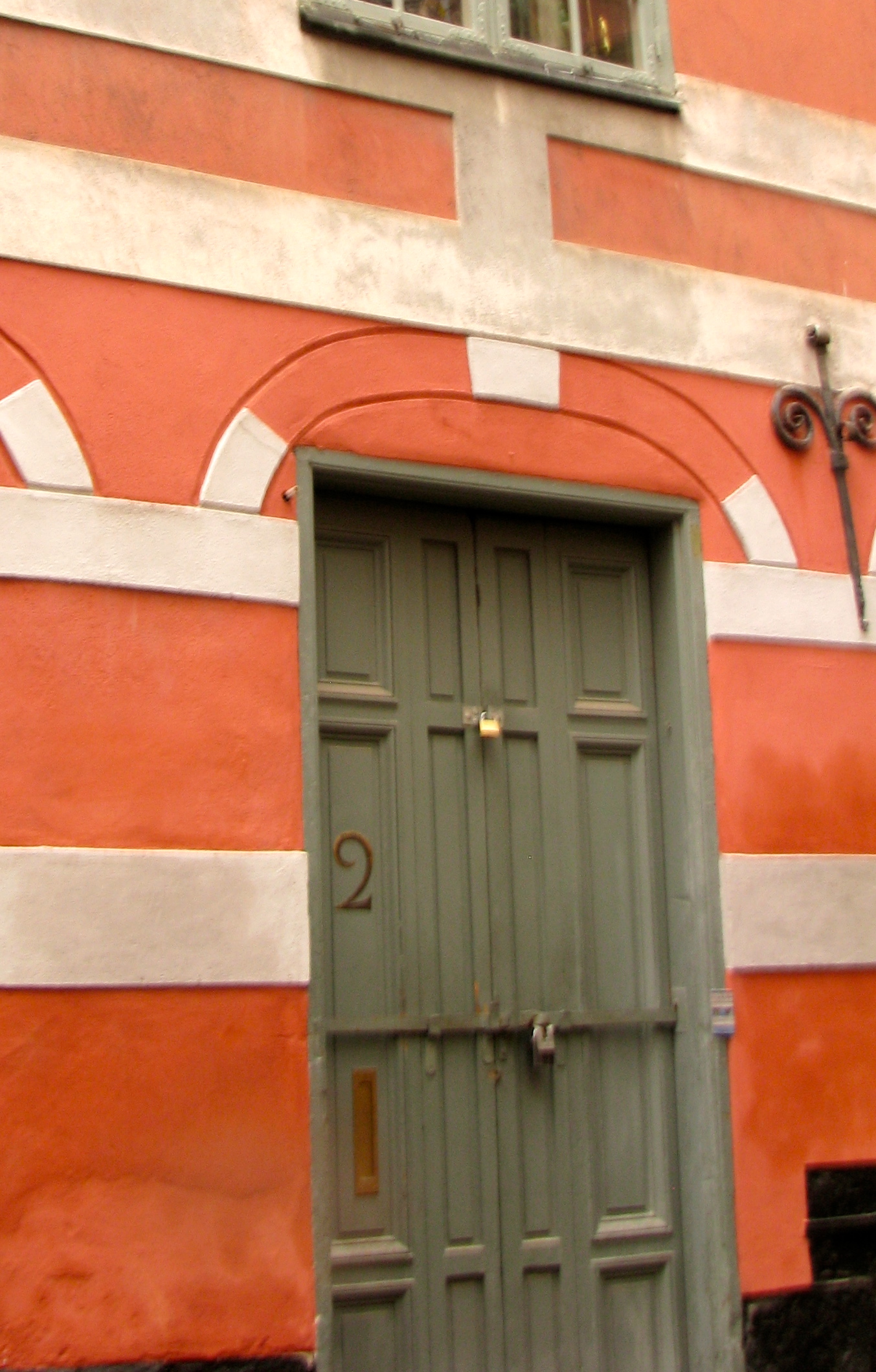
These particular ones are green…

Standard
20140826_104116

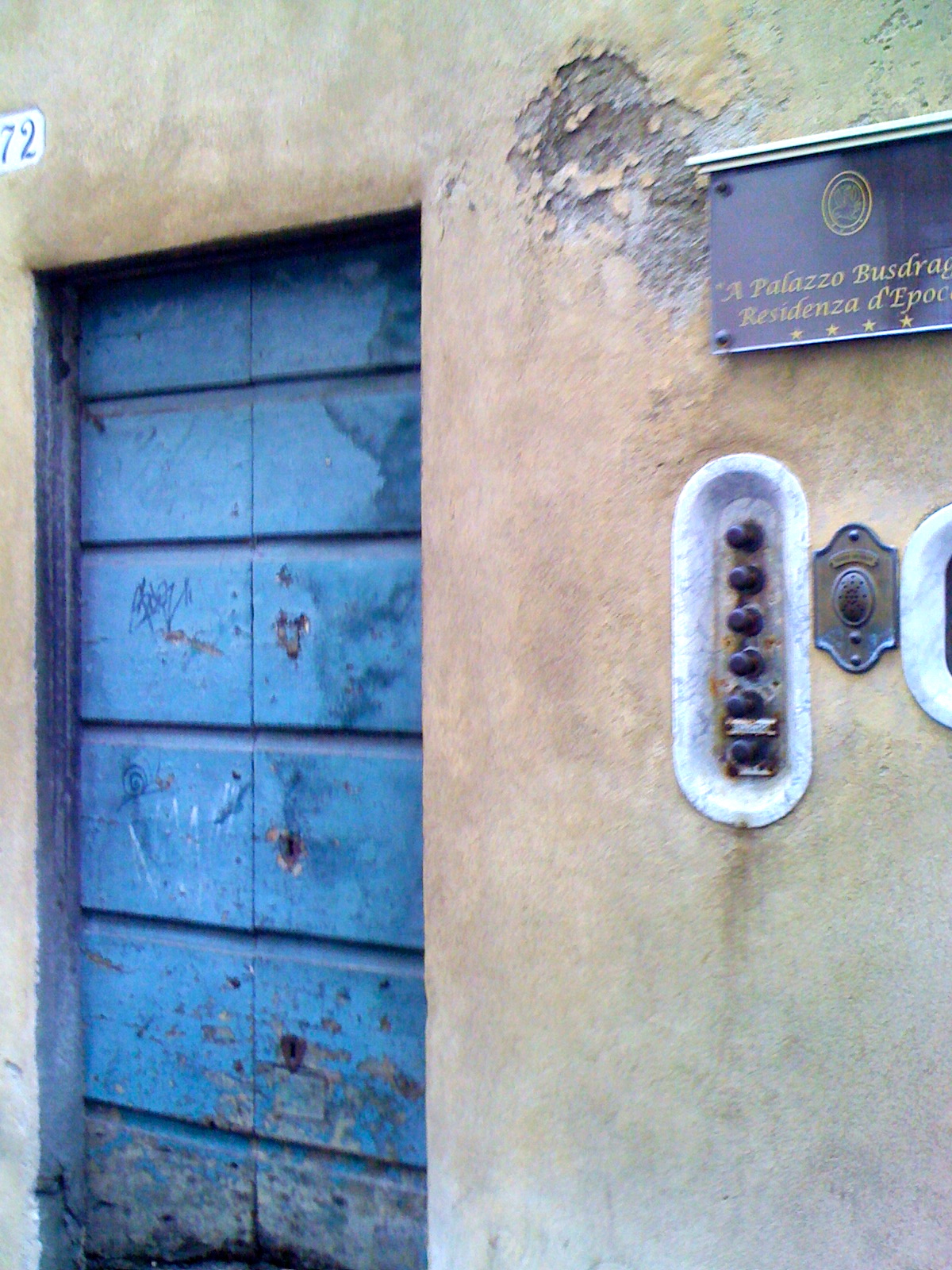
New challenges through a blue doorway in Sweden

As I closed my front door a few days ago, I thought of the new door that will soon open for me, wide with opportunities. It’s been a flurry of activity, packing and departing our house in Canada and I write this, finally relaxed, in a cozy hotel lobby in Sweden.  Sunk into a deep sofa, candles flickering on a simple wooden coffee table, we’ve been mostly awake for the past 32 hours.  Trying to keep jet lag at bay, soon after arriving in Copenhagen we made our way to nearby Lund. It’s a beautiful Swedish university town where our eldest has recently moved to study for his Masters degree.

It’s good to see him settled in his little loft apartment and know he’s ready for this next challenge, his new doorway of opportunity. I’m empathetic that many of us are experiencing change at this time of year. It’s the end of summer and the season of new beginnings for students, yet often a time of struggle for parents coping with their departure. By chance, my moving to Kazakhstan has coincided with our son’s transition and as we visited him this evening, I insisted on taking a picture in front of his new blue door.  Although I suggest these photos rather casually wherever we may reside, I know that there’s an ulterior motive. These photos of our more than two dozen front doors evoke poignant and treasured memories of life lived inside, around and through those portals.

IMG_0267

The doors that inspired a piece of writing in Tuscany

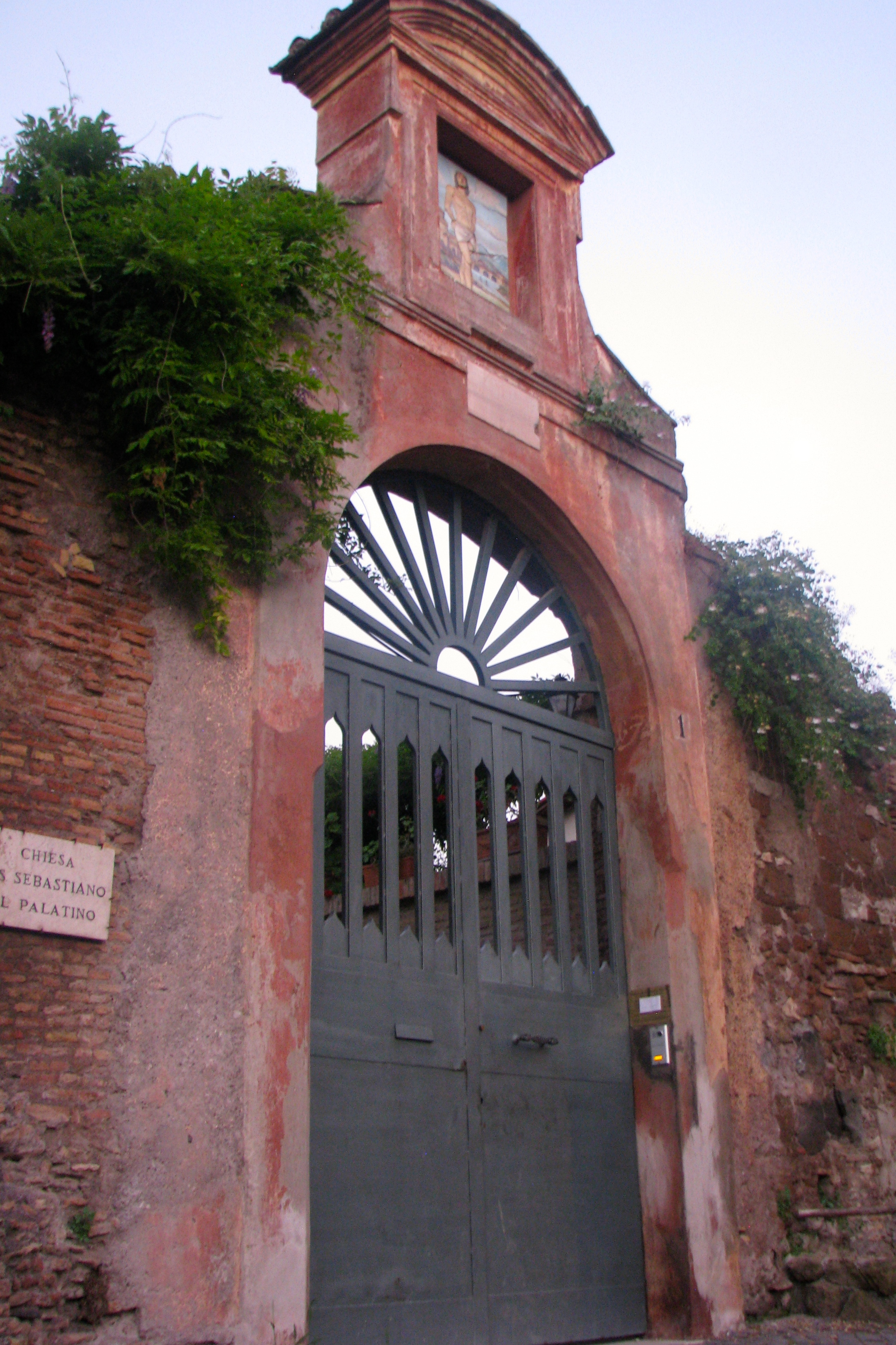
Anyone who knows me well, knows, I love doors.  In fact, one of the tasks at a fondly remembered writing retreat* was to wander silently for thirty minutes gathering inspiration for a piece of writing.  Set in a serene bamboo grove, it’s curious that my muse was not drawn from a natural setting within the Watermill grounds. Rather, I was intrigued by a stack of abandoned doors.  Then again, my choice wasn’t all that surprising for someone who sees them as more than a barrier to keep out the elements. For me, a door can be exciting, mysterious and even better if there’s an interesting ‘knocker’ or other hardware on it!

Of those doors tucked away in an old Tuscan shed I wrote;

IMG_0965

In Krakow, Poland

IMG_6949

Stockholm, Sweden

These particular ones are green, in fact many shades of green, the peeling paint revealing layers of life’s moments. They are now stacked in a vertical pile, discarded behind the archway they once inhabited. I am endlessly intrigued by them; their texture and colour, their hardware and design. To me they become subjects to admire, photograph and even collect.  The doors I prefer are old, often in abandoned structures or homes.  They no longer have the joy of being opened, closed, or being left ajar so the cat can slink in and out. Behind their scratched panels and knotted wood, they hold secrets of lives lived within their protection. Lives, perhaps of hard work, turmoil, misery, even grief – but also of joy, laughter and secret words that cascaded up to their secure surface but didn’t venture further; keeping those vignettes tucked safely inside, keepsakes for family and friends.


IMG_1643

An old Roman Villa

Doors are often portrayed as metaphors for life; for hope, opportunity or invitation.  In fact, in Roman religion and myth, Janus is the God of beginnings and traditions, and thereby of gates, doors and doorways. He is depicted as having two faces, one towards the future and one to the past. The Romans even named a month after him – the gateway to the year, January.

220px-HK_Wan_Chai_Stone_Nullah_Lane_Blue_House_74D_n_Door_Gods_n_Letter_Box

A door in China, protected with door gods

The Chinese and other eastern cultures believe in a ‘door god’, represented in decorations positioned on each side of an entry to a temple, home or business. The ‘god’ wards off evil spirits and fosters good will.  It seems doors have always been symbolic and endowed with purpose; often as portents of change.

IMG_7051

A symbolic heart graces a Norwegian door

In Norway, I was charmed  by ‘hearts’ that were hung on wooden doorways, especially at Christmas time. They seemed to beckon one inside, perhaps away from the damp and cold, into a warm hearth. Doors have traditionally been of wood; oak, cedar, cypress, elm or even olive. However constructed, even flimsily such as a tent or teepee, the door has ever signified a secure boundary.   And yet that boundary opens wide to allow one to go forth and explore, though we all know how comforting the sight of your own front door can be after a tiring day or late night out.

DSC00731

One of my favourite doors; the town hall in San Gimignano in Tuscany

I have photographed them in many countries, often for their beauty but typically for the curiosity they invoke. Upon leaving the Middle East where we lived for seven years, I even brought two home with me.  One is embedded within a coffee table, the worn, dark red wood now protected with glass. The other was rescued from a garbage pile beside a once imposing, but now dilapidated fort in the barren foothills of Oman.  I like to think I rescued that one from being chopped up for campfire kindling!

Sintra, Portugal

An abandoned door in Sintra, Portugal

And as for the changes they represent, for someone like myself who happens to open and close more than my fair share, it isn’t always easy.  A few days ago as the cabin lights dimmed and the plane taxied down the runway, tears escaped from my eyes. My anticipation for this next phase was overshadowed by a mother’s love for her children. As two of ours remain in Canada the knowledge of the impending distance tore at my heart knowing this family of five is once again separated by countries, even continents.  Yet, there’s the underlying comfort that within some months, a door will be flung open and family will be reunited with stories to tell of all our adventures.

For now, I can’t wait to see the interesting portals I’ll find to walk through to explore, to appreciate more wonders of this interesting world.  Did I mention my next front door will actually be a Hotel…there just might be a few stories forthcoming from there!

DSC03536

In Christiania, Copenhagen


IMG_0358

Lucca, Italy


*The Watermill at Posara in Tuscany, as written about in blog post ‘ So you want to be a writer…’

Two backpackers, post restante and a collection…

Standard

We left with backpacks, cameras and journals; that’s all that was necessary really.  Not a cell phone, a tablet or a computer.  Yes, it was wonderful last week to Skype with my son in Thailand and WhatsApp with him today as he sat in a thatched hut in Laos. But I feel privileged to have travelled with the promise…I’ll write soon.

IMG_2354

Two backpackers in India, circa 1989

Understandably, it was wrenching for loved ones to wait for letters and postcards to arrive and hopefully read that all was well.  But that was the beauty of it; to receive that correspondence and devour those long awaited words.  First eagerly, but then more slowly to take in every detail. Those letters could also be secreted away and brought out again and again,  just to feel closer to that person so far from home.

We had planned only a basic itinerary for our six month backpacking trip.  Yet it was enough to inform our parents to send a letter to Poste Restante Dehli on such and such date, then to Kathmandu by another date… and on and on.  That was our only means of communication, we agreed only to resort to collect phone calls if necessary.

IMG_2335

Poste Restante as a return address on an original Aerogramme

Poste Restante is French for ‘post remaining’ or mail that is held.  One could also refer to it as General Delivery.  At the time, walking into one of these main post offices on the other side of the world was an experience in itself.  They were often dark and musty with a uniformed postmaster sitting with disinterest behind an untidy, wooden desk. Not wanting to be disturbed, it was usually a performance for your mail to be located as he hunted the tall shelves, layered with endless cubby holes.  You waited with anticipation yet also with trepidation.   Will there actually be anything for me, did they send it in time?  And if they had, you did not carelessly tear open the envelope. You found a place to open it carefully, then read, hoping all was well back home. I have a distinct vision of the steps to the Poste Restante in Hong Kong; crowded with backpackers eagerly reading their long awaited letters from home.  Not only did we correspond frequently with our parents, we also received many letters in return.

A long letter on parchment paper from Nepal

A long letter on parchment paper from Nepal


And thankfully, every one of them was kept.  Each letter and postcard recounting the tiny details one forgets through the years. To read them now evokes images and memories that electronic gadgets will never replicate.  They are now hidden away, somewhere safe, in the hope that one day they’ll be appreciated for what they represent.  A time when words were chosen carefully and written in your most presentable penmanship.  A time when words were savoured. In fact as travellers, most evenings we would happily write by candlelight which would shed a more romantic sheen on the often basic hostel we found ourselves in. Updating our journals or writing long letters on carefully chosen stationery became a relaxing ritual, with the added comfort of knowing how much pleasure they would bring. Once they finally arrived on the distant shores of Canada and Scotland.

It seems my love of paper and stationery was with me even before I jaunted off to Asia.  For some reason I can’t explain, I have always adored it.

The first paper collected, the iconic Florentia from Italy

The first paper collected, the iconic Florentia from Italy


My collection began on my first trip to Italy when I was 18; that lovely ‘Florentia’, with its paper of finely embossed gold, woven through vibrant flowers and leaves.  I remember it was displayed on my desk once I returned home and I couldn’t bring myself to use it.  It was just too beautiful.  I now wander into the tiny shops when I return to Italy and find it impossible to not treat myself to just one more bundle of notes or calling cards, anything will suffice really.  And I gladly use them now, as often as I can!

My compact souvenirs, stationery

My compact souvenirs, stationery


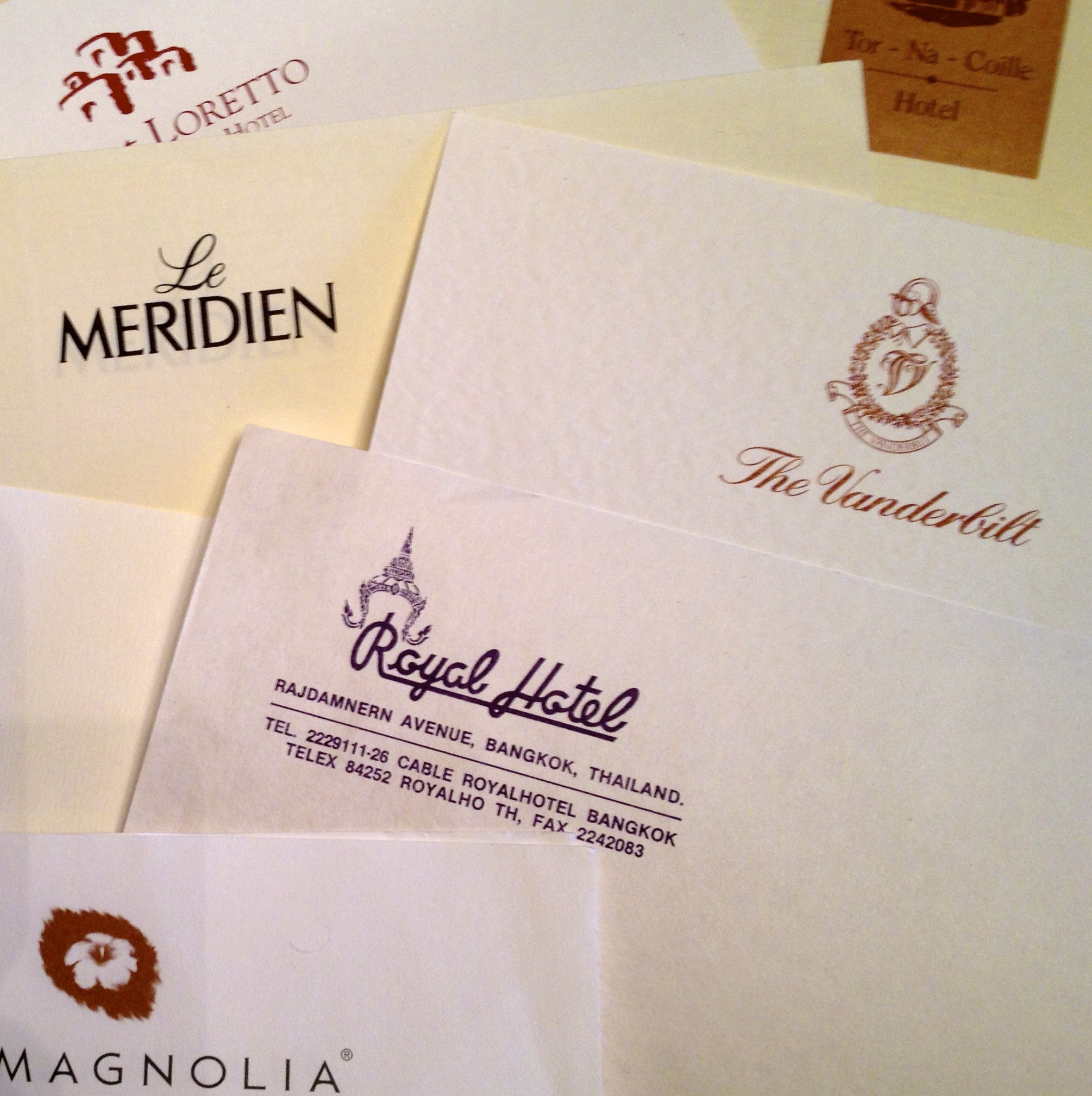
That first purchase prompted me to also collect hotel stationery. That one sheet of paper and envelope encapsulates a moment in time and place, each with a unique letter head and often foreign language.  It evokes the sights admired and the time enjoyed, in a place you’ve been fortunate to have visited.   And so I admit, since that backpacking trip in 1989, I have taken just one piece of paper from each hotel.  However, nowadays, I often have to ask as it appears that

Letterheads that evoke a time and place

Letterheads that evoke a time and place


stationery is a dying art, much to my dismay. Though I’m sure the demand has diminished, what with those handy tablets and computers! Of course we couldn’t live without them, however there’s nothing I’d like more than to reach into my mail box tomorrow and discover a waiting letter. Post marked from Asia, with stamps that hint of where it’s from, with an address that’s just yours, with an exotic letterhead…ah, one can but dream.  Let’s see if he reads this!

Paris… Iron and Beauty, part one

Standard

On a recent trip to Paris I happened to become a little obsessed.  It wasn’t with the expected landmarks, the chic cafes, or even with the delicate mille-feuille pastries that I enjoyed daily (well just a slight obession with those.)

The graceful , timeless art form of iron

The graceful , timeless art form of iron

No, there’s an element to the city that can possibly be overlooked unless we narrow our gaze and ask; what is it that makes Paris so striking…so beautiful.

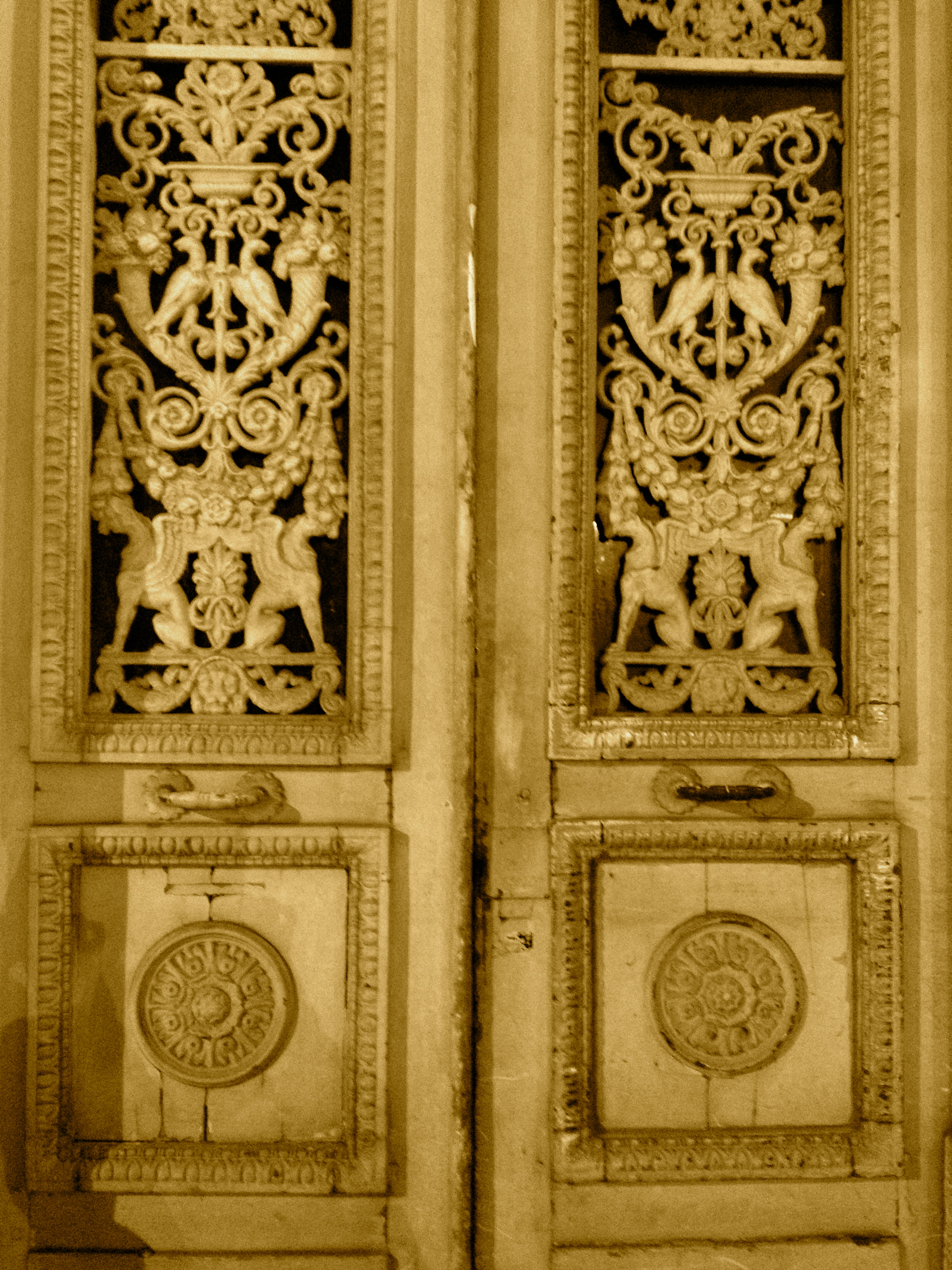
And, it’s everywhere.  Winding and curving in the decorative balconies, stairways and lamp posts. Inhabiting charming doorways, gates and the fanciful Metro signs and entrances.

Not to mention, that the iconic Eiffel Tower is also abundant with the material. It stamps its romantic signature on the city; simply, it’s iron.

IMG_1929

Intricate iron carvings ‘inhabiting’ a wooden door

IMG_2014

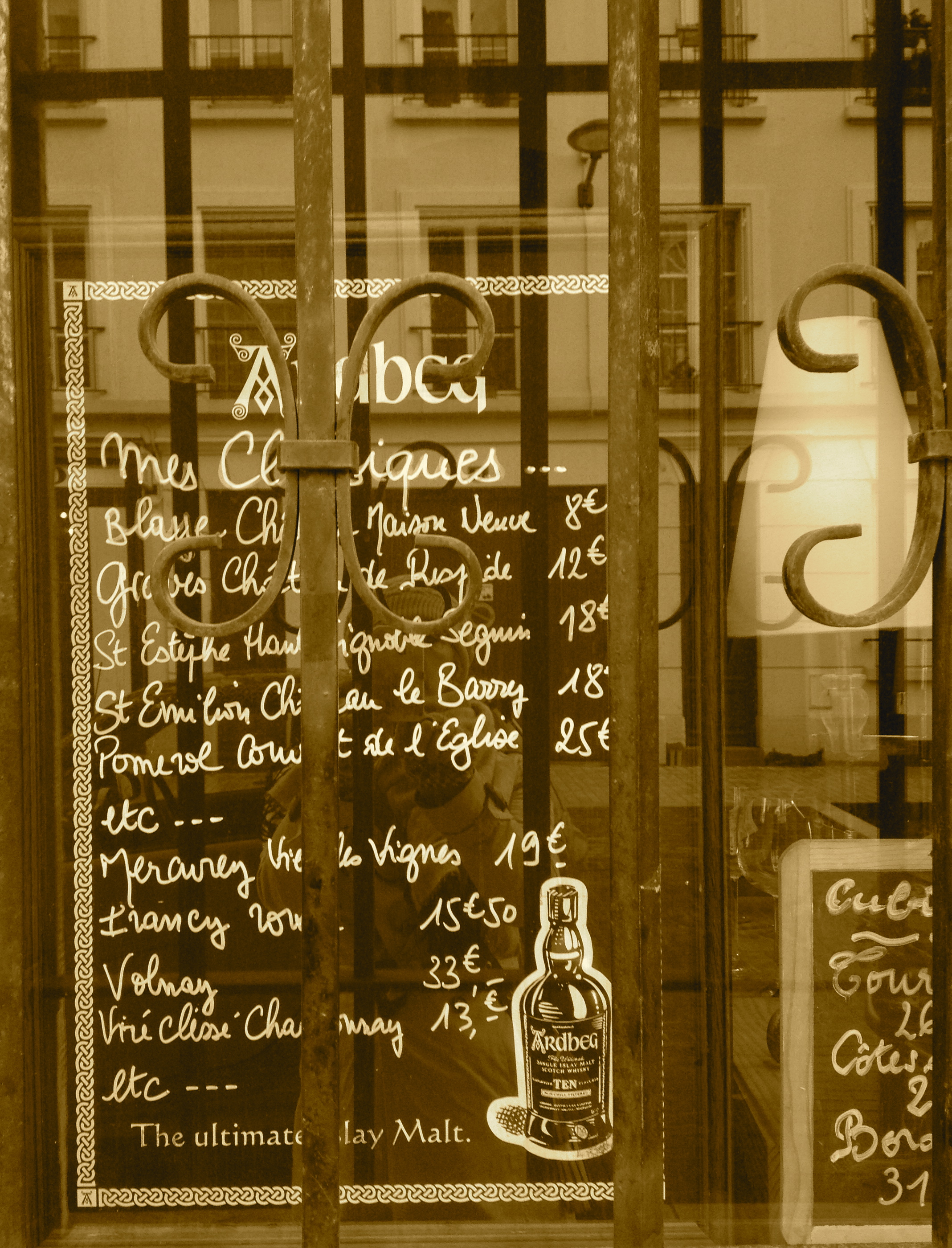
A flourish of iron protects a Parisian cafe

For me, history and architecture are inextricably linked, especially in the case of Paris.  The iron structure that is the Eiffel Tower would not loom over the city, if… The Metro signs that ‘play’ with iron and grace the streets of Paris would not stand if… if the city had not hosted the International Exposition in 1889.   Up until that period, iron had been a coarse, hard material used as far back as 1500 BC for weapons and tools.  After the Middle Ages, it began to appear in doors and windows for protection from raiders and marauders.  Moving forward, prior to the Industrial Revolution, the ‘village smithy’ was a staple of every town. In fact ‘Smith’ is from the German meaning “skilled worker,” which concurs with the high status they enjoyed at the time, a town couldn’t ‘move’ without them.  From the 1500’s onwards, iron became sophisticated and decorative which leads us to Paris in the late 19th century.

IMG_1866

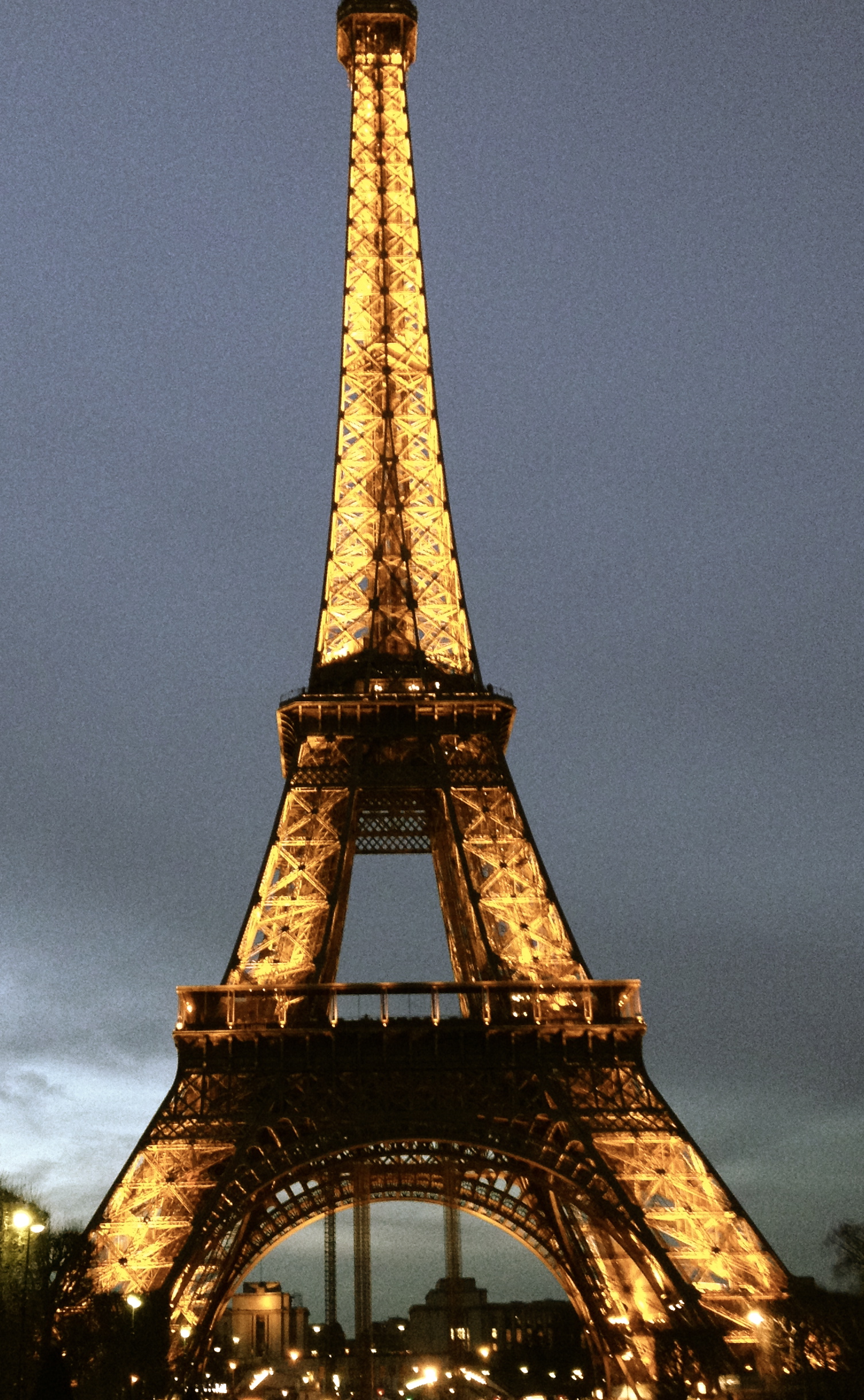
The tower that Eiffel built. All 18,000 iron bars of it and 2.5 million rivets!

As a city hosting the International Exposition, an iconic landmark was needed for the occasion and a design competition was launched.  Gustave Eiffel was awarded the commission and proceeded to design the iron lattice tower for the entrance of the Expo, all 18,000 iron bars of it! It was fiercely maligned by leading artists and intellects of the time.  They loathed it and pointed out that it didn’t do anything; it wasn’t a palace, a burial chamber, or a place of worship.  Eiffel himself had to admit that he mostly wanted to build it for the pleasure and notoriety, even footing 80% of the cost.*  A petition submitted by three hundred leading artists and intellects of the time ensued with the plea, “We, the writers, painters, sculptors, architects and lovers of the beauty of Paris, do protest with all our vigour and all our indignation, in the name of French taste and endangered French art and history, against the useless and monstrous Eiffel Tower!” Understandably,  it must have been an abomination as it towered over majestic landmarks such as the Pantheon and Notre Dame Cathedral which had dominated the skyline since the 1160’s.

Madame Liberty on display at the World Fair

A part of Madame Liberty on display at the World Fair

But alas, despite the outcry, the massive edifice was constructed with record speed. Eiffel had already established himself as a prolific engineer and his resume included the design and construction of the Statue of Liberty (a gift from France), among countless other projects.  The Parisians would eventually warm to the Eiffel Tower, as would the world, which still does to this day.  More than a century later, all that iron and its millions of twinkling lights is the most visited, paid monument in the world.  C’est magnifique!  Monsieur Eiffel would be proud indeed.

IMG_2016

Iron leaves wrap themselves around the one hundred year old sign

To prepare for the record number of visitors that would soon descend upon Paris for the Exhibition, a maze of underground transportation was planned by the Paris Subway (Métropolitain) Station.  We know it today as the Metro. The Parisian architect and designer Hector Guimard won the commission to not only mark the entrees and sorties to the new Metro, but to positively portray this new mode of transportation to the city folk.   And once again, the Parisians were not amused.

IMG_1901

A stately Metro sign along the Champs Elysees

Initially, they were opposed to the gaping holes in their boulevards that descended to the dark, maze of tracks below.  And they most definitely didn’t appreciate the new Art Nouveau style of the Metro entrances and signs, iron twisting as if to impersonate vines or flowers.  The style was now ‘in vogue’, drawing inspiration from nature and natural forms.  Plant vitality interpreted in abrstract-linear lines. There were also complaints that the freestyle font used in ‘Metropolitian’ was difficult to read.  Guimard certainly would have been offended as it was reportedly his own script that he had used for the ‘flourishing sign’.  How could they have known that eventually there would be people like me who would stand before it and deem it so pleasing, so original.  A pleasant contrast to the stone structures that dominate the Paris landscape.

IMG_2038

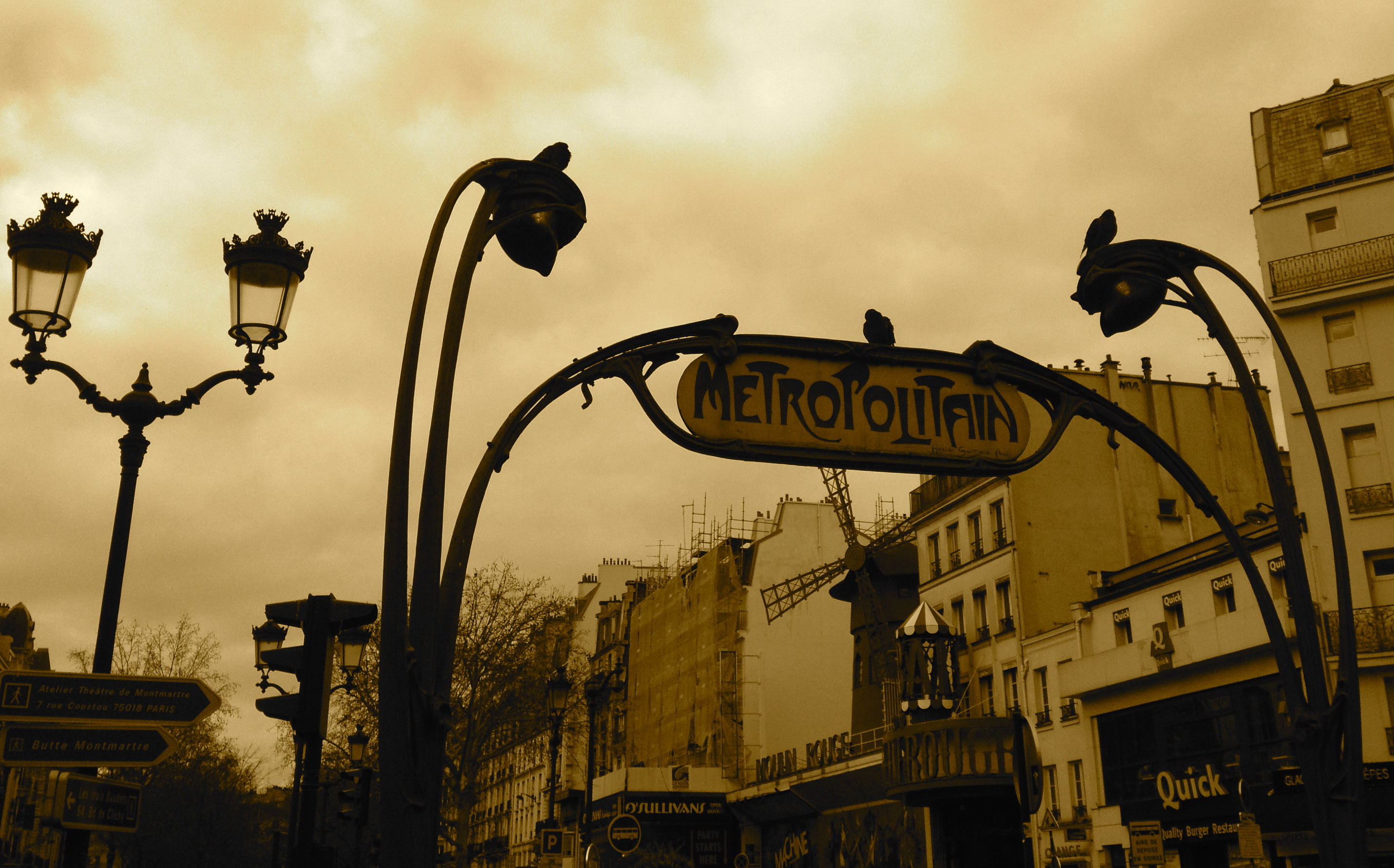
The Iconic Metropolitain sign (deemed difficult to read) held between two oracle lamp posts that portray plant stems. Moulin Rouge is in the background.

I can happily declare that on this trip, I mostly mastered the extensive labyrinth of stations, lines and routes that is the Paris Metro.  Along the way, I  adored the Metro signs as I flitted from one stop to the next. From Montmarte to the Seine, from St. Germain to Le Defence, stopping to photograph them as the Parisians rushed past on their daily commutes.  I had time.  Time to appreciate their elaborate designs, fluid despite the iron they’re wrought with.  Whimsical, yet sturdy and reassuring.  They made me smile, and they just so happen to direct more than 4.2 million passengers daily to their destinations. Paris wouldn’t be the same without them.

IMG_2009

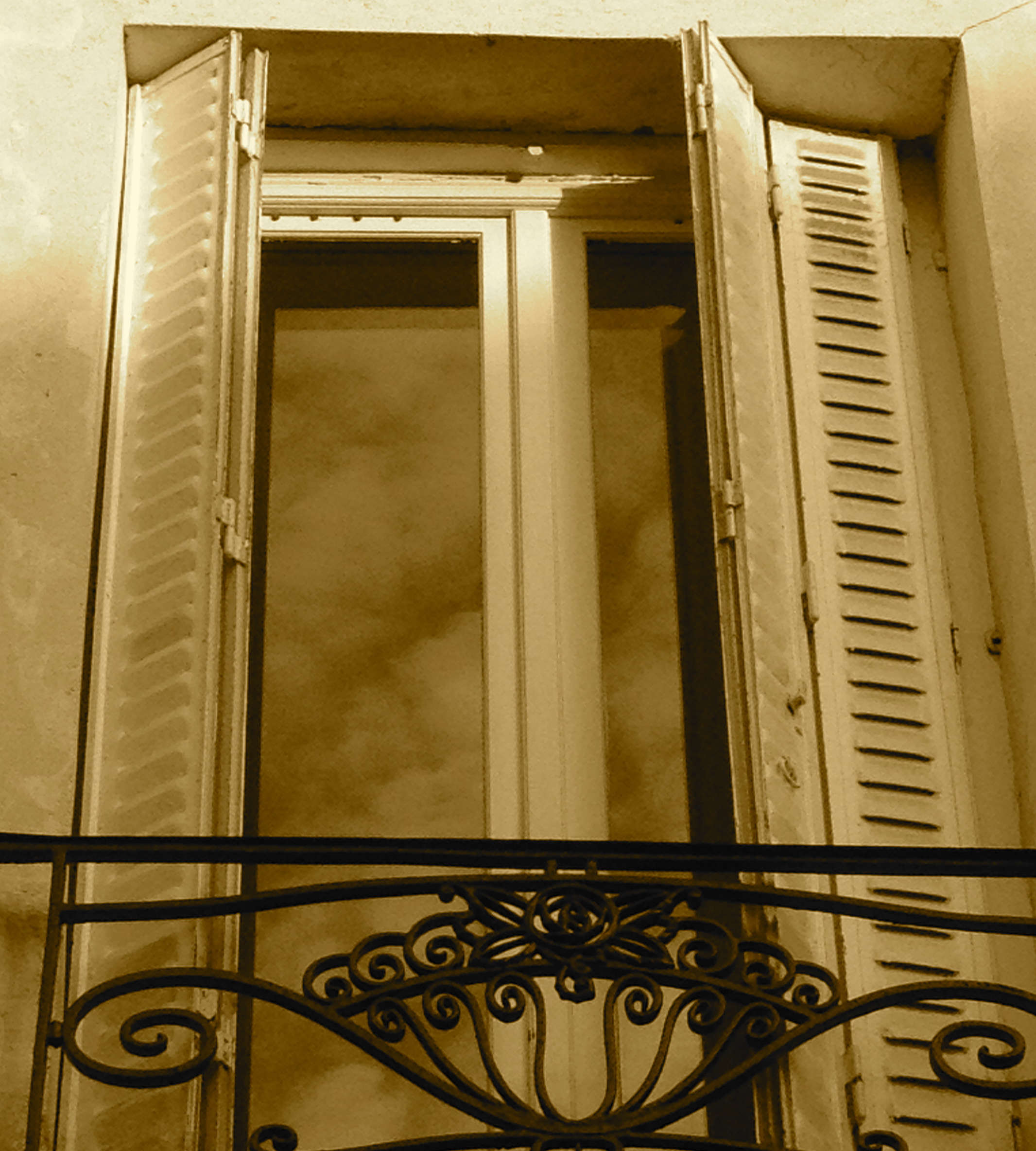
A delightful, decorative iron design on a Parisian balcony

And what of those two artisans that elevated iron to a higher level,  Eiffel and Guimard.  We know they left lasting legacies to the city of Paris, but what of their fate?  Eiffel had an illustrious career, eventually making significant contributions in aerodynamics and meterology. He died happily, listening to Beethoven in his lovely Paris mansion.

Guimard however, did not fare as well. He and his Jewish wife fled to New York before the Second World War, perhaps never to again have the pleasure of strolling past his designs that grace many Paris boulevards.  He died in obscurity in New York.

Fortunately, the work of these creative men continue to delight visitors to the ‘city of light’.  Let’s also spare a thought for the unsung heroes that worked in countless foundries, transforming iron into art that adorns a city which one cannot help, but to fall in love with. C’est Paris!

* Bill Bryson sums it up in his entertaining and informative, non fiction book ‘At Home, A Short History of Private Life‘… “Never in history has a structure been more technologically advanced, materially obsolescent and gloriously pointless all at the same time.”

*The Universal Exposition of 1889 was visited by some 28 million visitors. Considering many of them would have travelled by vessels across the ocean, it’s a staggering number.  Attractions included, unbelievably, a ‘Human Zoo’.  I had not realized this had existed.   Also, the Wild West Show was at the Expo, Buffalo Bill and Annie Oakley lassoing their way to notoriety.

The emptying of a nest…

Standard

I have three sons and in precisely five days, my eldest will fly away with a backpack and an itinerary with destination points such as Bangkok, Phnom Penn, Hanoi and Luang Prabang. He and his girlfriend have earned their degrees, worked and saved for a year, now they’re off!

How can I not be thrilled for them, I did the same when I was just a few years older than they are now. At the time, I promised I’d be back in six months, yet didn’t return to live until last summer. Some twenty-four years later and that’s what I am afraid of, and yet not.

IMG_6866I’ve just had the pleasure of living with the ‘vagabond to be’ these past nine months. After four years of separation while he was at university on one continent and I on another, it was a joy to have shared this time with him. The fact that he worked at a wine boutique was an unexpected bonus. I’d often be preparing dinner and receive a text asking what was on the menu so the wine could be paired. I shall miss that, and him, as we would chat about life over a glass of Grenache or Merlot until well past bedtime. Yet, I’m faced with the realization that once this young man steps on that airplane, he will have officially flown the nest. Grad school in Sweden awaits after the trip and I stoically write… it is how it is meant to be.

Almost five years ago, our nest dramatically emptied by two. It was arguably the worst months of being a parent that I’ve known. I ‘lost’ two kids in the space of a week and moved to a new country just to top it off. With my husband and youngest son already relocated to Norway from Houston, it was I who had the daunting task of settling the other two in Canada. It was their home country and yet they had never lived here which concerned us greatly. Our middle son went to a boarding school in the West and the eldest to university on the other side of the country. Those of you who have experienced this know how utterly difficult it is to walk away and leave your ‘babies’ to fend for themselves. It definitely is not how it’s portrayed in the movies with smiles and a quick hug goodbye. No, it’s wrenching and traumatic. After the second ‘delivery’, I drove through tears to the Toronto airport to catch a flight to my new life in Stavanger. All the while, vowing under no circumstance would I deliver the third son alone to university when the time came.

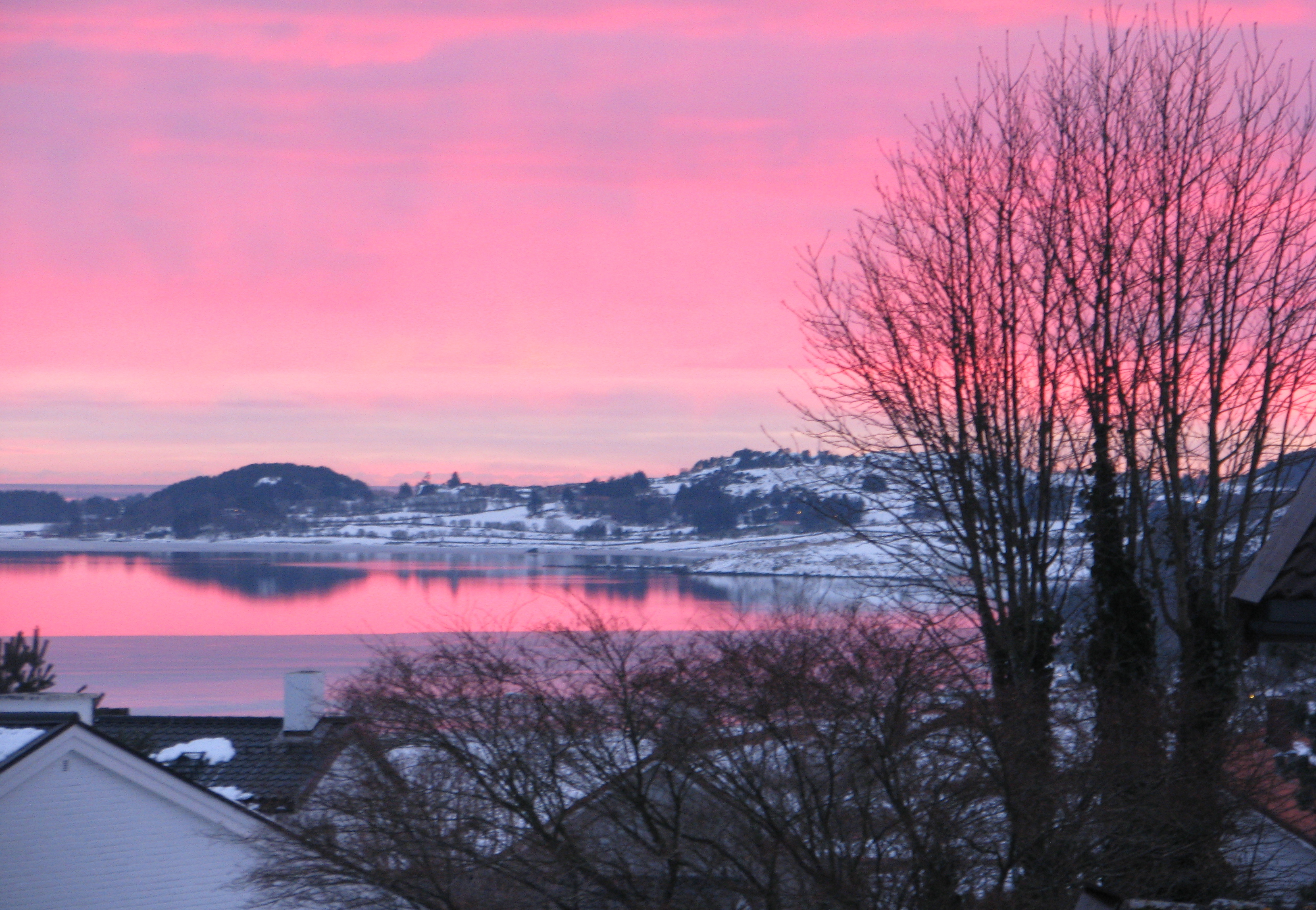
My view that cheered me

My view that cheered me

After collapsing in my husband’s arms once I arrived across the ocean, I spent many days of those first months curled up in a ball. With the rain pouring and the wind howling around me, I struggled to cope. Not only was I dealing with transition, I was in the throws of empty nest syndrome. I remember feeling as if part of me had been amputated.

Evening dinners were the worst. Three places set instead of five. Three of us struggling not to pine for that busy household of five. It was too quiet, too lonesome and many nights I would burst into tears, not able to contain my emotions. The beautiful surroundings and our view to the fjord helped somewhat. However, our youngest was also in turmoil and yet it was his humour that got me through the worst of it. He was suddenly an ‘only’ child with no bros to hang out with or kick a ball around with on a whim. No, now he got all the attention; just he alone which isn’t exactly what a sixteen year old finds ideal. It is well known that the effects of an empty nest also impacts siblings and they also can deal with a sense of loss and bewilderment. They require attention and understanding as they cope with new family dynamics. I remember many chats and hugs as the three of us did our best to adjust.

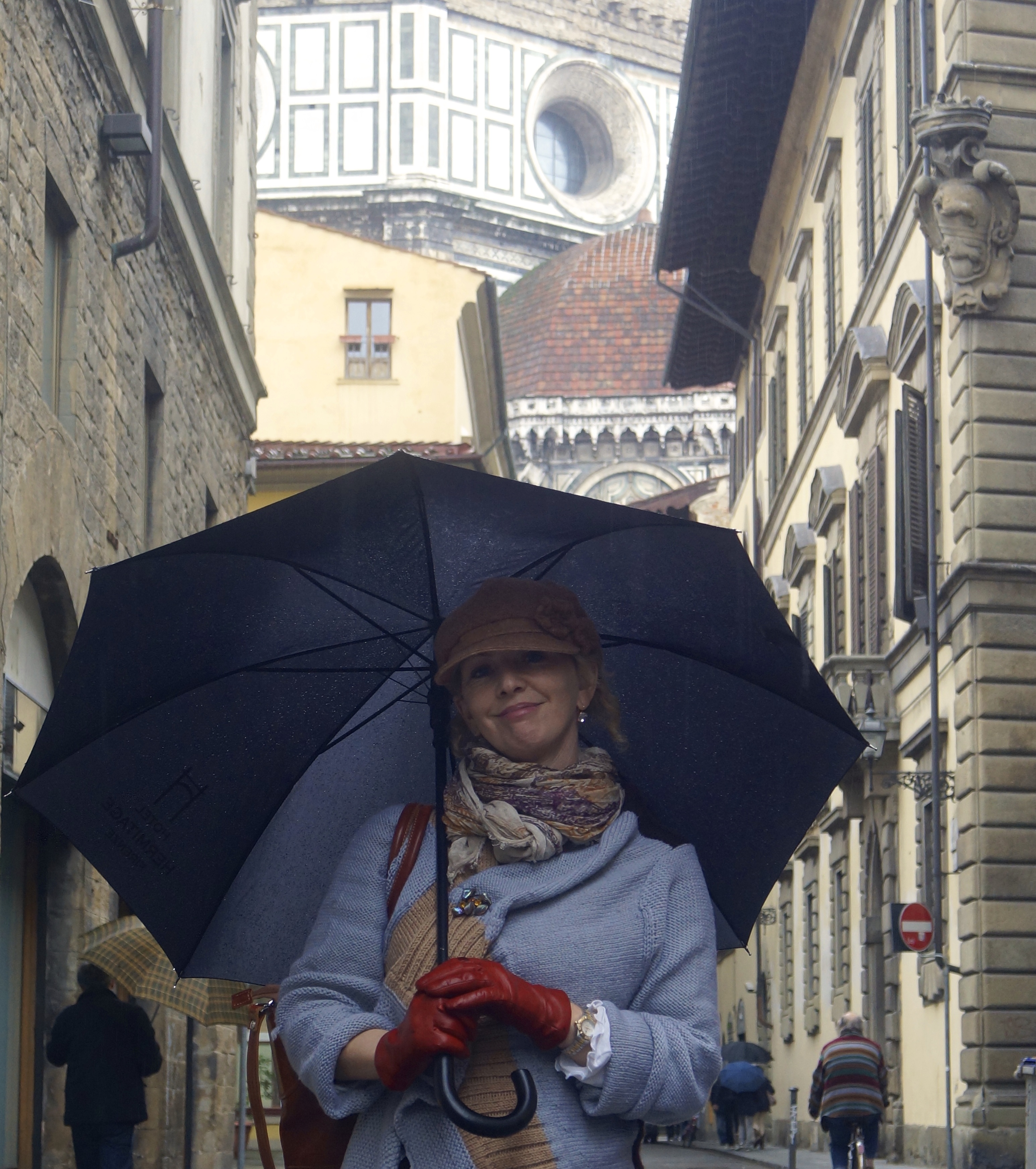
The reality is that nothing can truly ready us for this new phase in life and the advice I can give is thus; prepare yourself. With the relative ease of having only one teenager at home instead of three, I made the conscious decision to take on new challenges. It was essential to the process of moving forward. I wandered off to a writing retreat, studied art in Florence* and started a book club. I also took on a job that I adored. The silver lining is that it gives you the green light to do something different once that role of motherhood is more ‘part-time’. It may be trying something new such as a class, volunteering or finally finding time to complete projects that you’ve put off. I have friends that have taken up quilting, produced photo books and learned a new language now that they have more time on their hands. Some of us also started power walking which helped me cope as we walked, while we talked and talked. A number of dear friends helped me get through the worst of it. They know who they are and I will always be thankful for those long walks along the fjords and through the mossy woods.

A break from  studying in Florence; enjoying some new found freedom.

A break from studying in Florence; enjoying some new found freedom.

At the recent #FIGT conference*, empty nest syndrome was mentioned a number of times as women cope with the realities of their changing role. However, some of us agreed that it was also liberating. It was allowing us to explore new experiences and even job opportunities. I whole heartedly agree with Robin Pascoe in her excellent book, Homeward Bound.*  She writes, “Your life is your career. Women would better serve themselves by defining the word career as a path through life.”

How true, being a mother is a ‘job’ that we have for life and the skills that we gain are endless. Yet as the saying goes, there are two things we must give our children; roots and then wings with which to fly away. As mothers we have to be prepared to pat ourselves on the back for the good job we’ve done, yet try to move forward.

Opportunities lie ahead for us, just as they do for our young adults. I know my parents gave me their blessing to move away and as painful as the separation was at times, they’ve seen places in the world they wouldn’t have had the privilege of doing so. They’ve scoured beaches in Oman with us, rode camels in Qatar and happily sweltered at baseball fields in Texas, watching their grandchildren play ball. All part of where that road may lead when we leave home for a path unknown. It’s brave to recognize that leaving the nest that we’ve been raised in and comfortable with is part of life’s rich tapestry, if that is what is chosen.

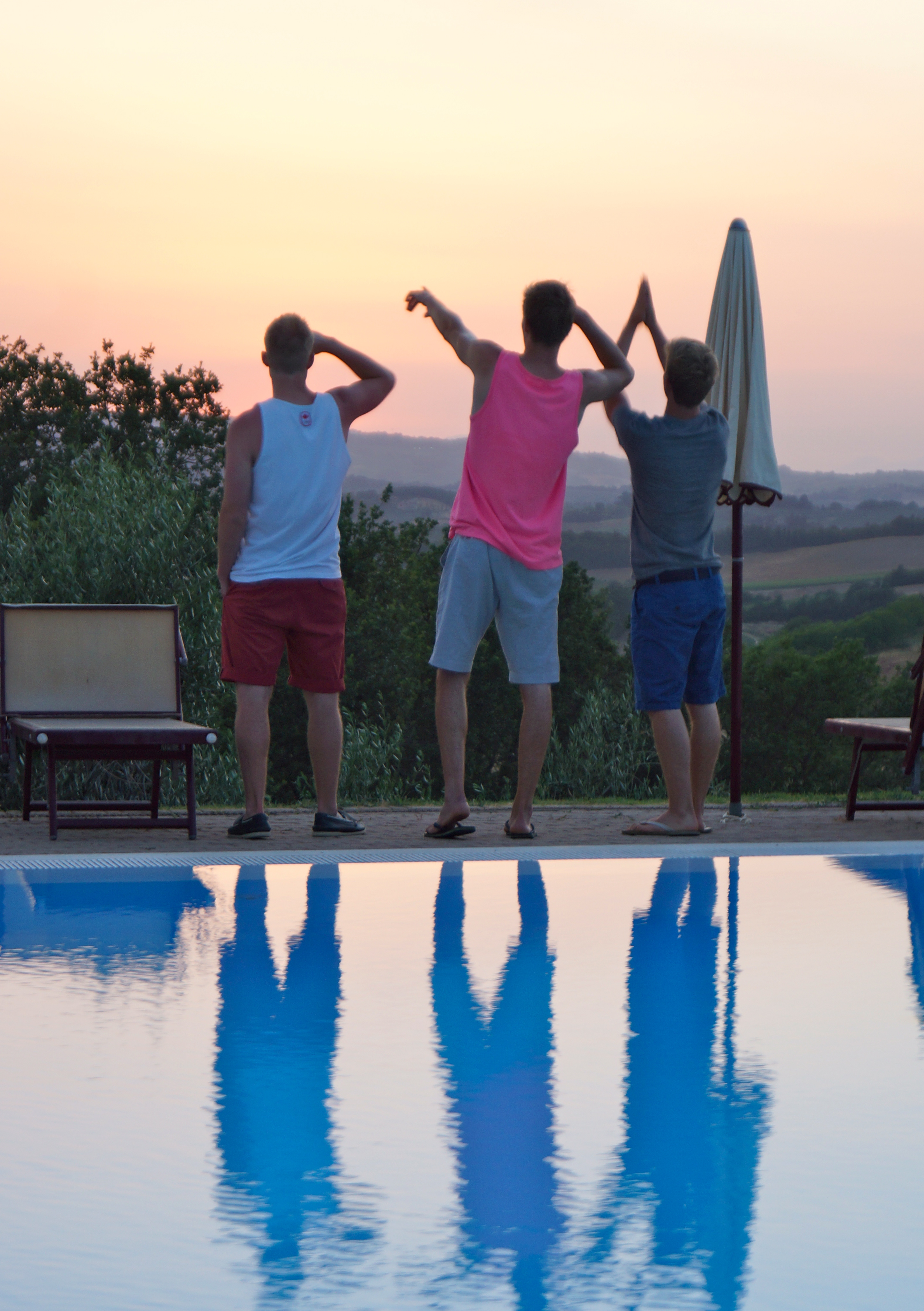
The three that will soon have flown the nest

The three that will soon have flown the nest

At the end of this summer, we’ll be empty nesters. Will we miss these three guys of ours, yes most assuredly. However, I’m excited about their next chapter, as I am my own. A few years ago my sons gave me a mother’s day card that I cherish. It’s elongated and folds out to the shape of Cleopatra. Listed on her dress from A to Z, is what my role has been these past years. What we’ve all achieved by being ‘just’ a mother.  And it reads;

Accountant    Babysitter    Chauffeur    Decorator    Educator    Fashion Guru    Guidance Counselor   Head Chef     Interior Designer    Janitor     Kitchen Supervisor     Landscaper      Mechanic    Nurse    Officer  Psychiatrist   Quality Control Director    Referee    Storyteller    Travel Agent     Underwater  Swim Instructor    Valet    Warden    X-pert Caretaker     Yard Technician       Zookeeper 

Yes, just a few skills for that well honed resume we acquire through the years of raising children. A priceless and noble job, but also one that we can use as a stepping stone to a continued, fulfilled life. Also, we can be consoled by the fact that we are always home, meaning we parents endeavour to provide a nest for those kids to come back to, whatever the age. And that’s a wonderful thing.

And, so as I write this I’m thinking of those two young university grads setting out on their adventure of a lifetime. They’re elated and I know we all wish them, simply…the time of their lives!


P.S.  Hubby was indeed with me to take the youngest to University of Victoria last summer.  How could he refuse as we dallied in Canada’s wine region on the return, the beautiful Okanagan Valley. Thankfully, it was all just a little easier the third time round!


*Renaissance Art at the British Institute of Florence

*FIGT as mentioned in my first blog

*Robin Pascoe is the author of numerous books on the subject of global living.  They can be found at expatbookshop.com

So You Want To Be A Writer…

Standard

I have to admit, being announced as a writer at the recent #FIGT conference was a proud moment. It had long been a dream of mine and my eventual epiphany was inspired by a borrowed book. That book would eventually lead me to a writing retreat in Tuscany, led by Jo Parfitt. At the risk of sounding over-dramatic, it changed my life.

Becoming a writer…in Tuscany

Becoming a writer…in Tuscany

I’ve always been envious of people who are diligently committed to their writing, as opposed to simply proclaiming their wish to be a writer, as I had done for years.  Having lived and travelled for twenty-three years in countries strung across the globe, I have nevertheless written every step of the way. Though up until now, those experiences have languished in my journals, begging to be released. They attest to adventures such as safari by camel in Rajasthan, truffle hunting in the Arabian desert, and trekking in Nepal.  To be fair, a few of those diary pages made it to published articles;  Fleeing Tiananmen Square was one and thankfully, on a happier note, Shopping in the Silver Souks of Oman.  The latter is definitely a lighter read!

Yet there’s still no book to speak of despite pleas from my ever patient husband and even a grandmother’s admonishment to, “Please write that book dear so I’ll know what you been up to all these years”.  Sadly, she’s no longer with us, which reminds me that time is knocking at the door.  It seems there hasn’t been that all consuming desire to lock myself away and write, that persistent need to tell my story. I could blame it on raising sons on different continents and working part time which kept me more than busy.  No excuse, countless writers produce a manuscript with far less ‘crippling’ situations than mine.  I now appreciate that perhaps we need to grow into things, to arrive at that place more experienced, more poised, and to forgive ourselves for ‘lost’ time.

While living in Norway these previous four years, I finally heeded my husband’s protestations  and “find something I was passionate about if I wasn’t going to write that darn book”.  I did cultivate my passion for history and became a tour guide.  And I did write, so to speak, with verbal narratives.  I can tell you everything you want to know about the Vikings, shipping fleets and herring exports, or why most of the wooden houses in Norway are painted white. In fact, I would tell stories for three hours at a time, weaving history and local culture into rich tapestries, but alas they’re not on paper. My stories were informative and entertaining, but ephemeral nonetheless.

And so it was through a book lent to me, written by Maggie Myklebust, that I finally became committed to writing.  Maggie had an inspiring story to tell and she was brave enough to do so in her book Fly Away Home.  It touched me on many levels, but mostly Maggie’s determination to become an author, something she could not have envisioned.  Her publisher was Jo Parfitt of Summertime Publishing, who would that autumn lead a writing retreat in Tuscany. After years of dabbling as a writer, I dug up the courage to put my proclamations to the test. And if it all failed miserably, at least I would have had a week in beguiling Tuscany.

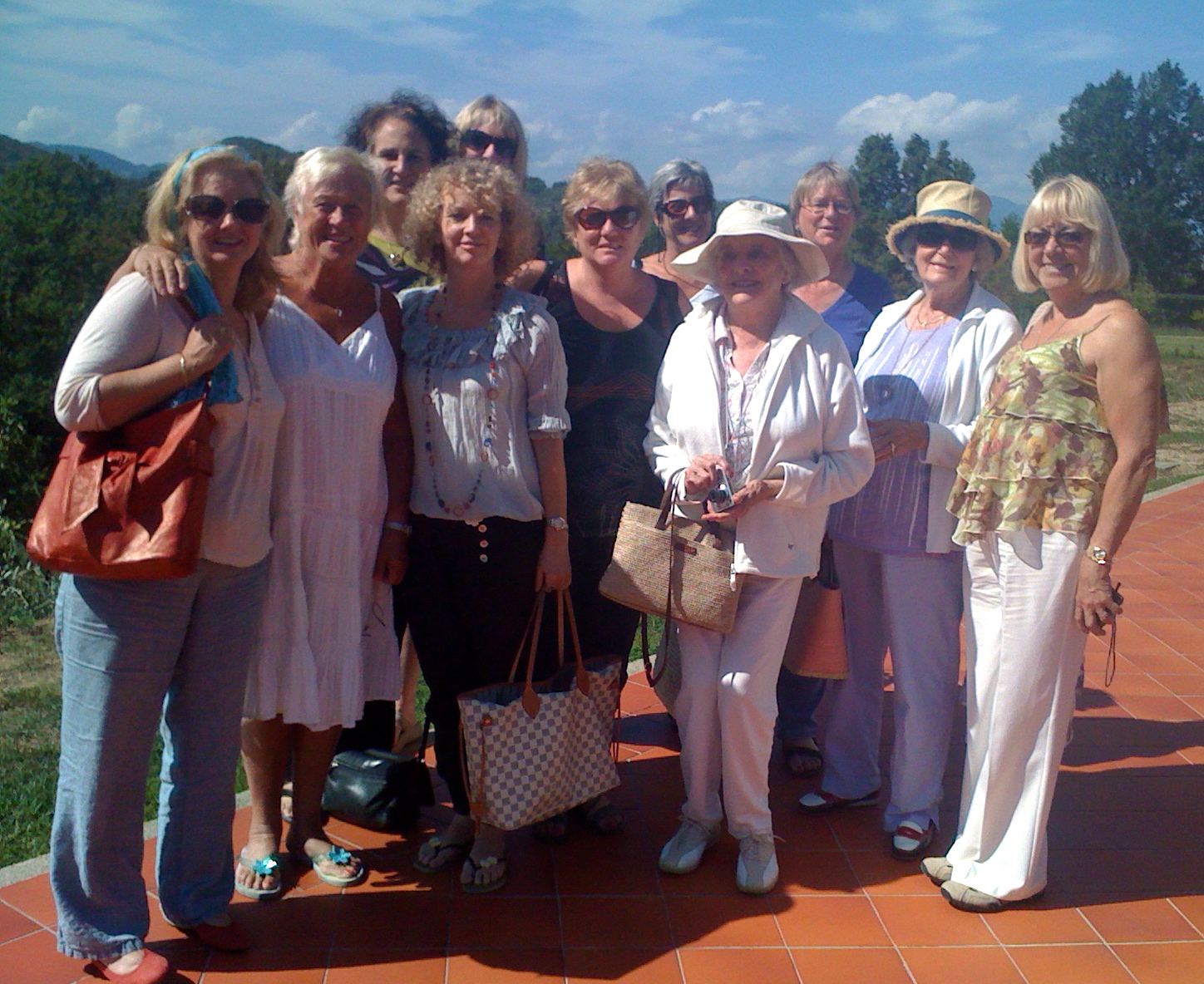
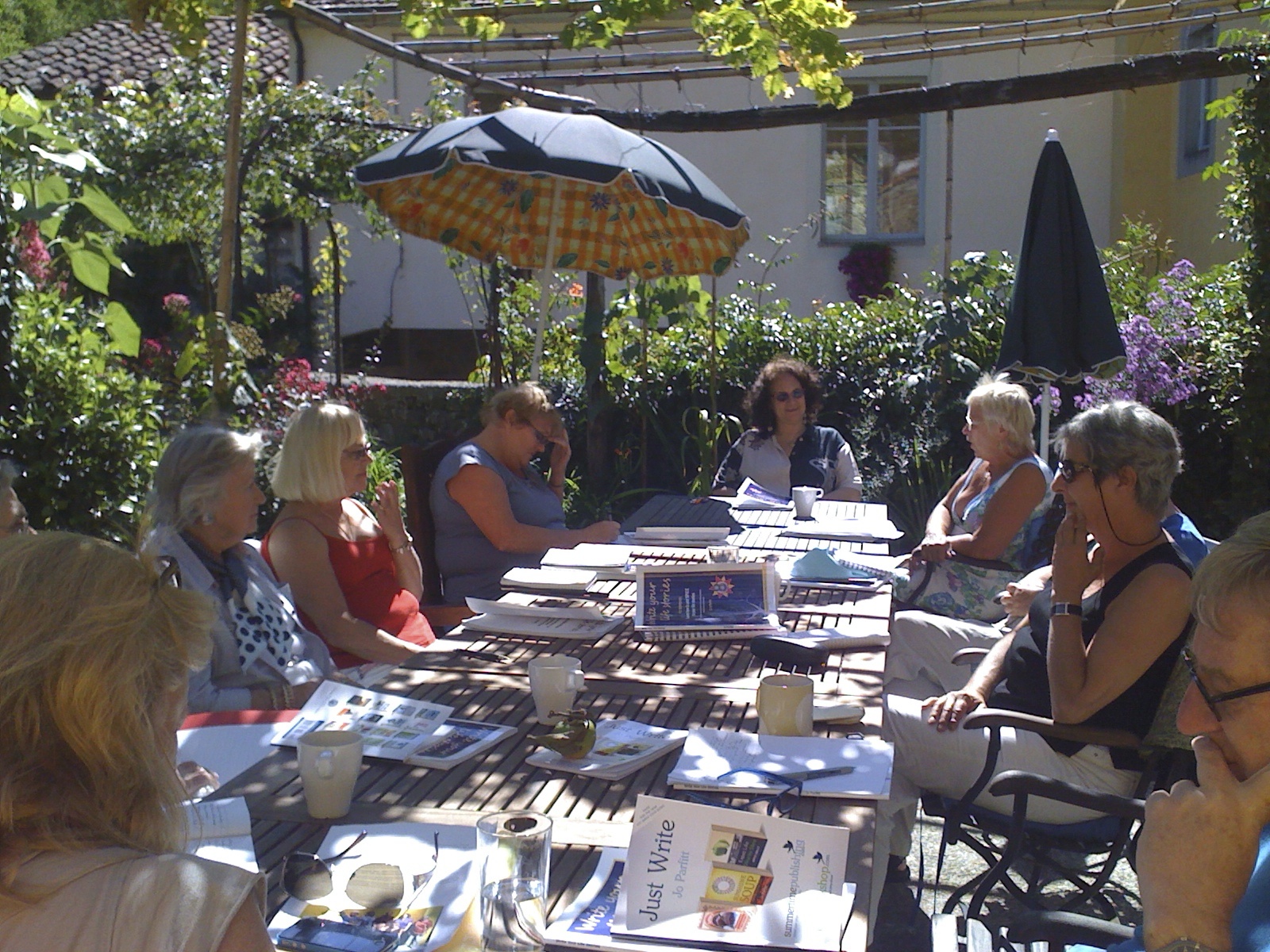
The Tuscan Writers

The Tuscan Writers

Eleven strangers had chosen to be thrown together. Eleven strangers who shared a love of words, poetry and story telling, but could we write?   We all had doubts as to why we had taken this plunge; frightened, yet excited with the possibilities of what the week would bring.

Writing at the Vine Terrace

Writing at the Vine Terrace

The group was mostly British including eighty- four year olds, Pamela Mary and Peeta.  These lovely ladies arrived together, their sun hats set firmly atop their silvery coiffures. They had  been raised by nannies and servants in Her Majesty’s far flung colonies while their fathers served the British Empire.   Both were eager to record their stories from a bygone era for family and posterity. They only wrote with pen and paper, no lap tops, and their penmanship was beautiful, of course.  We were inspired that they had the courage to begin the journey of writing their memoir, confirmation that it is never too late to fulfill a dream.

The Watermill at Posara was the ideal setting for a writing retreat. The Tuscan sunshine, superb hospitality and gorgeous surroundings welcomed us with open arms.  With the back drop of a cobblestoned courtyard and terracotta pots stuffed with bouganvilla, we embarked on six days of lessons and inspired writing. Most of our work took place under the Vine Terrace. Shaded by a mass of grape vines, their plump grapes poking through the trellises, the terrace welcomed us into its safety.  It is here our writing would evoke emotions of sorrow, joy, disappointment and laughter, along with tears.

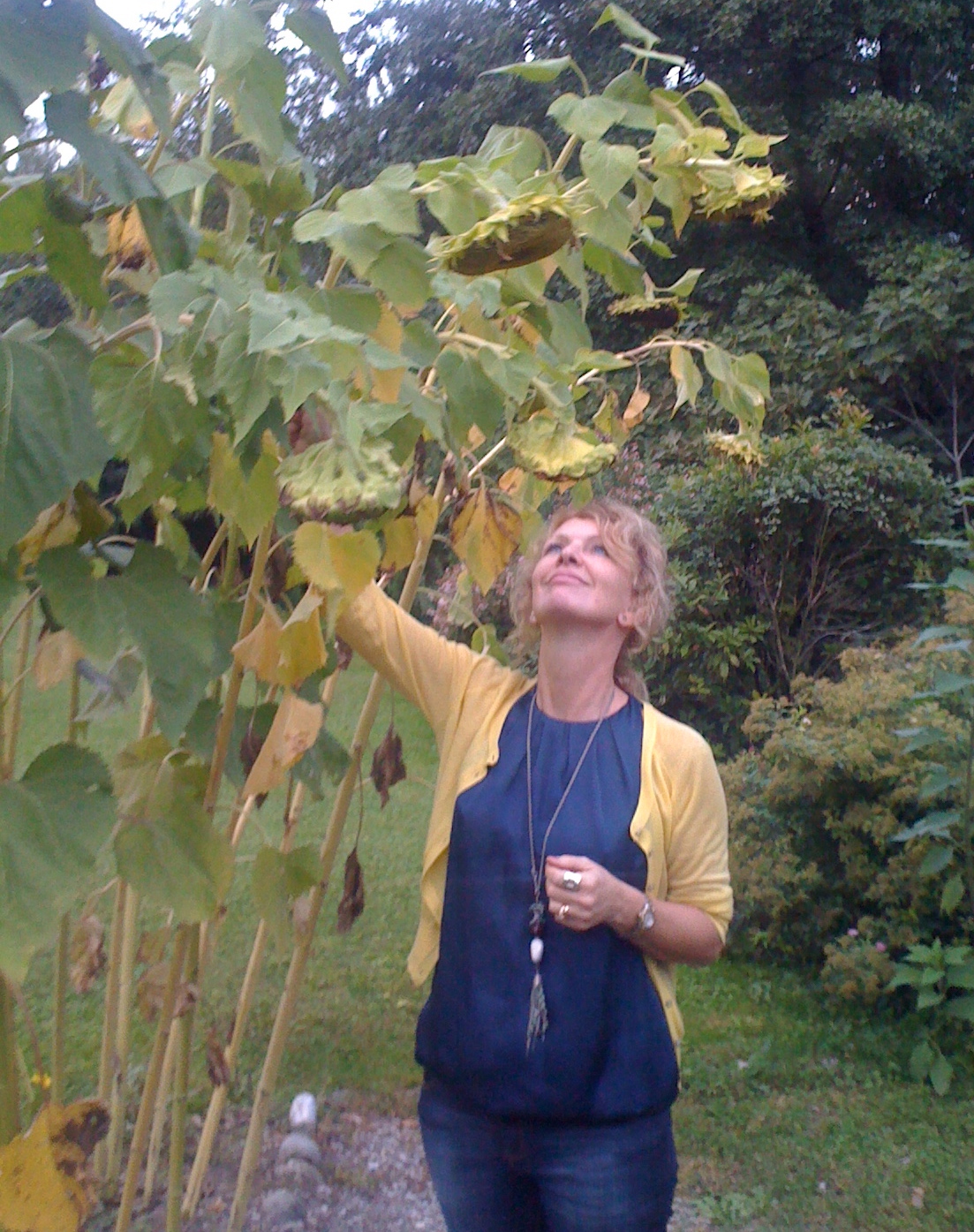
Our mandate was to learn and observe, to write, to polish, to present by 5 p.m. This did not vary. Every day, bar one, we knew at this time we must present a piece of work to be read aloud for all to hear, to ponder and to comment upon. As the sunflowers nodded in the late afternoon sun and the nearby bells of Posara chimed, we ruminated with our words and reached into our souls.

Frightening and challenging yes…

Instructive and inspiring, yes again..

Life Changing, absolutely.

At precisely 6:30 each evening, we were reminded that it was Apertivo time as the tiled table was promptly set with a fruit laden decanter of Aperol and carafes of Chianti.  It was a welcome reward for our writing toil, and balm for our souls that we had bared to each other.  After a delicious meal, our day would conclude in the comfort of the drawing room. Sinking into deep sofas, we engaged in lively conversation while sipping on chilled, locally made Limoncello.

The only male in our group was a famous British screenwriter (who shall remain anonymous) and we wondered why he was there, though pleased that he was.  He would read from his poignant memoir, recently begun but already captivating.  He would also regale us with stories of his Hollywood exploits, just as intriguing, I can assure you!  We all contributed with tales of jungle treks, of living on a houseboat, of lovers, of simpler times, of loss.  Each evening, was more entertaining than the previous. Each evening, eleven ‘strangers’ with different pasts became closer, breaking down barriers that would enable us to bare our souls just a little more in our writing the next day.  With the window sashes thrown open allowing the moonlight to peek into our lively gatherings, we would comment that another day had indeed been well lived at The Watermill!

The most integral member of that group and the reason we were all there, was Jo Parfitt.  We blossomed under her nurturing guidance, her magnanimous manner and her colourful scarves that greeted us each day. Because of her, we became writers… we became a writing family.

The nodding sunflowers

The nodding sunflowers

I had arrived in Tuscany with my sandals, sundresses and my favoured Uni-ball pens firmly packed.  I left……a writer.


P.S.  I’m finally writing that darn book!