Australia…elusive kangaroos, big surf and happy vineyards in Margaret River

Standard

“Truly, you’ve never seen a kangaroo?” the boutique owner said incredulously, wrapping my purchase in her trendy Perth boutique. Much like the city, it is vibrant and colourful. Perth is rich in art and architecture, and proud of its colonial and convict roots – all with the impossibly ideal back drop of the Swan River.

“No, in fact it’s my first time to Australia,” I confessed, admitting that her country is somewhere I had always wanted to visit.

“You’ll have no problem spotting a kangaroo, we’ve got a ton of them,” the young lady assured me. “Way more ‘roos’ than people.” I think that is the moment it began; my obsession to see one of these iconic symbols of Australia. There is so much about this country one dreams of seeing, but let’s admit it, a kangaroo is right up there.

Perhaps my curiosity with ‘down under’ took root years ago. On a six week Contiki tour through Europe, the Aussies were definitely the crowd you wanted to be around. Always fun and partying, they kept you guessing with a colourful and lyrical vocabulary all of their own.

“We’ll just call you Tess,” I was told on day one after introducing myself, “and love your sunnies by the way.” In keeping with the penchant for Australians to nickname everyone and everything, my sunglasses were now sunnies and my name was Tess…it kind of had a nice ring to it!

After a night of revelry in Greece, that fellow traveler would wake up minus one eyebrow, shaven off in honour of his birthday. We had celebrated until the wee hours of the morning.

“No worries, Tess,” Russ told me with a sly grin, “it’s how we do it in Australiaaa.” Rubbing the white patch on his sunburned forehead, like a freshly plastered band-aid, he declared there was only one thing to do.  “More ouzo mates?” We all greeted the morning sun with another shot of the Greek ‘nectar of life’.

img_1146-1

All these years later, I’m more inclined to drink fine wine and here, I’m in luck. After a week of exploring Perth while my husband ‘toiled’, we decide to tour Margaret River, Western Australia’s acclaimed wine region. We’ll visit renowned vineyards and see one of Australia’s most daring surf beaches. We will stand in awe of beautiful and unusual flora and fauna…unique on this continent, like nowhere else on earth. It seems to reason that we’ll spot a kangaroo or two?

img_2502-1The first hint of the iconic hoppers – they can travel at an impressive 40 km. an hour – are the road signs. In place of signs cautioning of caribou in Canada, of sheep in Scotland, or perhaps camels in Kazakhstan, the highways in Australia warn drivers of the kangaroo. The gangly marsupials outnumber the population by almost 3 to 1. Said to be particularly prolific in the ‘outback’ with some standing over 6 feet tall, it’s best to drive though that territory with a substantial 4WD, big bull-bars and spotlights…just in case you meet a ‘big red.’

Gosh, we’re only in a small rental car so I’m feeling a little fragile. I sit in the front seat, camera ready, full of anticipation and poised for action. Mile after mile of beautiful scenery, but no ‘wildlife’ to be seen. As we near Margaret River without so much of a glimpse, I implore my husband to pull over, “Let me at least take a photo of the sign then,” I say dejectedly.

The roo quest is all but forgotten as we drive through coastal dunes towards one of Australia’s most formidable surf beaches, Surfer’s Point. With some of the biggest waves in Australia, including the massive Margaret River Bombie, waves are said to rush at you like a freight train. This area is a surfing mecca. The breaks are renowned for striking fear into the hearts of all but the most heroic of surfers. As I marvel at a surfer gliding over a house-sized wave, I am transfixed by the force of nature…and of the surfer’s artistry in mastering the cresting wall of water.

img_1159The fear of sharks alone, more present than ever these days, would give most people pause. The many warning signs positioned prominently along the beach tell it like it is…rips, waves, cliffs and sharks. The surfer emerges from the water and I catch up with him in the parking lot and ask if he gets scared out there.


“Yeah, was at first,” Gavin admits, “but caught the wave and felt good. I reckon this is one of the best surf beaches in Oz right here, pretty hard core.” He tells us to come back with a bottle of wine for sunset, “prettiest you’ll see.”

I come across John sitting contentedly, gazing out to the ocean, until I pester him about his classic Land Rover. Wet beach towels dry on its sturdy hood. “It’s a ’77,” John tells me with pride. I immediately picture myself cruising through the outback in its rugged solidity, photographing all those roos…

img_1149

When John hears I’m from Canada, he mentions Vancouver as many Australians seem to do. I offer that Captain Vancouver had actually been close by all those years ago, just along the coast at Albany. I relate that Vancouver had claimed the spot for the British and named it King George Sound, collecting botanical samples all the while. “Is that right, small world,” and we move on to discuss the unusual flora carpeting the dunes around us.

img_2406

Surfers and families alike hang out at beach front cafes or just ‘chill’ along the coastline. It is a spectacular setting of turquoise and indigo waters surging onto white, powdery sand…punctuated by the crash and roar over the reefs of Mainbreak. Blankets of billowy clouds hover just above the horizon. We barefoot it to the most brilliant of vistas and wade in the chilled waters of the Indian Ocean. It is a fine day to be in Western Australia.

img_2396-1

Not far away is the charming town of Margaret River. The name first appears on a map in 1839, named after Margaret Whicher, the cousin of the founder of nearby Busselton. Mr. Bussel was one of many European migrants that settled the area, logging and clearing farmland. Yet it’s hard to believe that by 1922, scarcely more than 100 settlers called this beautiful area home.

But Margaret River had more in store for itself and is now surrounded by some of the world’s most spectacular vineyard scenery. To visit the mostly boutique-sized wine producers is to meander down narrow tree-lined roads, stopping to not only savour wines (and craft beers), but also to appreciate the perfection of the vineyards themselves.

img_2483

The estates are perfectly gardened with heavenly-scented lavender and perfumed roses, with spiky and bulbous native shrubs. With grass-trees and the ever abundant kangaroo paws, Western Australia’s floral emblem.

Rows of sturdy grape vines precisely pattern the fields and gentle slopes of grassy meadows are alive with browsing sheep, with black and white cattle. And with mobs – groups of kangaroos as they are called – or so it is said. I picture them, bopping through the rows as in a giant linear maze. A delightful playground, little joeys peeping out from their mama’s pouch. But on this day, not a single one to be seen.

img_2471-1

We stop at Vasse Felix, reportedly boasting the original vines of Margaret River, planted in the 1960’s. The founder, Dr. Tom Cullity, is hailed as the pioneer of modern viticulture in ‘Margs.’ He initially resorted to falconry to control pests, but the story goes that the falcon circled the vineyard once and flew off never to return. I ponder how it is that the roos don’t partake of the grapes. I later read that they cohabit quite comfortably in vineyards, prefering the grass that grows between the rows.

I also learn that Thomas Vasse was a French explorer who mapped the South Australian coast in 1811. He would later lose his life on the high seas. Or did he? Perhaps he was rescued by Aboriginals and taken in, then again, perhaps he was saved at sea and ferried away. It remains a captivating mystery in these parts. What we do know is that Dr. Cullity chose to name the vineyard after him, appending the word Felix – which means happy or lucky – implying a more fortunate twist of fate for the fabled mariner. How fitting…it is difficult not to feel happiness at the Vasse Felix Estate.

After lunch at their acclaimed restaurant we meet Nola, our hostess for wine-tasting. She describes the ‘beautiful fruit-driven blends’. We learn that the confluence of temperature, humidity and soil in Margs is ideal for grapes. We chat, sample and I succumb to an excellent Sauvignon Blanc Semillon and a perfect Filius Chardonnay – one for each suitcase.

I notice a sculpture of a reclining kangaroo, comfortably sprawled. Beautifully lit and back-dropped by the warm hues of donnybrook stone, it seems to be the ideal setting for family photos. Well that’s one finally spotted, even if it isn’t real!

Yet we’re determined. The day has turned moody with somber clouds and light rain. We venture onto a few back roads, chancing upon the haunting Buranup Karri forest, home to some of the tallest hardwood trees in the world. This forest supported many early settlers in the timber and firewood trade. The karri trees thrive in the local loamy soil; a mixture of sand, silt, clay and rich organic matter.

img_1205We wend our way towards town, detouring out of curiosity to see the extensive Leeuwin Estate. The grounds are long closed and the sun is lowering in the sky. Suddenly my husband slams on the brakes, “There’s one,” he says motioning to the field,”there, between that row.” I leap out of the car and creep to the fence. No it’s gone, just hopped away…maybe I saw a tail?

We decide to call it a day, but chance upon the Brewhouse and stop for an early evening libation. Reportedly opened by ‘three mates who wanted their own bar to walk to’, it is busy on this Sunday evening. A lively band plays outside while kids happily run amok. Locals greet each other warmly…eveyone seems to know everyone in Margs. In walks the crew from Vasse Felix, they recognize us and give us a shout.

Ah I love this place, it’s so like TofinoI happily remind myself that I’m destined to return. A friend of mine owns a small vineyard here and though we missed each other this time, I’ll most definitely take her up on the offer of a private tour. Felix indeed…

We take it easy on a small sofa and warm ourselves by a wood-burning fire, a couple soon plunks themselves down on the other. There is an instant connection with Julie and Chris. Originally English, Julie is a nurse and cannot fathom ever leaving her adopted country. Her boyfriend is a local through and through and is immediately charming. Chris’s stereotypical Aussie accent gives his stories even more character; maybe with just a bit of extra flourish thrown in for us…to make us feel welcome no doubt. We laugh our way through an animated and illuminating conversation.

Chris tells us he was once a ‘copper’ but is now a builder. I sense he wishes he had his brother’s job…piloting helicopters along the coast to spot sharks. “That’s a job? I mean is that necessary?” I ask naively.

“Oh yeah darl, bloody sharks are everywhere, we need Shark Watch here in Oz.”

“Really, I didn’t know! And this darl,” I ask, “you’re the third guy this week to call me that, is it doll?”

“No it’s darlin’ of course,” he says and then it comes to me. Wonderfully, Chris reminds me of my one-eyebrowed friend back on the beach in Greece. Full circle.

Our new friends talk about the weather and how it impacts daily life. “Oh yeah,” explains Chris, “our lifestyle involves the ocean mate, you don’t do anything unless you’ve checked the conditions first.” Julie nods in agreement and mentions that they’ve spent the day diving for abalone, ah, another idyllic day.

“That’s for sure,” Chris chimes in. “Nothing better here. You load up the ute, throw in the eski and the barbie. Ya got your shadey, ya got your ‘shelia’,” he roars, slapping Julie’s thigh playfully.

“Don’t you dare call me a ‘shelia’, Julie warns in mock outrage.

Funny thing is, I understood all of that perfectly.

You load up your 4 WD, you throw in the cooler and the barbecue. You’ve got your sunshade or awning (hitched permanently on any vehicle worth their salt in this region) and you’ve got your girl.

It all sounds perfectly fabulous to me!

Alas, the eventful, fun, idyllic day that never seemed to end, has indeed done just that. Ok, so we didn’t see a silly kangaroo we tell ourselves as we drive back to Vintner’s Retreat, our charming B&B, fittingly situated on Merlot Place. During our stay, a steady stream of birds have flitted in and out of the garden to show off…28’s, galahs, lorikeets, roselles and kookaberros. Rose, our gracious hostess, had mentioned the ‘friends’ that visit her front lawn. “I have kangaroos here all the time, it’s very normal.”

We pull into the driveway and we damn near faint. There on the front grass, I kid you not, are two of the illusive Macropus Rufus

The kangaroos pop up from their grazing and turn their heads towards us as we get out of  the car…“You two finally home? We’ve been waitin’ for ya mates!”


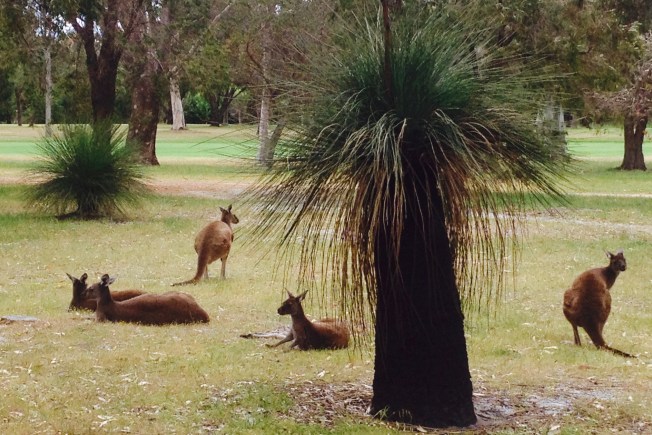
Post Script: And on the next morning, it all became so easy. ‘Go to the golf course’ we were told at breakfast…oh, yeah, there were mobs of them….

img_1246

Of Magical Mysore…of farewells and re-attachments…

Standard

img_0771Time with family and friends recently in Canada was wonderful – home in the true sense. However my other life in India called.

The world may be my oyster, yet there is a downside to living on different continents. Once back in Bangalore, reality quickly set in.

After four months of a ‘monastic’ existence whilst consumed by a book project and another few months away, I returned to Bangalore feeling a stranger and out of touch. I needed to fit back into a social life.

As in the past with other adopted countries, I trust a time will come when it feels more effortless…

Perhaps it wasn’t surprising that my first reaction was not to yield to my surroundings, but rather to explore. “Let’s see more of India,” I implored my husband. “We need to take advantage of being here.”

The next morning we pack our bags and head to Majestic, the city railway station. A little more than two hours later, the train delivers us to the charming city of Mysore. The saying goes that you haven’t truly experienced South India unless you’ve journeyed here. Our first hours in the city hint that this might be so. The streets feel different from Bangalore, but in a way that was strikingly familiar. I am transported back to those enchantingly simpler times we had experienced backpacking in India, over a quarter of a century ago.

img_0819-1Mysore’s streets and broad tree-line boulevards, are lively but less urgent than Bangalore’s. Stately buildings exude charm and a sense of place and history. All reminiscent of our India of old – a fondly re-discovered treasure.
The city is steeped in history, defined by the regal Maharajahs of the Wodeyar dynasty and by the infamous Tipu Sultan. Known as the Tiger of Mysore, Tipu was India’s freedom fighter and revered for resisting the onslaught of British imperialists. His state succumbed only after their fourth campaign. The Sultan is also celebrated as the pioneer of rocket warfare… but more of Tipu Sultan later.

We stay at a former residence built by the Maharajah of Mysore himself, a cozy retreat for his European guests. The Royal Orchid Metrople is that touch of old world charm with its tiled verandahs of potted palms, intricate lattice work and inviting wicker chairs. I enquire who the lady is, proper in a lacy Victorian collar and hairstyle of the 1920’s. Her portrait is handsomely framed at the foot of the lobby’s spiral staircase. With a hint of reverence, the concierge confirms, “We’re quite certain she was our first guest.”img_0765

I conjour a day in the life of this European visitor. I imagine her penning a letter at the writing desk in the Maharani suite – the very one we were staying in – carefully folding the parchment before sliding it into an envelope. Perhaps the correspondence describes a social gathering of visiting dignitaries, the unexpected thrill of an elephant ride or the purchase of fine Mysorean silk. Perhaps the letter addresses the paradox of the writer’s privileged colonial lifestyle, in contrast to the struggles and injustices of many locals. I would tell the writer that as foreigners in India, we try still today to reconcile the inequalities that surround us. We embrace the culture and the heritage, but often grapple with the poverty of the underprivileged.

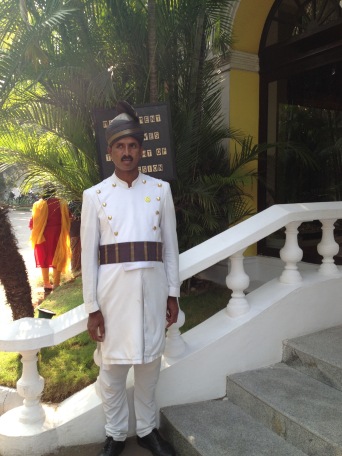
img_0768Our guest from the 1920’s makes her way down the spiral staircase to the porticoed entrance. She dons a sun hat and the doorman, splendidly attired in the Mysore fashion of the day, bids her ‘Good afternoon’. He summons a carriage and the visitor is conveyed to the Maharaja’s Palace. As the palace draws into view, she is instantly captivated.

As it was then, so is it now. Mysore Palace remains one of India’s grandest royal buildings. The most visited tourist attraction in India after the Taj Mahal, six million visitors a year are transported back to an era of unparalleled grandeur. This is the seat of the Mysore royal family, where the most beloved of Maharajahs, Krishna Raja Wodeyar IV was installed in 1902.

img_0828

The extensive palace grounds are lush, shadowed with rain trees and dotted with sacred temples. I’m asked to join groups for photographs and willingly oblige. It is clear we are much more of a curiosity here than in Bangalore. Small children greet me with smiles and a, “Hi Auntie, where are you from?”

We join the multitudes and deposit our footwear before entering the inner palace. Photos inside are not allowed, but then they could not do it justice.

The ‘Indo-Saracenic’ architecture of the Mysore Palace is a mix of Hindu, Muslim, Rajput and Gothic…and it is breathtaking. With soaring rooflines, mosaic floors, doors of inlaid ivory and displays of gold such as the elephant howdahs, the palace is designed to inspire awe. The durbar (the ceremonial meeting hall of the royal court) is magnificent in both scale and opulence, emphatically projecting the power of the Wodeyars who ruled for almost six centuries.

The much beloved Krishna Raja Wadiyar IV was the 24th Maharaja, ruling from 1895 to 1940. Focused on education, hospitals and religious sites, he worked to alleviate poverty and improve public health and industry. The forward-thinking Raja also built Asia’s first hydro electro project. Nearby Bangalore benefited and was the first city in India to have electric street lights in 1905.

Indeed the strides made during the Raja’s reign, inclined the revered Mahatma Gandhi to remark that the Maharaja was truly a Raja Rishi, a saintly king. His princely state of Mysore was acknowledged to be ‘the best administered state in the world’. But of course the Maharajahs of Mysore (as with other princely states) were also known for their excesses. Doing a Mysore was a phrase coined by Rolls-Royce executives in the 1920’s, code for the purchase of ‘Rollers’ in batches of seven…as the Maharaja Krishna was inclined to do!

The palace is a trove of treasures. Finely detailed wall paintings portray scenes from the Wodeyar’s stately processions and lavish lifestyle. Depicted in intricate detail, the Maharajahs are adorned in the finest Mysore silk and richly bejewelled. They sit atop caparisoned elephants, under the shade of a howdah or upon golden thrones. And they are rich beyond compare. At the time of his death in 1940 at his summer palace in Bangalore, Krishna Raja Wodeyar was one of the world’s wealthiest men.

We emerge from the palace into the expansive grounds. Hawkers gently tickle drums to entice. Cheap bangles, sandalwood carvings, incense and oils are offered – Mysore’s reputation for sandalwood and the finest of silks is undisputed. Brightly painted carriages and their listless ponies invite; more modest echoes of the elaborate carriages that once graced the the streets of Mysore.

img_0918-1The next morning a ‘carriage’ of a different kind awaits us. The environs of Mysore beg to be explored and we jump into a classic ’66 Mahindra Jeep. It’s rugged and basic, it’s a beauty.

Faizan from Royal Mysore Walks greets us affably and promises we’ll enjoy the tour. “You can ask me anything at all,” he says, “but just call me Fez, it’s easier.” As a former tour guide myself, I easily identify with him.

Fez is knowledgeable, engaging and gently puts us through the odd history quiz… perfect!

The drive takes us to the ramparts of Tipu Sultan’s fort in Sriangapatnam, an island formed between two channels of the Cauvery River. Hyder Ali, Tipu Sultan’s father, had usurped the throne, then expanded the Mysore kingdom but would be forced, with his son, to defend it in four Anglo Mysorean wars. Fought over three decades, the final and decisive campaign by the British East India Company was in 1799. Even now more than 200 years later, the battlements seem impenetrable and might have remained that way but for one man.

I envision the battle as Fez paints the scene with a wave of his hand. “There was a traitor” he tells us. “His name was Mir Sadiq and so despised is he even today that people throw stones at his tomb.” The general betrayed the Sultan by colluding with the British, opening a breach in the walls that lead to the defeat of the Mysorean troops and to the death of Tipu Sultan, the only Indian king to die on a battlefield.  At a nearby palace, we see the face of Mir Sadiq actually smudged out in paintings, more evidence of the contempt with which he is still held. On the other hand, Tipu Sultan is a national hero; his reputation for brutality is a story for another time.

14706885_1142879749091919_2180319888311831210_o-1

That British victory yielded the richest haul of war-spoils from any battle they ever fought. I’m fascinated by this remarkable period, indeed of all Indian history…the Moguls, Maharajahs and the British rule which is both maligned and embraced here. As we leave the ramparts, a simple wooden bullock cart trundles past. Two beasts of burden pull the sturdy cart along a time-worn trail at the river’s edge – a scene unchanged for centuries.

Our Jeep rolls past sugar cane fields, silk worm farms and stands of eucalyptus trees, the sights and smells rushing through the open vehicle are colourful, raw and exhilarating. We turn off the highway and thread across an ancient narrow bridge over a gently flowing river. The Raja Ghat extends either side of us, scenes of ritual bathing and high-spirited play combine; scenes that evoke moments of clarity… I am in India!

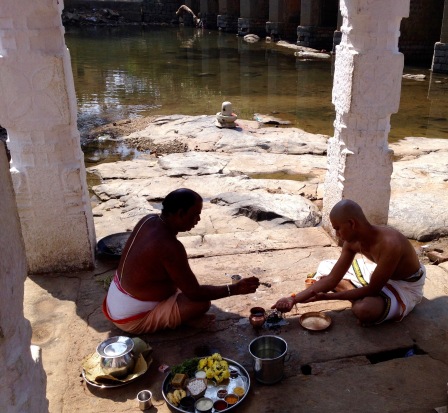
img_0860On the side of the stepped ghat, under an ancient stone pavilion, a ceremony unfolds. A young man, bereaved of his father, is in the midst of a solemn ritual. Guided by a brahmin priest, he recites prayers as water is rhythmically dabbed on his wrist. His head is shaved as tradition demands. We listen to the priest’s intonation, a soothing, flowing mantra. We offer condolences to the women witnessing the ceremony, sensing that we have intruded on their grief. Yet they acknowledge us with a gentle nod as we quietly take our leave. On the upper ghat, another Brahmin priest invites us into his vividly painted temple to witness the ritual about to commence. Inside, the centuries-old place of worship is cool and somber. We sit cross-legged on the stone floor opposite the priest flanked by two men, one an assistant, the other the supplicant.

img_0862The priest leads them in prayer for the well-being of the family. The father takes his cues from the Brahmin as his adult son and wife look on. Sanskrit mantras mix with wafts of camphor in the still air. Rice and turmeric are sprinkled, offerings in a timeless ritual.

Hands pressed together, and mouthing a ‘namaskara’ to the mother, we again take leave. She returns my gaze, her eyes confirming that our glimpse into this sacred family tradition was welcomed. I am moved by the openness of many Hindus and their openness of sharing their living traditions.

img_0868-1

In the mid-afternoon sun, more scenes of communal prayer and family unity play out on the ghats. As children splash in shallow pools, the rhythmic slap of laundry beats out a languid tempo on the rocks. Ever-present, sacred cows luxuriate as they munch vegetables in the shade of a mango tree.

img_2243

On our return to Mysore, Fez points out stops that we will have to plan for our next visit; sandalwood incense makers, silk farms and even traditional painters of those iconic bullock carts that seem the very essence of rural India. The jeep tour with Fez has offered us insights we would not have had the privilege of seeing.

img_0913South India lives up to its reputation of friendliness, of mystic sights and ancient traditions. This is why, I remind myself. Why this peripatetic life with its farewells and re-attachments, its solitudes and contemplative transition, is more than worth it. These are the moments to treasure.

I get my bearings back over the next few days once I’m back in Bangalore and resolve to be contented. I attend a number of social events through the week and feel a little more connected. “Are you free this weekend?” I’m asked.

“I’m afraid not,” I say, “I’m off again.”

As I pen this, my suitcases await at the door for this evening’s flight; it is Singapore and  Australia for the next ten days. Without any children here, I can freely accompany my husband on a business trip. It’s true… indeed I do feel very fortunate.

The Grand Bazaar in Pondicherry and a train passage to old ‘Madras’…part two

Standard

IMG_1121

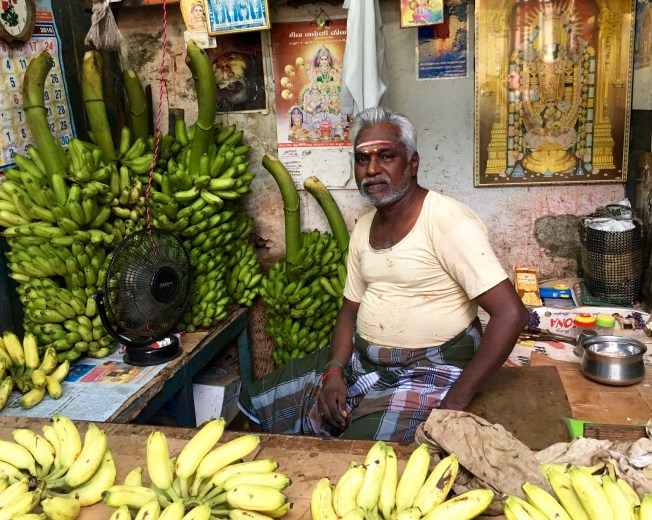
“Bonjour Mademoiselle, ca va?” asks the shallot seller. His smile is radiant, his demeanour peaceful. He shifts and shakes his shallots in a slim basket, removing their skins and depositing them lighter and more saleable into a substantial basket. The shallots are the sellers only commodity this Sunday morning at Pondicherry’s Grand Bazaar.

If you’ve watched the movie Life of Pi, you’ve briefly glimpsed Pondicherry. The narrative begins here, the film sweeps through parts of the old town including the expansive bazaar. Founded in 1827, it’s about the size of a football pitch, and we had been told to not miss it.

Pondicherry’s rich heritage is revealed here; the sellers, the produce, the decorative flower garlands created and sold for cultural and religious occasions. As I experienced in Kazakhstan, a market is where the fabric of a city reveals itself. A place where the murmur of regional languages, the aroma of exotic spices and unfamiliar produce beguiles you. An experience where the cultural thread that stitches a community together heightens the senses – market places are a traveller’s touchstone.

The shallot seller is proud to be of French ancestry, common in this once French port on India’s South East Coast. Pointing to his talika spread across his forehead, he makes it clear that his devotion is for Shiva. The broad stripes, painted or smeared from ash, are worn proudly on followers of the Hindu deity. The seller motions to his stripes and white dot, “Shiva is love,” he tells us in dreamy affirmation. I marvel that he sits, sifting his produce and smiling contentedly, almost in the pathway of the bustling bazaar…in complete serenity.

IMG_1072

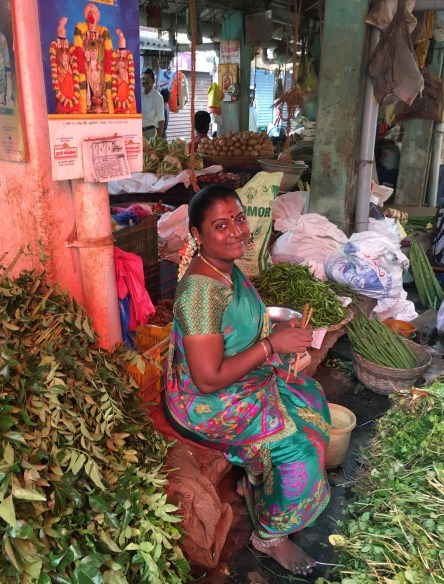
Most sellers have a stall, a perch, a ‘hole in the wall’ from which to sell. Many have their own small puja (shrine), a smattering of religious calendars and a hefty ancient scale beside them. Some have a speciality item, others sell it all. Red for apples, tomatoes and luscious pomegranates. Green for coriander and limes, curry and betel leaves, peas and lady fingers…you know them as okra. Purplish eggplant IMG_1117and orange for carrots and mangos.
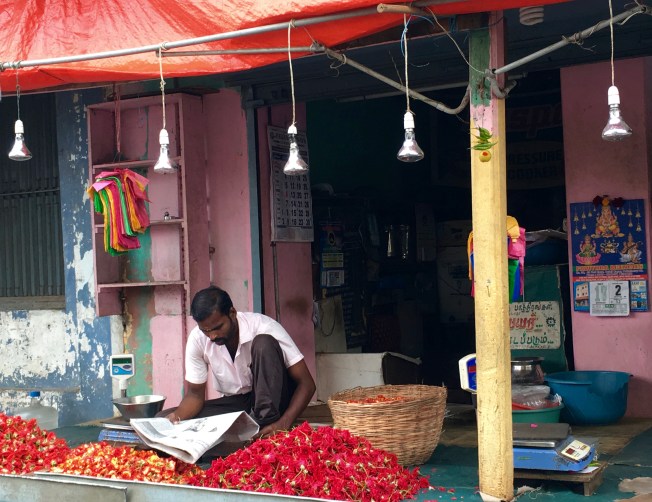
In Southern India bananas straddle both the yellow and green spectrum, their bunches often sold on thick stalks…ready to be steamed, fried or roasted. Banana leaves are vital as ‘plates and platters’. Practical yet with a side benefit – it is believed that antioxidants are transferred to the curries and masalas from their thick, waxy leaves.

I feel I’m in the way as burlap sacks of beans, groundnuts and garlic are heaved high on shoulders and humphed past me. I’m cautious underfoot for squashed oranges and smashed corn husks, for the odd rat that darts in and out. I dig my hands into stuffed, rolled down sacks, trickling and rolling rice, myriad beans and lentils through my fingers.

I’m thankful for sincere smiles as I make my way through the crowded lanes, haggling and chatter filling their space. My curiousity is most often met with warmth and returned smiles. The odd person reminds me they are busy trading and understandably, my camera isn’t welcomed by all.

The volume of produce is staggering, yet somehow it seems to get sold. This is where the people of India procure their food. Not at sterile well-lit grocery stores, but at bazaars, at markets, at roadside vendors.

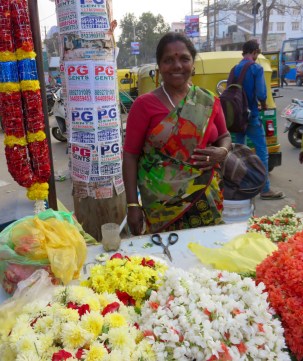
As colourful as the canvas of fruits and vegetables is, the cultural complexities of the flower and petal stalls are even more intoxicating. These petals of jasmine and lotus, chrysanthemum and oleander, roses and marigolds, are transformed into the dainty, the neck-sized and a variety of shaped garlands for welcoming and worshiping. One might even wrap a garland around an auto rickshaw…yes, they can be purchased by the meter. They can reach seemingly gargantuan proportions and be elaborately decorated; they have to be seen to be believed.

IMG_1103

Flower petals are bought cheaply by the bag, both for wholesale and for personal use. It isn’t uncommon to come across ladies sitting on street sides conversing and threading, petals slowly forming a garland. Yet most garlands are threaded at a maker’s stall.

I meet Chandra and his two sons. Their hands are swift and supple as they thread jasmine and roses. “It’s a family business,” I’m told. “My sons are following my foot-steps.” Small businesses such as Chandra’s are the backbone of India and the garland business is prolific.

img_4516They are offered for worship, draped around doorways at a housewarming, a new motorbike or auto rickshaw may be blessed with a garland, a bride and groom exchange them three times during a wedding. They are also woven into a lady’s plaited hair, especially here in Southern India.

I’m told that each Hindu deity has a unique garland: Goddess Lalitha prefers hibiscus, Lord Vishnu wears tulasi leaves, Lord Subrahmanyan likes to be draped in jasmine, whereas Mahalakshmi likes red lotus. Ancient kings appointed keepers whose only role was to tend flower gardens – cultivating precious petals for daily devotions, never to be sold. It is also rumoured that these royal gardeners did not marry.

When I wander to a tucked away lane and find garlands as tall as myself, it crosses my mind to take one to our hotel as a kind gesture. I realize it’s prudent to ask if there’s a special meaning attached to the over-sized creations, “Oh yes madam, those are for funeral!”

The rules for the flower pluckers, the sattarars, is fascinating…and yes I use the word ‘plucker’. In India, the word pluck is always used in reference to flowers. You do not pick flowers, one plucks flowers. It seems the rules for sattarars are rather specific, whether it be for the plucking or the making of garlands.

Flowers should be plucked in the early morning, ideally after having bathed. The flowers or petals should not have been smelled by anyone. They most definitely should not be used if they’ve fallen to the ground. Namajapam, or the repetition of holy names, should be done while plucking.

While constructing garlands the petals and other material such as banana tree fiber used as the base should be kept on a table but ideally above hip level – a flower for God should not touch the feet. I note that Chandra and his sons were building their garlands above the hip, their creations then displayed above them. I realize I had lifted one gently to my nose to appreciate its fragrance. Did I unwittingly break a rule, or does that only pertain to the loose petals?

img_4545-1

It seems the fragrance of jasmine, the most cherished scent of Indian flowers, is meant to be enjoyed. When their delicate ivory buds are threaded into gajras, not only do they decorate women’s hair, it is believed the scent reduces anxiety, emitting peace and happiness. Ancient Hindu art, chiseled some 2000 years ago, depict goddesses with delicate gajras enhancing their thick locks. And so it is, still today.

I stand close to ladies at a temple and the scent of jasmine lingers. More of those exotic scents and vivid colours that this traveller soaks up. I breath it in and cherish the scene. The images that await me in the coming day, further affirms my love of travel.

We journey back to old Madras (Chennai) by train. Not in first class or in air-conditioning, just the type of train that millions of passengers travel in daily. The kind of train with only bars on the windows and rickety old fans whirling above simple seats. The kind of train that costs less than a dollar to ride 160 kilometres or so.

We are the only foreigners, first aboard, and firmly planted next to the windows. This is important as the bench-seat for 4 will fill to 5, 6, maybe 7 by journey’s end.

img_1418-2Barely ten minutes out of Pondicherry a time capsule awaits. As the clatter of the wheels settle to a rhythmic, soothing pattern, the city gives way to a beautiful patchwork; palms, rice, vegetables and flowers. From these fields come the produce, the bounty found  in Pondicherry’s Grand Bazaar.
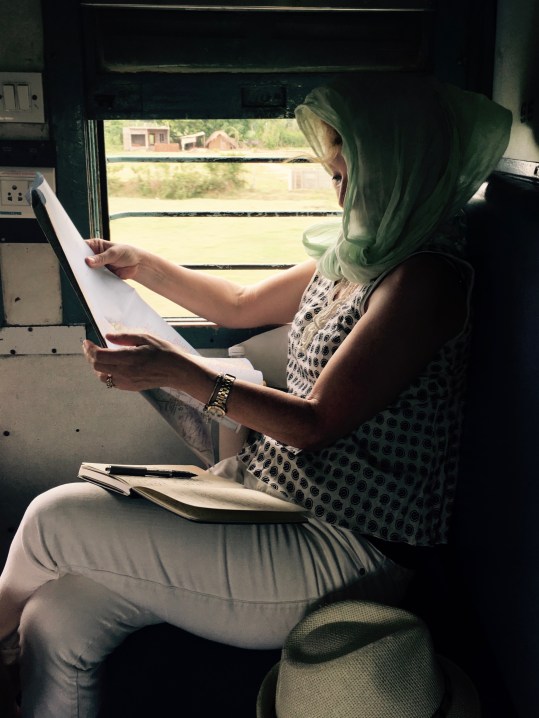
Against this verdant backdrop, ladies swish in bright saris as they tend crops and herd flocks. Small villages – simple buildings roofed with palm-fronds and tin, bullock carts trundling down narrow lanes – an old age farming culture stocking India’s bazaars and markets.

The train halts or passes through lyrically named towns like Valavanur, Vullupuram and Vikravandi Mailam. At Tindivanam it gets busy, the 4 seater long-bench is now a 6. A sinewy fellow in a vivid orange lungi asks to borrow the Times of India, a rural family boards dressed in fresh linen and shiny saris – their young daughter toys with a new cell phone, a young professional strikes up a conversation. Might he get a photo for Facebook with our son?

The train screeches to rest at platforms, sellers jump on, plying the aisles…roasted groundnuts, guavas, biscuits and papers. The chai sellers need only to latch their aluminum urns onto a window bar. Tiny cups of sweet chai pass through the gaps; it’s common to treat your fellow passenger. As passengers disembark there are nods all around, perhaps a handshake, we’ve become acquaintances. “Very happy you are traveling the train,” they say.

Temples peek over groves of palm and trees of mango, children splash naked in ponds, water buffalos laze close by. At Melmarmuvathur, dusk settles in and the sultry evening finally offers a cooling breeze.

And the light casts different hues. Green fields deepen to emerald and hills become shadowy. The smell of the sultry air changes.

IMG_1417 (2).jpg

Our young friend Anand shakes our hand warmly. The train has rolled into his station, he’s home to visit his recently widowed mother. We regret that we hadn’t exchanged contact details.

The scene changes at Chengalpattu Junction, on the outskirts of Madras. It’s now 7:00 p.m. and crowds of young professionals have left work in suburban offices and await their train into the city.

The fields give way completely to a rainbow of tall skinny homes, to the crush of the city. A milky, full moon dances over the lights of Madras. I close my trusty Moleskin and pack away my travel notes…the images dance vividly in my mind’s eye.

Pondicherry, the once French India…part one

Standard
IMG_1284

Colonial architecture in the French quarter

From the time we arrived in Bangalore, we had been told to visit Pondicherry. “You’ll feel like you aren’t quite in India,” people say with a twinkle in their eye.

We decide to fly to Chennai (or the once and more romantic sounding Madras), then take a leisurely drive south to Pondicherry. With our driver forewarned to be sensible (well aware of the customary incautious driving), we make our way down the Coromandel Coast of the Bay of Bengal.

The mass of Madras gives way to villages and verdant fields stretched along a narrow highway – squeezed with villagers on foot and bike, goats, cows and bullock carts, and then the stream of traffic. We’re all vying for space against the ‘green monsters’ as I’ve dubbed the massive hulks of metal, painted a shade of that pesky green. There are herds of them, public buses that transport millions of people daily throughout India. They stampede the pavement like rampaging elephants, horns trumpeting and wheels trampling – commanding the road as they overtake dangerously, swerving out and back into their lane with only a fraction of space to spare. Your life flashes before your eyes, bend after bend. By the time we arrive in Pondicherry, this passenger is a wreck.

IMG_4293

The welcoming kolam

“I’ll have a gin tonic please,” I plead as we sink into deep wicker chairs at Maison Perumal. We’ve been welcomed with garlands of jasmine and fresh lime sodas in the three-storied courtyard…ironically stuffed with pots the same shade as the ‘monsters.’ “I’m just happy we’re alive,” our son quips as he sips his lime soda.

Jaison, our host at the Maison explains the intricacies of transportation in India. “The buses are on a tight schedule, they have to move ma’am. Maybe take the train back…that’s the only way to see India.” I make a note to check the train schedule.

Pondicherry, the French interpretation of Puducherry (meaning new settlement), has two distinctive quarters, the Tamil and the French. We initially stay in the Tamil quarter. Originating from the Tamil population, the state surrounding the Union Territory of Pondicherry, it was once referred to as ‘black town’. It was settled alongside the French quarter in the late 1600’s.

The Tamil quarter developed around five Hindu temples, countless small pagodas and the Grand Bazaar. This is where the highest caste of Hindus, the Brahmins, lived as well as the businessmen who controlled large-scale trade, the Chettiars. Maison Perumal had been the home of a prominent Chettiar family, the Sunder Iyers, for more than one-hundred years. The family were bankers and cotton traders and lived in a multi-generational fashion – framed sepia photos line the corridors and hint at their privileged lifestyle.

20160716_120450

Sam John at Maison Perumal

Sam John, the hotel’s manager greets us. Meticulous in starched white cotton, he points out the finely carved pillars that elegantly frame the courtyard. “This family traded in Burma, so returned with Burmese teak. This is a large courtyard, sixteen pillars, fitting for a prominent Chettair mansion.”

It seems we’re sitting in the men’s courtyard, the women’s is the smaller one, close to the kitchen. They share similiar architectural features; red-oxide tile flooring for colour and open air wells for ventilation and light. In fact the age-old concept according to the Vaastu Shasta (the traditional Hindu system of architecture), each house must posses an open courtyard to honour the auspicious link between the five elements – the courtyard also bustled with family gatherings.

I ask Sam about the stone bench at the entrance of Maison Perumal, having noticed that the Tamil homes have a street verandah with a lean-to-roof over wooden posts, and a masonry bench tucked in the corner. “This is called the thalvaram. A shady place to give protection for the passers-by and to protect the building from the sun and rain. The benches are thinnai, used to welcome strangers or to chat with neighbours. We like sitting cross-legged on the benches, keeps us nimble, like yoga,” Sam tells me.

IMG_1202 (1)

Sunday morning thinnai

We experience the concept of thinnai first hand as we’re invited onto a verandah as we pass by a quaint bungalow early Sunday morning. Two sister-in-laws are chatting as they shell peas for mid-day lunch. Like us, one of the ladies is also visiting from Bangalore. We comment on the chaotic streets that we’ve escaped from. We relish breathing the healthier air of  peaceful Pondicherry.

Sam John mentioned the importance of retaining this low-key way of life when we had spoken. He was passionate in explaining that Maison Perumal is a Cgh earth experience hotel, they have a clear ethos.

IMG_4341

A tri-shaw tour

The chain of hotels has non-negotiable principles of preserving the nation by honouring local heritage. Cgh hotels are restored to preserve their heritage and architecture. Sam had told us, “Respecting the past, all the hotels have adopted the local culture and way of life, paying homage to traditional modes of living, nature, architecture and heritage.”

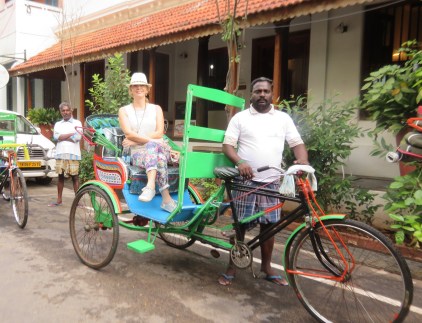
At Maison Perumal, we ‘feel’ the ethos as we appreciate the attention to detail in the restored building, its second story evoking the French style with stained glass windows and authentic furnishings. This was often the case in a Tamil home, the marrying of the Tamil and French style. We enjoy local cuisine and an opportunity to tour on a trishaw. “We’ve engaged locals to do these tours,” Sam said proudly. “It helps support the community.”

One morning during our stay, a kolam is being chalked in the courtyard as we make our way to breakfast. It is a morning ritual for the Tamils (as in other parts of India) to create a design in the courtyard and at the home’s entrance. They are delightful either in their simplicity or in more embellished artistic forms, although decoration is not the main purpose of a kolam. Traditionally drawn from rice flour it welcomes people, small creatures and even deities, not least of whom is Lakshmi, the Goddess of prosperity and wealth.

The patterns range from geometric drawings around a matrix of dots, to free form art work and closed shapes. Folklore has evolved to caution that the lines must be completed so as to symbolically prevent evil spirits from entering the inside of the shapes, and thus from the inside of the home.

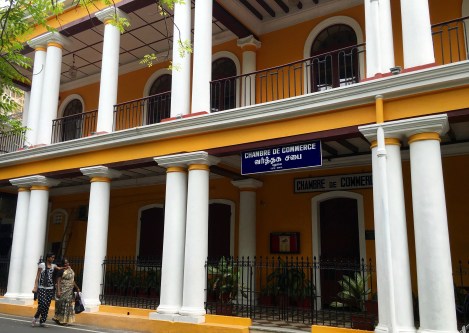
Such ancient traditions such as these are still a part of every day life for the people in the Hindu enclave. The French quarter gave an entirely different sense of time and place. Puducherry, or Pondy, as the locals now refer to their city, has been a base for trading since the early 1520. Of the Europeans, the Portuguese were here first to trade in textiles; the Dutch and the Danes followed. But it was the French who rebuilt a prominent fortified town and a thriving port of call, despite the British (in nearby Madras) razing most of it to the ground in 1761. The Treaty of Paris returned Puducherry to the French in 1763 and they quickly rebuilt. Today its unique charm captures the romance of those early Colonial days; of retreating  from the punishing heat on breezy verandahs after a day of trading those sought after commodities: cotton, indigo, cinnamon and cardamon, coffee, mehe pepper, cowrie shells and Chinese porcelain. They all passed through the warehouses before journeying, east to west.

IMG_4483

The respite of a colonnade portico

The French quarter, home to the French and other Europeans was dubbed ‘white’ town. Their homes and public buildings mirrored the upper-class French style. Imposing gates hinted at the prosperity of the owner ensconced behind high compound walls. They hid lush garden courts and verandahs decorated with exquisite scrolls and floral motifs. Ideally facing the sea breeze, the colonnaded porticos were essential to day to day life as the settlers coped with the extreme heat and humidity –entertaining staved off the sometimes interminable boredom of life in the Indies.

Women of the day visited, gossiped, read and wrote short stories. Tales were told of ‘Indian culture’ as they perceived it to be. Their interaction with the ‘natives’ was restricted to a minimum – mostly to their staff of butlers, gardeners and servants, and punkah wallahs who ensured a constant flutter of air from delicate wicker fans. Every good home also employed palanquin carriers who transported their sir and madam in improbable style. The large box-like contraptions with shuttered windows and a long pole on either end, (handles for the carriers) allowed residents in the French quarter to ‘hide away’ as they made their way through the streets.

We take a tour with Ashok who works with INTACH, the Indian National Trust for Art and Cultural Heritage. Their mission is to preserve heritage buildings, save them from further dilapidation, breathe life back into their storied pasts. We’re told the old town is in danger of losing its unique charm if more treasured buildings cannot be rescued. Along with the beautifully restored we see once-proud homes, shops and government buildings, lingering and neglected in a slow, sad demise.

Ashok leads us to one of the loveliest of the restored mansions. As we enter through the gate to a stately, white and lemon-hued mansion, there is complete silence despite the presence of many women. They sit embroidering, the chirp of birds and the rustle of palm leaves their gentle sound track. “This was the French Trading Company office and then the Governor’s mansion,” Ashok tells us. “Now run by the Sisters of Cluny Church, they train and help underprivileged ladies through their embroidery work.” It is an uplifting setting and a noble venture – an example of the practical possibilities of preserving the legacies of bygone years.

IMG_1002

Embroiders at work in a peaceful setting

Deciding to stay a few evenings in the French quarter, we meet Chandra, a lovely young Parisian. Along with her cousin Ryan, she is the acting proprietor of La Closerie, Bay of Bengal. The guest house is a combination of an old French home and a new annex that melds together seamlessly.

“My mother bought the colonial home about twenty years ago. It was restored and extended four years ago, I’m here to manage it for a year,” Chandra says. She mentions the contrasting pace between Pondy and Paris. “There are quite a few of us French here with Indian roots. It’s a vibrant community, a unique opportunity to spend a year here.”

Chandra is one of many French men and women we meet. When the French left Pondy in 1954, many residents retained Indian citizenship and property, even those who chose to return to France. While some descendants benefited from inherited homes, others found it to be a burden and unable to meet the cost of refurbishment.

Jawaharlal Nehru himself, who in 1947 became the first Prime Minister of Independent India, made it a point to preserve the unique heritage of this once French India. “I want Pondicherry to remain a window of culture,” he had stated. And indeed through the efforts of INTACH and other committed bodies like cgh, Pondicherry is trying to do just that.

We take a late afternoon stroll along the sea front, joining the locals taking in the salubrious sea air. People linger in groups conversing, or ponder alone matching the brooding sky over the Bay of Bengal. The weathered lighthouse looms over the crowds, once more useful when it guided trading ships into these shores. Sculptured pillars from an ancient fort stand guard over a statue of the revered Ghandi – a statue of Nehru stands close by. The scene is much changed since boatmen and tall ships crowded the jetty, and the more somber history of Pondicherry’s colonial days unfolded– the shipping of thousands of Tamils as ‘coolies’ or indentured workers and slaves.

But for now we leave the sultry beachside with its gentle waves, with its people – French, Tamil and Muslim living harmoniously. A place where time stands still yet moves cautiously forward. One last time, we cross back into the Tamil quarter…there’s the Grand Bazaar to visit and that train passage to reserve back to old Madras.

13918635_2804075711565_2100690531_o-2

Postcards from Malaysia…a writer’s journey

Standard


IMG_3238 (1)

The past few months have found me researching, interviewing and penning. I’m involved in a book project which is endlessly engaging and challenging.

With a team of writers, photographers, a brilliant designer and project manager, we collaborate from various countries –yet happily rendezvous for some eventful on-location forays. It’s an interesting journey as I delve into the history and culture of a place that I am now very familiar with… Penang, Malaysia.

With trips of discovery and a recent getaway to Borneo, experiences gained and people befriended continue to make this the most rewarding of times.

Thankfully our home in Bangalore, India, is now ‘settled’ with the arrival of our shipment which most definitely took the ‘long way around.’ We have an eclectic mix of old and new, from here and there; Omani, Indian, Chinese, Malaysian, Middle Eastern and Thai…and some wooden skis propped in the study to remind us of home.

The guest-rooms await a visit from our sons in the not too-distant future and our adopted family has grown by one. Preya joins us three times a week – her spicy South Indian food is scrumptious and help in the house is much appreciated as another month of work ensues. All is well in the neighbourhood; the monsoon rains are expected imminently, Munglora has procured a charming ancient scale for my new kitchen and without a doubt, the roof top yoga kept me sane.

A good friend commented that I was fortunate to have this ‘mountain to climb.’ Indeed it does feel like a wonderful, steep journey, one that I could not have imagined two years ago when I set out with my blog…it feels quite surreal yet natural at the same time.

So for the moment, just a few of my favourite images from the adventure thus far…many kind thoughts, Terry Anne


IMG_3283


IMG_3867


IMG_4078


IMG_0130

IMG_9498


IMG_0758


A vibrant Indian neighbourhood…under the shade of a rain tree

Standard
IMG_2537

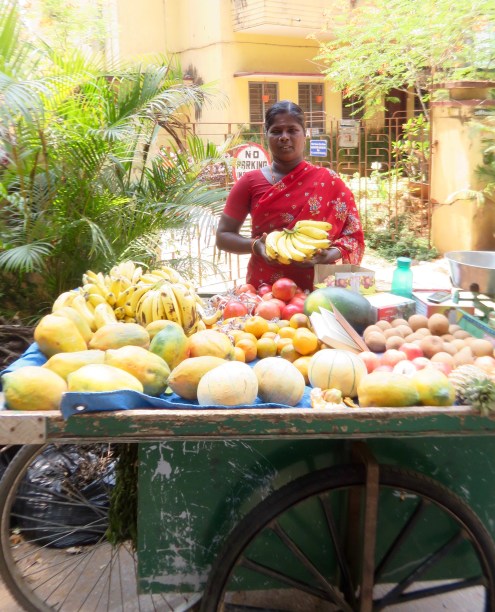
The neighbourhood fruit vendor

The lyrical calls of the wallah echo through our tiny street…fruit, vegetables, papers, knife sharpening, and the call for tea…chai! These vendors, with well-stocked wooden carts and bicycles, are still part of the fabric in this traditional neighbourhood.

Our move was only days old when I first heard this chant. As I lingered with my Sunday morning coffee, I heard the rising pitch of a female voice. The words were unclear yet the entreaty to ‘come buy’ unmistakeable.

“That must be a wallah!,” I said expectantly, rushing to gaze down to the leafy street.

The vendor was wearing a vivid red sari, contrasting her laden, deep green cart. Hurrying to the street, I meet my new fruit seller, Munglora. She greets me by removing the tiny red dot, a bindi, from her forehead and placing it just between my eyes, “welcome,” she says with an engaging laugh. Despite the language barrier, I can tell she’s a character.

I gather strawberries, melons and pomegranates for ‘a song’, yet discover that like an excited child, I had only rushed down with a few rupees in my hand. “Ok, ok,” says Munglora and jots down the amount owing in a faithful ledger. She’ll be sure to see me next Sunday this way.

A few of the neighbours make their way from their aging villas. Their friendliness is matched by their curiosity about this new couple on the street, “Where are you from and do you have children,” they want to know. It seems a little more acceptable that we’re so far away from our sons when I tell them they are studying and that by co-incidence, our landlord’s son went to the same university/college as I had in Canada. “What a small world,” we all agree pleasantly.

Munglora has parked her cart near the tall school gate at the end of the street and the impeccably uniformed school guard soon introduces himself. It’s obvious he takes pride in his long service to the Bishop Cotton Boy’s School. Built in the 1860’s, it’s one of the oldest institutions in Bengaluru and I gaze beyond the gate towards the Colonial style buildings with their terracotta tiled roofs. Oh how I hope I’m offered a tour of the grounds one day!

These authentic encounters validate our decision to not live in the confines of a walled compound. After much deliberation, we chose a beautiful apartment in the heart of the city. It’s unexpectedly modern with cooling marble floors and generously spacious for this urban location. Best of all, our terrace is shaded by a canopy of massive rain trees, impossibly tall coconuts, mango and bamboo.

IMG_2609

Under the shade of a rain tree

They shelter the headmaster’s garden below, its calm interrupted twice daily by the  passing flow of students. The morning security guard motions to school children in starched white uniforms to hurry, hurry, as they jump out of a car or auto- rickshaw and rush the gate, late for class. Mothers wave their student goodbye as they disappear into the lush grounds…phew, made it just in time! I hear cricket games in the distance, the national anthem and school announcements…all a pleasant ‘commotion.’

IMG_2584

The rush of school pick up

We soon discover the school has also given us a music studio…serenades drift up to our terrace, strains of Adele, jazz and snippets of Indian folk. It blends with the headmaster’s menagerie of ducks, honking geese and a very plump turkey who fans his plumage and makes his presence known with long, squeaky honks. Thankfully, pleasant birdsong and chatter of hawks, pigeons and parakeets soften the soundtrack.

“Monkeys pass through about twice a year,” my landlord tells me as we appreciate the vista from the terrace on the first day. He laughs as I recoil, my lifelong fear of monkeys revealed. We’ve had a comfortable rapport since I first viewed the apartment and he’s obliged us with window treatments of our choice and painting in a shade complimenting my Indian inspired decor of lanterns and silk cushions in gorgeous hues of duck egg green and soft blues.

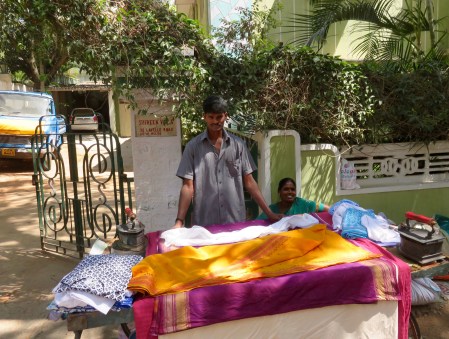
I feel further spoiled when I realize that an iron wallah sets-up in the shade of the doctor’s garden across the street. The first day, I take over five shirts to be ironed “50 rupees,” Laurence says, shyly glancing up from his coal-powered iron. I ask how long the coal stays warm in the hefty contraption. “Two hours,” I’m told and when I attempt to tip an extra 20 rupees, Laurence returns it to me. Five beautifully pressed shirts for about $1, his rate the same for all. There is help of every nature in the neighbourhood and I understand that it is both our pleasure and an obligation to avail ourselves of these services…it’s expected.

“Anything, anything at all you need, you go to Anand,” the landlord insists. Part of the small ‘family’ we seem to have adopted is this young man with a ready smile and his finger on the pulse of it all; cleaners, internet hookup, pest control, repairmen. Anand is the acting boss of the other ‘family’ members of this five apartment complex including the maintenance and sweeper fellow, the drivers and the security guard who is never far from his post at the gatehouse.

IMG_2773

Villas standing their ground against modernity

Every time my husband passes our guard, Rajesh Kumar, he is given a quick salute. Our Rajesh isn’t as well turned-out as most of the guards, but he is always gentlemanly, insisting on carrying my shopping up the short flight of stairs to our wide, welcoming front door.


IMG_1672

A welcome tilak and a vase of ‘eight-hundred roses’

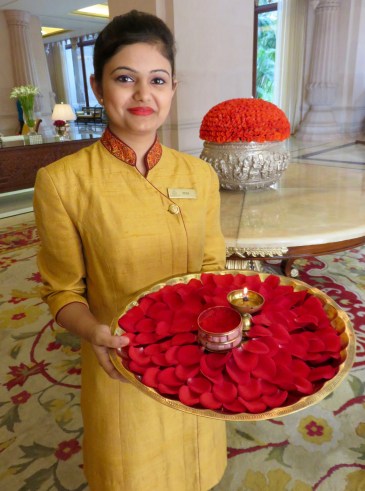
At one end of our short street stands the Bishop Cotton gate, the other intersects with a tree-lined road dotted with bars, restaurants and older villas that stand defiant against the onslaught of development. They contrast a handful of nearby hotels where one can disappear into storied luxury; where doors are opened by resplendently attired doormen and vases of eight-hundred roses welcome in sparkling lobbies. Where one is welcomed with a Namaskar and approached with a tray for the tilak.

This is the welcoming ceremony of dotting a small dab of vermillion or sandalwood on the forehead, just between the brows. This is believed to be where the spiritual eye resides…the place of latent wisdom. And unlike Munglora’s self-adhering bindi, these are more ‘permanent.’

Close to all of this is the ‘lung’ of the city, Cubbon Park with ample walkways, jogging paths and bike trails shaded by silver oaks and Cook pines from Australia. “If they were to ever diminish this park, there would be riots in the streets,” a fellow park enthusiast tells me. I believe I’d join in – it’s imperative that Bengaluru safeguards its dwindling greenery.

IMG_2753 (1)

Architecture contrast, looking out from Cubbon Park

We visit the Bangalore Club built during the British Raj for the pleasure of ranking officers and officials stationed in this former cantonment area of barracks and regimental head quarters. This club is redolent with history and after a swim or game of tennis, one can quench one’s thirst with a sundowner in the ‘Men’s Lounge’ (women now allowed) where Winston Churchill still has an unpaid bar bill and a stuffed leopard recalls the pursuits of hunting and gaming…it’s as if you have stumbled upon a movie set.

We continue to explore this past weekend and just a short auto-rickshaw ride away, we find ourselves a little further into the cantonment area. Whether you agree, or not, with this period of history, iconic vestiges of it remain. From 1806 to 1881, this area comprised the largest British Raj cantonment in southern India. We seem to find the old residential area. We peek behind crumbling stone walls where once stately bungalows are strangled by overgrown gardens and telling shop signs cling to redundant buildings.

We’re welcomed into the superbly maintained St. Andrew’s Church and our eyes are drawn to wall plaques that reveal the history of church members in the late 1800’s. People from England, Scotland and Wales, either stationed or chose to make their life here. Some having met their demise from malaria, dengue fever, leopard and tiger attacks…sad reminders of the perils of life in tropical climates.

With that thought in mind, we make our way to Commercial Street to buy mosquito coils and see this lively shopping district first hand. Other than the odd modern shop planted in the maze of crisscrossed streets, we’re transported back to the India of our backpacking days. It is still here; the intoxicating blend of colour, aromas and noise…the stamp of an authentic Indian street. Holy cows hold up traffic, vendors offer an array of goods and artisans inhabit impossibly small spaces creating stunning craft pieces.

We chat with rice and salt merchants, their archaic sign and ‘ancient’ scale an indication of their long standing business. The sellers willingly pose for a photo as does a nearby vendor of saris, an artisan stitching delicate mirror triangles onto brilliant pink silk, a lime juice vendor, a rice grinder, an antique dealer who details the merits of a brass Hindu collectible to me; all friendly and proud of their wares and talents.

IMG_2840

A proud artisan

We are lucky enough to meet Deepa as she sits with other women on the steps of a Marathi community hall, a long way from their traditional Mumbai origins. They’re celebrating a Hindu festival and after a friendly introduction, Deepa insists on taking us to the neighbourhood temple. Once there, yet more women are sitting quietly in the cool of a small temple and smile a welcome as we enter. A private puja, (prayer alcove) is opened for us to peer at the garlanded God and once again, a touch of vermillion is dabbed on my forehead.

IMG_2854

Deepa with her daughter…gathered with friends

“Come back with me,” Deepa insists, “it’s time for the festival lunch, you’ll eat with us.”

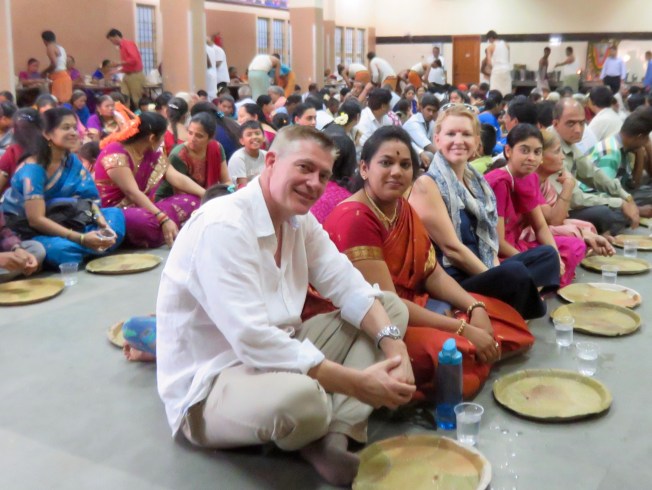
We stroll back through the congenial neighbourhood…circumventing cows recumbent on the cracked sidewalks and nodding ‘hello’ when Deepa is greeted by yet more people she knows. Once we’ve returned to the hall, we find ourselves seated cross-legged on the floor, a hand-stitched banana leaf plate before all two-hundred or so of us.

Deepa’s young daughter sits just behind me and practices her English. Her brother-in-law gives helpful instructions on eating with one’s fingers and the young lady next to me plies me with questions. We are the only foreigners, yet made to feel welcome and I sense they are honoured (and a little bemused) that we are enjoying this festival lunch with them.

IMG_2880

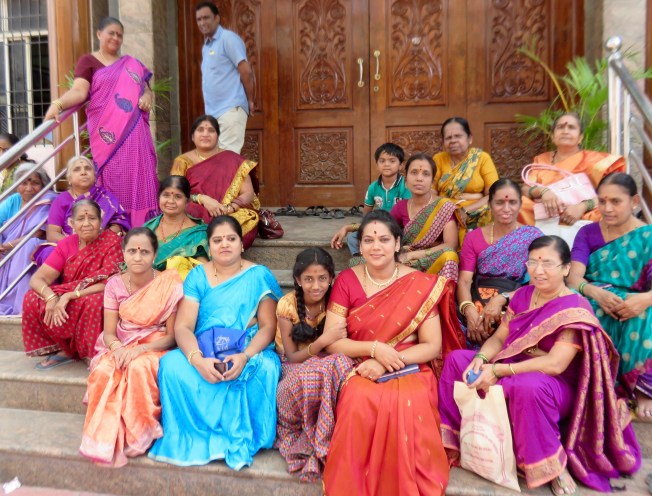
Guests at a community festival

Suddenly, it’s all hands on deck as barefoot young men in sleeveless t-shirts and longhis serve from slender metal buckets. One after another, a plop of rice, masala, vada, raita,dosa, more rice…all eaten with only your right hand. I ask for another popadom as the rice is too hot for these uninitiated fingers.

“Your husband has finished everything,” Deepa tells me as I look over and see his plate wiped clean. Not surprising, it’s the best food we’ve had in the first six weeks in India!

“Did you like it?” our hostess asks as we bid farewell and exchange numbers. “Anything you need at all, you call me and we’ll get together.” We thank Deepa and tell her how much we’ve enjoyed the experience.

IMG_2892

A break on Commercial Street

It has been that way, so many welcoming people from expats, to locals, to transplants from other parts of India; we couldn’t feel more embraced these first weeks.

After the busy weekend, I meet a new friend and neighbour for coffee and I’m pleased with yet more unexpected ‘luck.’

“You know there’s a roof-top yoga studio I practice at. It’s just on the other side of your apartment,” Camilla says, knowing that I’ll be pleased.

It’s too good to be true, literally next door…yet another wonderful discovery of this neighbourhood.

And there will be much to experience and discover once we’re fully moved in, when our shipment arrives from Canada; it seems to be on a world-wide adventure all of its own.

We’ll then wander and embark on trips outside of Bengaluru, into this enchanting land of India.

First, however, I have a book project in another magical country, Malaysia. You’ll find me in Penang the next few weeks..wish me luck!


The joy of womanhood and a Tante… of tulips and hofjes in Amsterdam

Standard

IMG_2279Her name was Klara. She was a true Amsterdammer who rowed the Amstel and cruised the cobbled streets, stylish and carefree on the back of her paramour’s motorcycle.

That was many years ago, just after the second world war, long before she succumbed to old age and a mind stripped of precious memories.

I thought of my deceased great-aunt this past trip as I strolled from my hotel to the FIGT Conference in Amsterdam. I not only luxuriated in the cool air, but in the Anton Pieck perfection of doll-like houses along serene canals. I take my level of comfort here for granted, yet I owe much of that to Klara who shared it with me eagerly from my first visit.

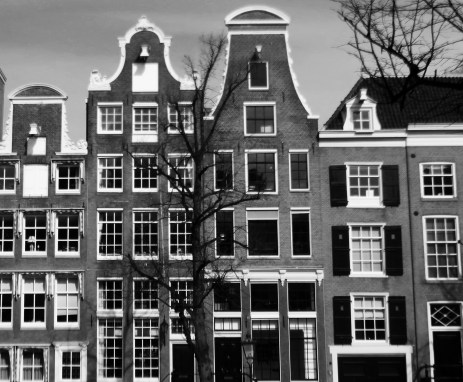
Not long out of college, I fell head over heels for this city of Rembrandt and IMG_2219Golden Age architecture, of stout upright bikes and tulips in infinite bunches… of tall homes with gables of necks, steps and bells.

From her simple, postage-stamp sized home, Klara seldom joined me, but would send me forth with explicit directions to explore. Then on my return would relish in every little detail.

To my delight, Klara’s book-shelf was stuffed with musty history books about Amsterdam. After thumbing through them, I would return them exactly to where I had found them. In a small space, everything has its place and Klara liked things just so. Klara could be stubborn and delightfully opinionated (a little like all of the women in our family) but she grabbed life and dangled it enticingly before you.

IMG_2490I keenly felt Klara’s absence one chilly day while exploring. I warmed in a simple cafe; one that serves mushy pea soup and burns long stemmed candles on scratched, worn tables. One where velvet curtains encircle the entrance to keep out the draft – where locals linger over a Heineken.

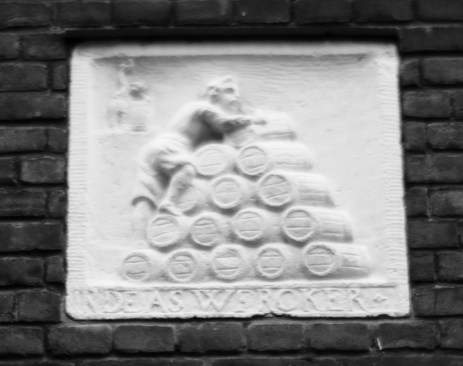
I found myself in the Jordaan. This had been a working class neighbourhood where tanneries once bustled and where masons and road builders had lived. A place where still today, stone carvings on building fronts tell stories. Ah, there lived the cobbler, a builder, a mason, a cooper, or a seller of hot water and heated bricks for warming your feet. Much needed when the fog and damp settled over the canals and froze you to the bone.

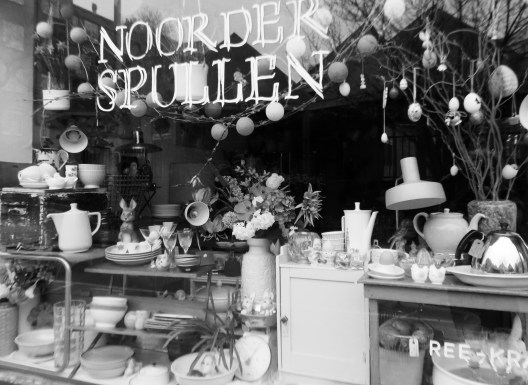
IMG_2494These chiseled cartouches implore us to slow down and conjure that time. I also come across shops that aren’t fancy and offer ‘stuff’ spullen, places where one can browse endlessly. I see a vision of Klara’s home that once proudly displayed all the trinkets gifted to her and wonder where it had gone.

IMG_2453

Yet as much as I miss Klara, I hear her Dutch accent echo in other women that I have the pleasure of meeting during my stay. One another day, I’m befriended by Patricia at the Van Loon Museum; her English has the same cadence and warmth.

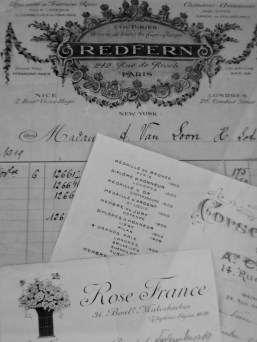
“Are you enjoying the exhibit?” the stylish woman asks as I’m intently perusing faded receipts from Parisian corset and lingerie shops. They’re arrayed beside an ‘evening wear diary’… so vital was it to not repeat frocks and evening gowns in the social whirl of a wealthy Dutch family at the turn of the century.

Patricia and I continue together, marvelling at the exquisiteness of The Mode Exhibit. We appreciate collections of jewellery and fine beaded handbags, then transfix on the lush fabric wall-covering that adorns this stately mansion. We admire the chandeliers, detailed family portraits and even modern-day tulips and perfumed roses. It all brims over with the richness of, simply… beautiful things.

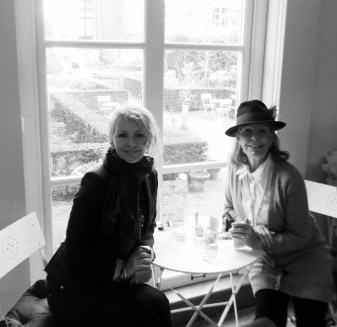
I sense Patricia is familiar with the giddy lifestyle of cocktail parties, soirees and lovely homes as she relates her swinging Paris days. She’s a striking, refined lady of a ‘certain age’ and reveals more about herself over a cup of strong Dutch coffee.

“I’ve had it all,” Patricia tells me, “now my life is art galleries, museums and concerts.” It seems this cultured life suits us both and as if to prove it, she implores…

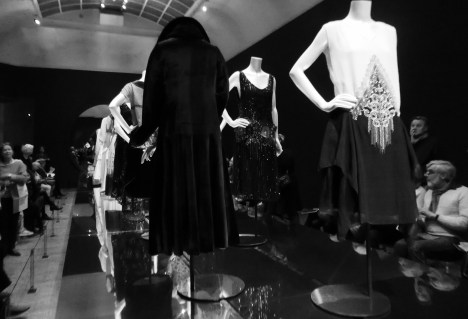
IMG_2207“If you like this, you must see the Catwalk IMG_2192Exhibit at the Rijksmuseum.” Off we go on the sun-drenched yet brisk day, to soak up yet more exquisite fabrics and designs. Gathered from centuries past and as early as the Golden Age when Dutch culture was at its zenith, the creations rotate slowly on a long oblong stage as if on a sumptuous sushi belt. Enthusiasts of all ages sit at this avant garde fashion show, coveting the delicate, aged designs.

IMG_2241 (1)“Oh how my Tante Klara would have loved this,” I proclaim to my new friend. I relate how years ago Klara had given me a black lacy dress, sleeveless and hand-stitched. She had once worn it with panache; I was thrilled to have it as mine and wore it with infinite pleasure. Klara’s seamstress eye would have devoured this collection that was swirling slowly for appreciative fashion- lovers.

Patricia and I admire the ‘poster’ of the exhibition. Model Ymre Stickma’s image is super-imposed into a print of the voluptuous wedding dress, the elaborate masterpiece of the collection. Captured by the renowned Dutch photographer, Erwin Olaf, her hair is deliciously coiffed and her décolletage devilishly exposed; it was the ankles during that period that were seductive and kept hidden under heavy hems.

I take a photo of Olaf’s work, brilliant in its marrying of classic fashion with the vitality of a beautiful, empowered young woman. Prachtig, prachtig, I hear Tante Klara’s approval… superb, superb!

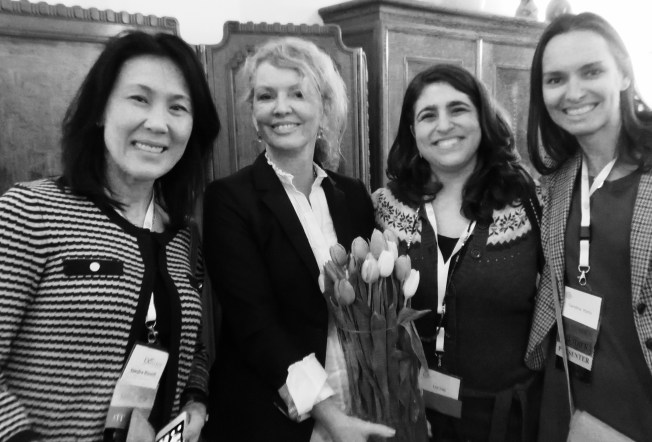
IMG_2214Through the following days I meet many empowered and interesting women. The Families in Global Transition Conference brings many together; they thrive in careers and raise children globally, they are entrepreneurs, authors, publishers, educators, life coaches and more. We network, learn from each other, dine, laugh, lament and celebrate as one. We comment on how fortunate we are to come together, how marvellous it is to share stories of womanhood against the backdrop of a global life. We hug our farewells, restored and uplifted.

IMG_2506 (1)The company of these kindred spirits comforts me in this first return to Amsterdam; the first time that Klara is no longer here. The last few visits dementia had stolen her spirit, her creative and inquisitive mind, and just a few months ago her life.

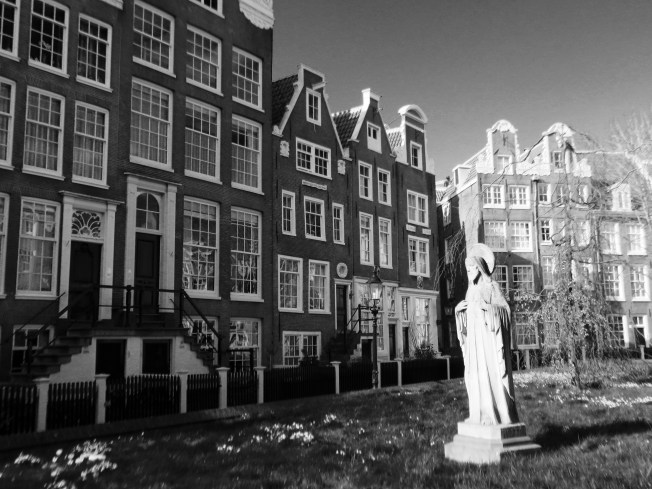
Late one afternoon a few of my friends and I are on our way to dinner. “Come with me,” I say, “there’s a special place I want to show you.”  I guide them off a busy street through a carved, stone archway that reads… Begijnhof. We emerge into a serene setting, the rattle of trams and the whirl of bicycles disappear. The courtyard is quaint with churches and houses that beg you to whisper and reflect.

This tucked-away sanctuary was similar to a monastery for women, the Beguines, a Christian religious order whose members lived in semi-monastic communities. First mentioned in 1346, the Begijnhof is the only medieval almshouse founded in Amsterdam. The last Beguine, Sister Antonia, died here in 1971 and still today, all the inhabitants are female.

IMG_2375Klara first introduced me to this serene oasis, and as I was then, my friends are charmed with its beauty and calm. The houses and churches that line the square are mostly from the 17th and 18th centuries; beautiful in their aged grace as is the elderly lady we encounter.

Shielded from the chilled March air in a camel-coloured fur, an elderly lady has just placed her walker at a solid wooden door. When we ask if she’s fortunate enough to live in this lovely Begijnhof, she nods and points to the first floor. Books crowd her window sill along with one of those simple brass candle holders… all framed by delicate lace curtains.

We introduce ourselves. “My name sounds much prettier in Hebrew,” she says with an engaging smile. We’re pleased when she lingers to speak to us.

“Where are you from?” she wants to know and her eyes twinkle even brighter when she hears that we come from various continents and live in others. Susan is inquisitive and delighted to hear this, then earnestly tells us to enjoy our time together. We bid her a fond farewell and agree that it’s good to know these hofjes were once scattered throughout the city, sanctuaries for women. They still are it seems.

IMG_2444 (1)A few days later I spend the day with a dear family friend, we were both fortunate to have been like the children that Klara never had. Hetty tells me of her final days and the peaceful end.
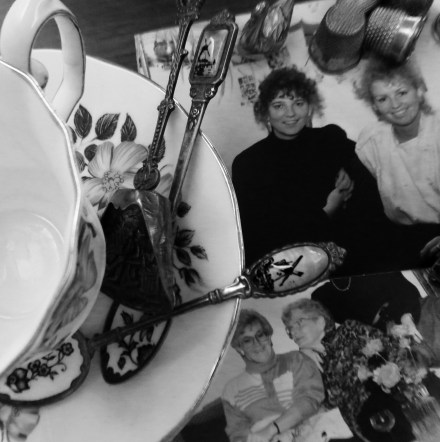
We had planned this gathering to reminisce about Tante Klara. “These are for you,” Hetty says softly, motioning to an array of ‘stuff’ on her dining table… it is heartwarming that it remains.

There are photos albums with dried flowers from my wedding and pressed heather from a trip to Scotland. There’s a tea cup from a visit to Canada and tarnished silver spoons embellished with Delft blue and white. All precious moments in time.

“Choose some jewellery,” Hetty continues, “and I think you’ll like these.” A passel of thimbles lay close by and my finger-tips brush over the dimpled silver. I know that Klara used them often. She loved stitching and creating of all kinds; it’s what she ‘did.’

Just one woman’s pursuit that fulfilled and gave satisfaction. No, her creations weren’t as beautiful as the lovely things this trip has put before me, but that isn’t what’s important. Engaging in anything from stitching to poetry, from reading to golf, to quilting to hiking… anything that we women pursue for pleasure, for the joy of womanhood, is to be coveted and embraced.

IMG_2579The first thing I had done when I arrived in Amsterdam was  buy tulips. “I’ll need a vase for my bloomen, please Meneer,” I had said to my host Pierre when I checked in at the charming Seven Bridges Hotel. As if by design, my room had thick velvet curtains, an armoire and an antique oval table for those tulips. I felt as if I was back at Klara’s.
Before departing from the city that I adore and returning to my new home in India, I posted a card to my mother in Canada.

As a ten year-old, she had waved farewell on the S.S. Waterman as her family sailed away for a new life, leaving not only country but their family. She remembers wondering she’d ever see them. Happily, they have all been a special part of our lives through the years.

That card to my mother was decorated with tulips and I penned details to her; of remembering Klara, the lovely mementos and time with Hetty, and that she had most certainly been there with me in spirit… it seems that Klara had been as well.

Version 2

First Dispatch from India…life amongst coconut groves, drishtis and leopards

Standard
IMG_1102

A coconut vendor in Bengaluru

“Is it possible to wander through the coconut grove,” I ask, gazing out to the enticing greenery that unfolds from my vantage point in the residence lobby, nine stories up.

“Ma’am no, remember the leopard,” I’m gently rebuked. The staff seem mildly amused by this newly arrived resident of Bangalore, or rather Bengaluru to use its traditional name.

IMG_0978

Coconuts, a staple of Karnataka

Yes of course, I chide myself, recalling the front page news on this morning’s Times of India; a leopard attack with two other ‘cats’ prowling this suburb known as Whitefield. Perhaps it isn’t surprising as we’re in Karnataka, a southern state of India known for its jungles, coffee plantations and rainforests…its ancient temples and forts. I gaze longingly at the coconut palms and eucalyptus dotting the open spaces between housing compounds, new apartment buildings and haphazard streets. I’m already yearning for clean, fresh air.

IMG_0983

A warm welcome from Kasturika

Even as a seasoned traveller, I find myself wavering between my usual curiosity and the less familiar sense of disorientation. This city of 10 million might well have become the ‘Silicon Valley’ of India, but the infrastructure hasn’t kept pace with its relentless growth. The roads are chaotic; no lane discipline, precious few lights, cows strolling at will, a jostle of auto rickshaws, cars, hand-painted haulage trucks and motorbikes all vying for space…edging forward, inch by inch with toots and beeps and throaty horns merging into a dissonant musical score. The moment you encounter the streets of India, all senses are engaged.

On day one, we’re welcomed by Kasturika our relocations expert, one of the millions of young professionals who have relocated to Bengaluru. Over the next three days, her insight and sensitivity help us transition as we traverse the city to view houses in various compounds. Some locals choose to reside in these walled oases, as well as expats who find the communities safe, orderly, social and if I’m honest…insulated.

IMG_1006

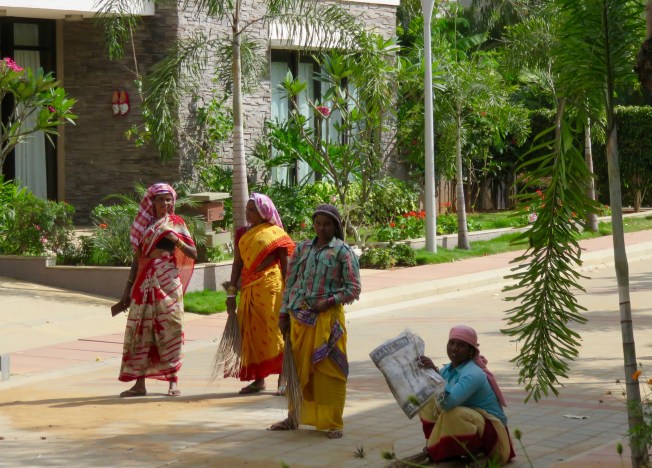
An ‘army of gardeners’

There’s isn’t any doubt as to the privileged life within these protected enclaves. Small armies of workers sweep the streets, tend gardens and guard the premises. Lush landscapes of palms, bougainvillea and fragrant frangipani contrast the street scenes just beyond… where bullock carts amble amidst the traffic mayhem and stray, bone-thin dogs pick at mounds of garbage. Where sari-clad women beg with desperate eyes, precious babies in their arms. Where so many women labour in the sun; digging, carrying, sweeping, and selling, hour after hour after hour.

But ‘out there’ is also where shop vendors smile widely when I pause to buy flowers or fruit. Where a man hefting a coal-warmed iron, working his way through mounds of laundry, greets me with a proud gaze. Where ‘an army of gardeners’ are bewildered when I ask to take their photo, but chuckle and tidy their hair as they pose. Where life unfolds in riots of colour, hierarchies of castes and prayers to a multitude of Hindu gods.

IMG_1283

Hefty coal-warmed irons

I try to marshall my senses, heightened by extreme emotional swings and sympathies.

Memories flood back of the two months we spent backpacking in India years ago and the contrast is surreal. Where once ours was a carefree adventure, we are now in an orchestrated search for a home, enclaved from tumultuous streets…yet part of me resists the notion.


IMG_1321

Colourful ladies sweep in a walled enclave

I flood Kasturika with questions as we crawl through traffic. I sit in the back of the vehicle feeling choked from the poor air quality. I put on my sunglasses and quickly learn to peer straight ahead when there’s yet another knock on my window from a hand outstretched and a plea.

Recalling my ‘First Dispatch from Kazakhstan‘ I know that these initial days are trying and I trust that I’ll settle as I always have in a new country. Yet I admit… I’m in culture shock.

IMG_1019

The daily palm frond collector

It’s a relief that I fall in love with the first house we’re shown. It’s new, with an open floor plan that communicates with the palm treed garden where parakeets flit and papayas thrive. There’s a sparkling pool in the compound and a small shop for basics.

But I’ll have to come to terms with summoning the driver to do any major shopping. It’s uncommon here for foreigners to drive as the roads are too challenging to navigate. I speak with other women about the loss of independence…they say you get used to it.

At the end of the first day, we’re gathered around the residence pool for a cocktail party and we meet young professionals from Denmark, Hungary and Poland, all here on short-term assignments. There is a genuine bewilderment as to why so many international companies have chosen to set up shop in this ill-prepared city; yet the brisk pace of investment continues.

IMG_1334

Flowers on a busy street.

On day two I peruse The Times at breakfast for news of the leopard…still on the loose. A headline jumps out at me that an elephant has run riot in a forest town damaging forty houses during a seven hour rampage.

I note the overt sexual overtones in countless articles and marvel at the detailed ads for arranged marriages, categorized by castes and religions. And it seems most parents have very attractive children…

I’m somewhat charmed when an Indian gentleman approaches my table and asks quietly,

“Have I seen you before? Perhaps in Bollywood, such a sweet and pleasing face.” I’ve already fallen for the charming rhythmic and slightly archaic pattern of speech that is heard here; it sounded lovely of course. I tell him that it’s unlikely as I’ve only just arrived, but thank him in any case.

IMG_1299

A Hindu Temple

“I told myself to let me have the courage and come say hello,” he adds gallantly and politely takes his leave. I chuckle at the Bollywood reference and as I gaze over the dining area I notice a striking young Indian couple that certainly look as if they’ve just stepped from a movie set. A group of ladies chat animatedly, their vivid saris colouring the room. The children of a young Canadian family fill the room with excited chatter, the young Euros are in deep conversation beside me. The cross-section of nationalities is emblematic of modern day Bengaluru.

That afternoon we travel north, viewing compounds removed from the city and the crush of urban traffic. I begin to notice that many of the houses are decorated with a somewhat malevolent looking mask near the front entrance.

IMG_1190

Nazar battu

“Those are nazar battu,” Kasturika tells me, “they fight evil with evil and protect your home or business. It’s an evil eye, a drishti.”  And they’re everywhere, as are temples painted in pretty pastel shades and an inordinate number of roadside fortune tellers. Also in abundance are coconuts; laden on bikes and wheeled carts, neatly stacked with guavas, grapes and more. Caged chickens cluck for sale in shoddy storefronts. I see little meat for sale as it’s very much a vegetarian based diet here. And everywhere, absolutely everywhere are the bright green and yellow three-wheeled auto rickshaws that transport passengers for a mere few rupees.

These scenes unfold alongside IT business parks and modern hospitals, timeless counterpoints to the boom. Late afternoon we make our way back through simple country villages, past fields of marigolds, cows grazing near haystacks and goods balanced on the heads of villagers. The narrow road is busy with bulky, garishly painted trucks that pass dangerously as they dodge cyclists, autos, and bullock carts. I feel the danger factor intensify.

IMG_1254 (1)

An abundance of fruit and vegetables


IMG_1127

The Parliament Building

Eventually we find ourselves near our temporary residence and I’m uncharacteristically panicky. Yet another beggar knocks on my window, a one-armed monkey hops along the roadside wall; I know that’s all I can take for one day and we cancel an evening engagement. As someone who has transitioned to nine different countries, I temporarily surrender and finally find peace by envisioning my pending walled refuge…perhaps I’ll hang a drishti at the entrance as well!

Making our way into Bengaluru proper on the third day, I finally get a sense of how the city looked in the days of the British Raj and why it’s called the Garden City. There are wide boulevards where trees meet overhead; this is where Cantonments were built and where Winston Churchill lived for a time basking in the colonial life of polo, elegant parties and hunts. Old colonial buildings recall the past, massive cricket stadiums fill for the national sport and stately government institutions proclaim India’s status as the largest democracy in the world.

IMG_1108

Weathered old buildings

A succession of South Indian dynasties once ruled this region. In 1537, Kempé Gowdā – a feudal ruler, established a mud fort considered to be the foundation of the city. It eventually developed within the dominion of the Maharaja of Mysore and became the capital of the Princely State of Mysore, existing as a sovereign entity of the British Raj.

In 1809, the British shifted their cantonment to outside the old city and a town grew up around it, governed as part of British India. Remnants from this period dot Mahatma Gandhi Road, or MG as it’s known.

IMG_1405 (1)

Krishna with a ‘Maharaja of Mysore hat’

On MG road we wander into an old bazaar where chits are still used for payments, carbon copies are given to complete the sale and a security guard thumps it with a rubber stamp on the way out; one can’t help but be transported back in time.

A street seller flanks the entrance and is down to his last guava. In a kind gesture, a group of young millennials insist I have theirs to taste. It’s piquant and delicious, sprinkled with an unknown spice. The friendly professionals are also new to this burgeoning city, the capital of Karnataka and pass on some local tips.

IMG_1164

The gift of guava

Our day finishes amongst modern sights of gleaming shopping malls with high-end showrooms and terraced restaurants. Part of me…no all of me…is relieved that this part of the city exists. Where I know I can escape to ‘Western modernity’, yet I know I’ll embrace the rich culture and the mysticism of India.


IMG_1158 (2)

A family in their auto

As we completed our three days with Kasturika, I tell her how much I’ve appreciated her openess to my endless questions.

“Every question is important when you’re thrust into a new environment, especially one such as India,” she responds. And so very true, India’s disparities can overshadow the beauty of its ancient stories echoed in everyday life…they beg to be appreciated for what they are.

We finish the day with a wander along a vibrant street where young people are enjoying a stroll or a drink, as at it would be in any major city. Yet in this atmosphere on a  balmy Saturday evening, a cow saunters past and suddenly there’s a ramshackle mess of a building next to a sari shop that offers valet parking…quintessential India.

IMG_1179

A small auto souvenir

We celebrate the completion of our orientation with the comfort that we’ve perhaps found a home. In probably the coolest Hard Rock Cafe we’ve been in anywhere in the world, we enjoy a glass of the local wine and I pull out a whimsical purchase from the day, that ‘ubiquitous form of transportation’ that will grace my desk and remind me of the trials of transitioning to this fascinating country.

For now, our transportation is in the hands of Shivu, our assigned driver. He collects us and manoeuvres through the gridlocked traffic. I ask him if he has children and when he tells me her name I note that it’s the same name as the compound I hope to live in…surely it’s a good omen!


Post script…At the time of writing, the leopard had been captured but has escaped. It is once again on the loose.


IMG_0975


A Snowy Winter Collection…an antique fur & the new year that awaits

Standard


DSC02065

‘Doll-like’ buildings in Lubeck, Germany

My winter collection isn’t one of lavish coats and fur-lined boots that protect from the frozen air; it’s more a collection of memories. ‘Doll-like’ European buildings dusted with powder-fine snow, simple wreaths bidding welcome to candle-lit homes, snowshoeing through fairy-tale pines.

IMG_4687

Wreaths bidding welcome

It’s usual for me to be home this time of year, in the mountains of British Columbia. I’m mindful that many of my favourite places, my most cherished memories, are of cold countries where a chilled climate quickens the pulse and deepens the senses. Even as the dream-like scenery fills me with wonderment and exhilaration, I yield to the serenity of wintery landscapes.

In a month or so we depart for warmer climes, to our next overseas posting. With endearing memories of the holiday season, these first weeks in January find me calm and peaceful as I’m surrounded by feathery snow, bluebird skies and stately stands of larch and pines.

DSC01976

Old Stavanger, resplendent after a snowfall

At the turning of the year, WordPress has reminded me of the year passed, of the one-hundred and some countries where my blog was read and of those places that I wandered to in 2015; Kazakhstan, Spain, Malta, Thailand, Turkey, Azerbaijan and Malaysia. Most of those destinations are in fact warmer climates, yet Kazakhstan and Canada indulged my penchant for snow.

DSC01913

An antique fur to warm

In Kazakhstan my recycled fur coat from the ’50’s was donned once or twice, melding with the local fashion to combat deep-freeze temperatures. The coat embraced me as we lingered alongside frozen inlets of the Caspian and trudged through snow-hushed Soviet-style streets. Ironically, that coat is packed in a shipment awaiting the next posting, one in which fur will be as useless as cozy mittens and hefty snow shovels.

IMG_4719

Powder-fine snow in Stavanger, Norway

I find a photo of myself snug in the antique fur in another country that I associate with glorious winter days…Norway.

Old Stavanger was resplendent after a snowfall, its wooden buildings a serene backdrop for shades of ethereal whites, contrasted with sprigs of heather and fresh pine on door stoops.

And of that old Winnipeg fur, ideally it should be here in Canada as I enjoy these last winter days before we transition yet again. Instead, I’m gathering my wardrobe of summery clothes to be shipped along with the things we need to build a new nest; collectibles, furniture and books. All that is important…except for our three sons. At this stage in our lives we live in different countries for much of the year; we’re proud of them and supportive, we’ll miss them dearly.

Our family has been happily ensconced under one roof over the holiday season, the first occasion since this time last year. We’ve seen each other throughout the year at various times and places, but to all gather around our table to dine and linger over conversation that we’ve waited a year to enjoy…well, it’s very cherished.

IMG_1135

Tranquility in British Columbia

20160102_111723

Fairy-tale pines

The season has seen us skiing and snowshoeing, playing games, making merry…being a family. We’ve regaled each other with stories and shared plans for the upcoming year. For me the next four months will be busy and challenging; a mentoring role in Amsterdam at the FIGT Conference and shortly thereafter, a trip to Malaysia to collaborate on a book project.

And not forgetting, the move in February to the ninth country that we will call ‘home’. So it seems my new year is to be filled with inspiring ventures and challenges, and most certainly some interesting travels. I wish my readers near and far, a fulfilling year in all the ways you wish yours to be.

But for now, for a few more precious weeks, amidst the planning and preparations, visas and packing, I’ll embrace the treasure that is winter. My crackling fire will warm me and these comforting walls that have welcomed us safely home, will give strength to embrace the endeavours ahead.

But I’d be remiss if I didn’t mention the destination of the impending move…it’s Bangalore. It’s India!


I’ll most certainly keep you posted,

Warm regards and a very fulfilling New Year, Terry Anne


Street Art in Penang…tri-shaws and Chinese lanterns

Standard

IMG_0855If you’ve ever doubted the positive influence of art, you might wish to reconsider. I’m in Penang, Malaysia, where street art has helped revitalize and create a cool vibe for travellers and locals alike.

I’ll be honest, I wasn’t immediately taken with Penang; the street art was bridging a gap until I started peeling away the layers of history that make this island so fascinating. It’s a living testament to its multi-cultural heritage and unique architecture.

Wanting first impressions of Georgetown, the inner city of Penang, I sought out a tri-shaw. Considering the vast number of these well-traveled, three-wheeled contraptions, it felt like the natural way to orientate myself.

“See street art?” the tri-shaw peddler asked as I sunk into his passenger seat, a welcome respite from the long day of travel.

“Sure, one hour please,” uncertain as to how long it would take to see IMG_0724the murals. The vast array of them was a complete surprise. And I couldn’t have known how delightful and engaging they’d be.

The images depict scenes of everyday Malaysian life, with local people and heritage as the inspiration. They’re honest and often fun, a combination of paint and installation; a strategically planted bike, swing, or motorbike, completing the painted scene. Wonderfully, the pieces encourage participation as people pose with the images, creating their own interpretation.

My tri-shaw chauffeur, Mr. Goh, often encouraged me to hop off his ‘chariot’ to take photos and pose. He expertly manoeuvered his three-wheeler through the hectic narrow streets and threaded it in and out of alleyways to find some of the more hidden away murals. Unfortunately, his limited English prevented conversation, but he pointed out each mural with a smile in eager anticipation for my reaction.

IMG_0723We stopped at a popular mural where people waited patiently to pose on the bike while a young couple created their own ‘masterpiece’. They became the star attraction as we all took their photo and chatted amongst ourselves. It’s clear that street art encourages interaction.

Mural after mural was revealed as we made our way IMG_0715through this Unesco World Heritage Site. Named after George III, Penang was ceded to the British East India Company in 1786 by the Sultan of Kedah, in exchange for military protection from Siamese and Burmese armies. The golden age of Penang was soon ushered in with tin, rubber and shipping industries. Other Europeans followed the British, as well as Arabs, Armenians, Burmese, Thai, Japanese and Indians to name a few. The most prominent group were the Chinese and still today, Georgetown reflects the rich layers of culture that they and the other settling pioneers brought with them.

As Mr. Goh navigated through the narrow streets, I soaked in the street scenes of Chinese mansions and shophouses, many having been restored since the Unesco World Site designation. Chinese lanterns decorate most entrances, often intricate, always colourful and steeped in meaning. I peeked inside long, IMG_0714narrow go-downs (warehouses), marvelled at colourful Chinese temples and admired statuesque Colonial-style buildings. Diverse peoples have given Georgetown its fascinating mix of culture and architecture. The street art is a modern extension.

I learned that a young painter, Ernest Zacharevic from Lithuania is credited for many of the installations, but I find out a little more when I have lunch with some new friends today.

Of course some of the conversation touches on Penang and I mention the street art.

IMG_0728
“Yes,” says Geokling, “it’s a good story. And it’s done so much to bring life back to Georgetown, but it wasn’t entirely planned.”

I had been told that Geokling has the inside story of just about everything one needs to know here. Her enthusiasm is evident as she relates the tale.

“This young backpacker comes to IMG_0860 (1)Penang and decides to stay awhile. He does some busking and asks if he can paint something on one of the walls.”

I could understand his mindset as many of the buildings are a little ‘worn’ with faded layers of plaster and paint hinting at years gone by. That first mural drew attention but has since faded. Ernest returned the following year which happened to coincide with the
upcoming Georgetown Festival in 2012 and was commissioned to create more installations. They triggered an overwhelmingly positive response from the locals. The artist said he “was thrilled to unleash the creativity tucked away in the streets.”

IMG_0758“Ernest is a celebrated muralist these days,” Geokling tells me as she scrolls on her phone to show me his latest installation in a Singaporean hotel.

We both agree it’s wonderful to hear a story where a simple passion creates IMG_0871opportunity, when a little luck changes a life. And for the local people and those who visit Penang, the street art is an endearing, welcome addition to the rich culture of Georgetown.

After lunch, I’m given a ride along the waterfront by one of the young fellows who had been in the lunch group. As we pass back along Beach Street, I happen to see my favourite tri-shaw peddler on the corner, just where I had found him.

“Gosh there’s Mr. Goh,” I say out loud, “I’d love to take another tour.”

“Should I let you out here?” Frank asks.

“No, I really shouldn’t, I have a blog to write. Would you mind dropping me off at China House please IMG_0846.”

IMG_0699And so I find myself in the trendy, impossibly long China House that I had been told I must visit. It comprises three heritage buildings linked by an open courtyard that houses a cafe, restaurant, wine bar, galleries and a stage. The atmosphere is indicative of a new direction in this centuries old trading settlement that cherishes the past, but knows it must also embrace change.

“Young people are coming back to Georgetown to hang out,” Geokling had told me. That’s evident this late afternoon as candles are lit and animated chatter floats my way.

This is the kind of place in which I love to write; embraced in the whispers of the past but alive in the exuberance of today.

I look forward to returning next year and peeling back more layers of this treasure that is Penang.

IMG_0749