Tag Archives: travel

Every market tells a story…

Standard
DSC04609

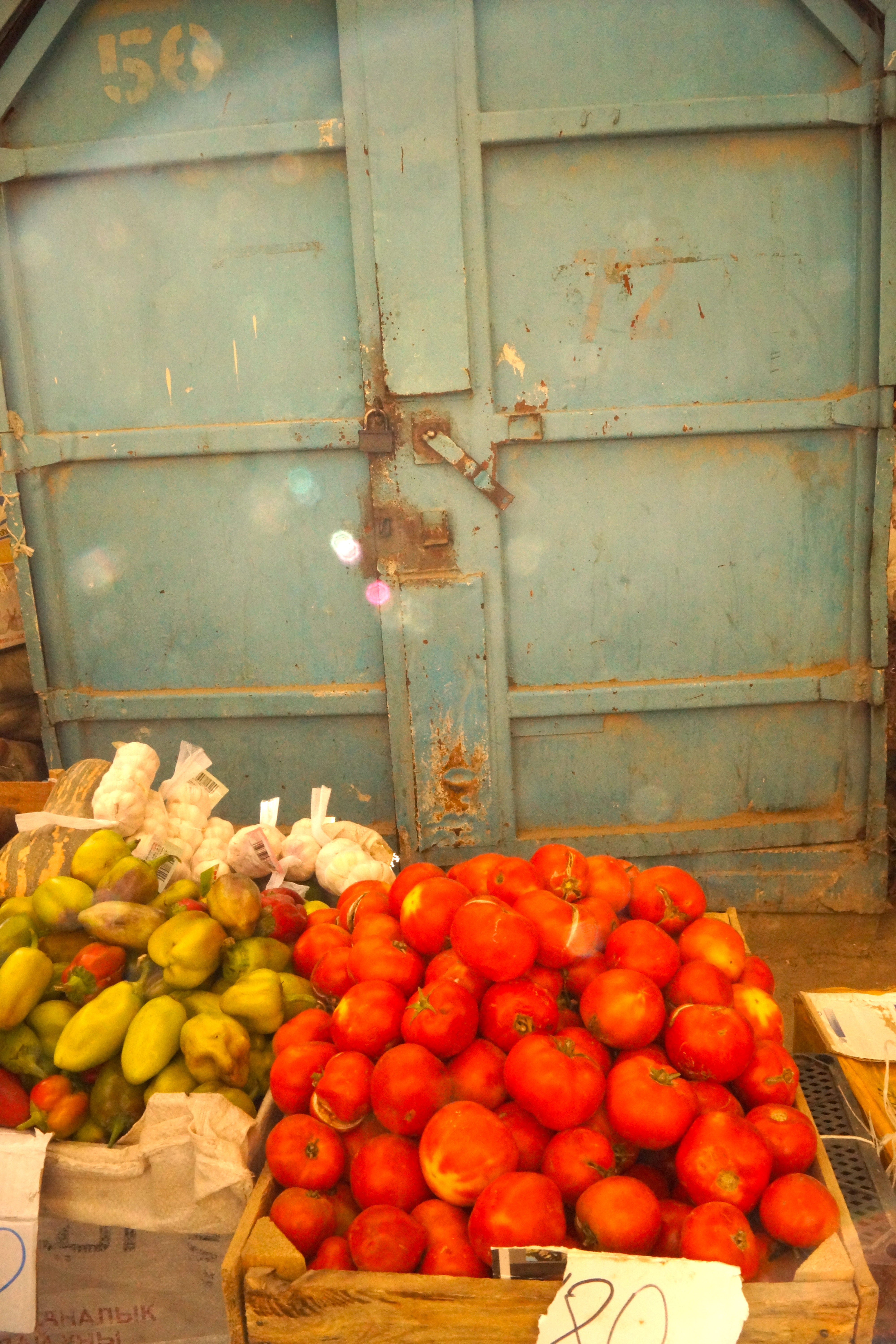
Tomatoes with a story

You’ll remember when I wrote my first dispatch from Kazakhstan I hoped for… “a labyrinth of streets and souks that come to life; exotic scenes, smells and intrigues.” I’m pleased to report that such markets are here in Aktau. They are lively, authentic and represent certain aspects of Eurasian culture and hospitality. Is a market not a place that tells stories and allows glimpses into cultures? I believe that to be true and so I give you….

Three markets known for their meat, fruit, vegetables, spices, plastic goods, cheap clothes and more.
Markets, where many of the vendors are from other lands. Home is Azerbaijan, Uzbekistan, Kyrgyzstan, Tajikistan; all those new Republics that were suddenly cut adrift from the Soviet Union, encountering unprecedented challenges in the years since. Some people have struggled, the next generation has found it easier.

“Many poor people,” Samira, my Azeri friend tells me.

DSC04658

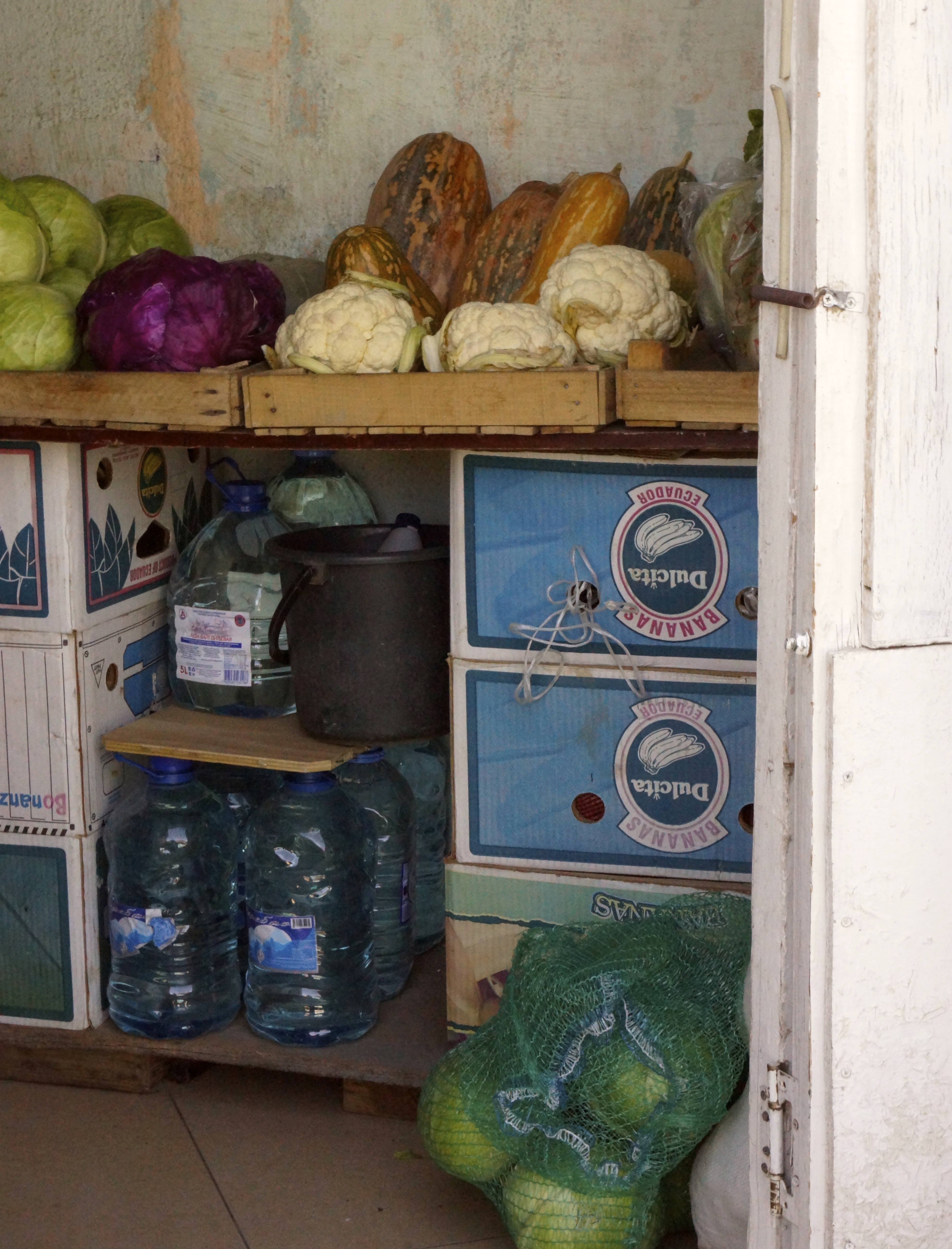
A simple market display

We are at the small Volna Market, stalls and stores just off a busy, main street. When the vendors discover that Samira is from Azerbaijan, she is surrounded.

“Please send greetings back home,” they say wistfully… they seem ever so homesick. A lady with striking red lipstick and tidy blond hair wraps smoked fish, then puts her hand to her heart.

“I’m from Sakhalin, Russia,” she says, seeming lonely despite the bustle around her. Perhaps like many, she was sent here as a dissident, never managing to find her way back home.

DSC06688

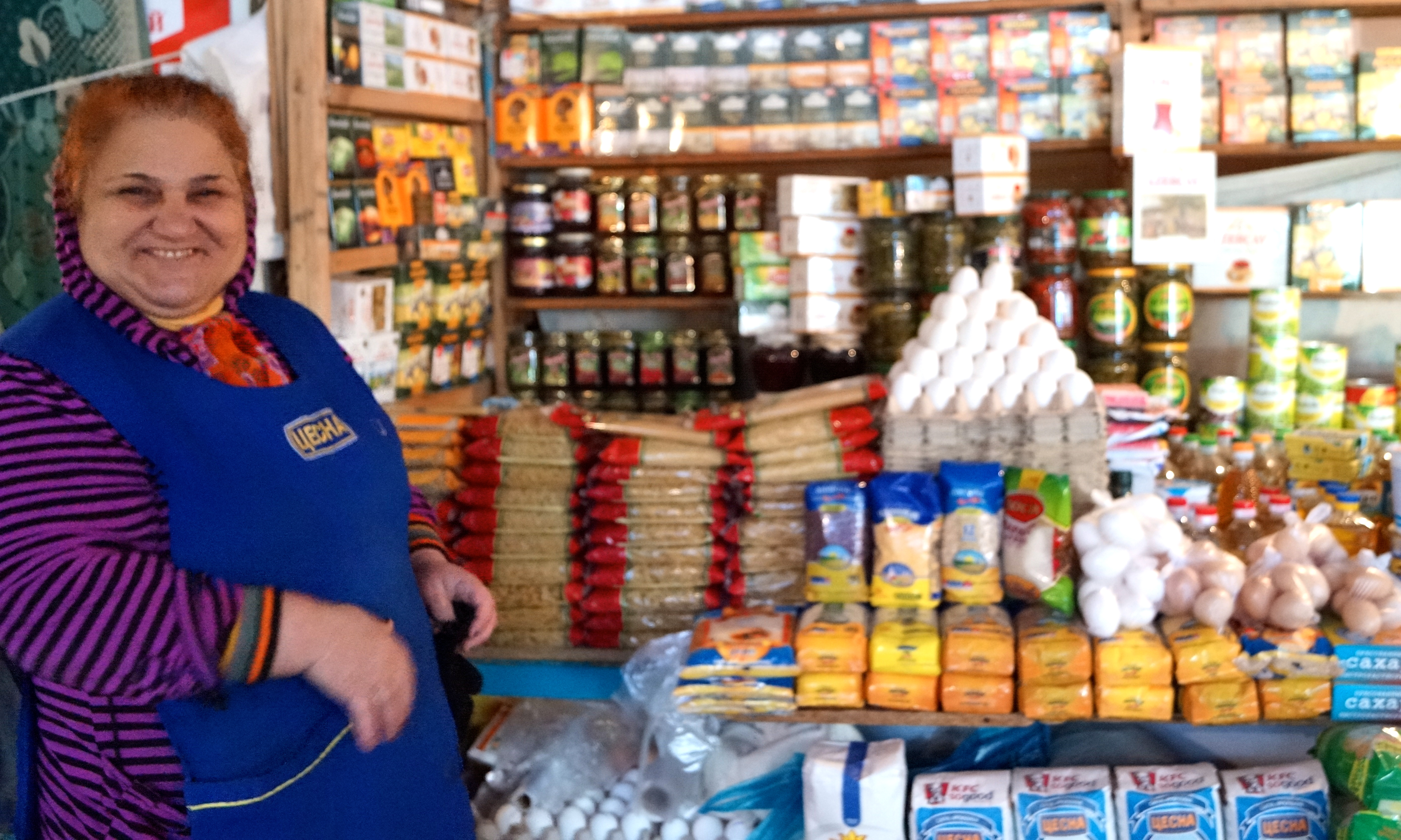
The friendly vendor from Azerbaijan

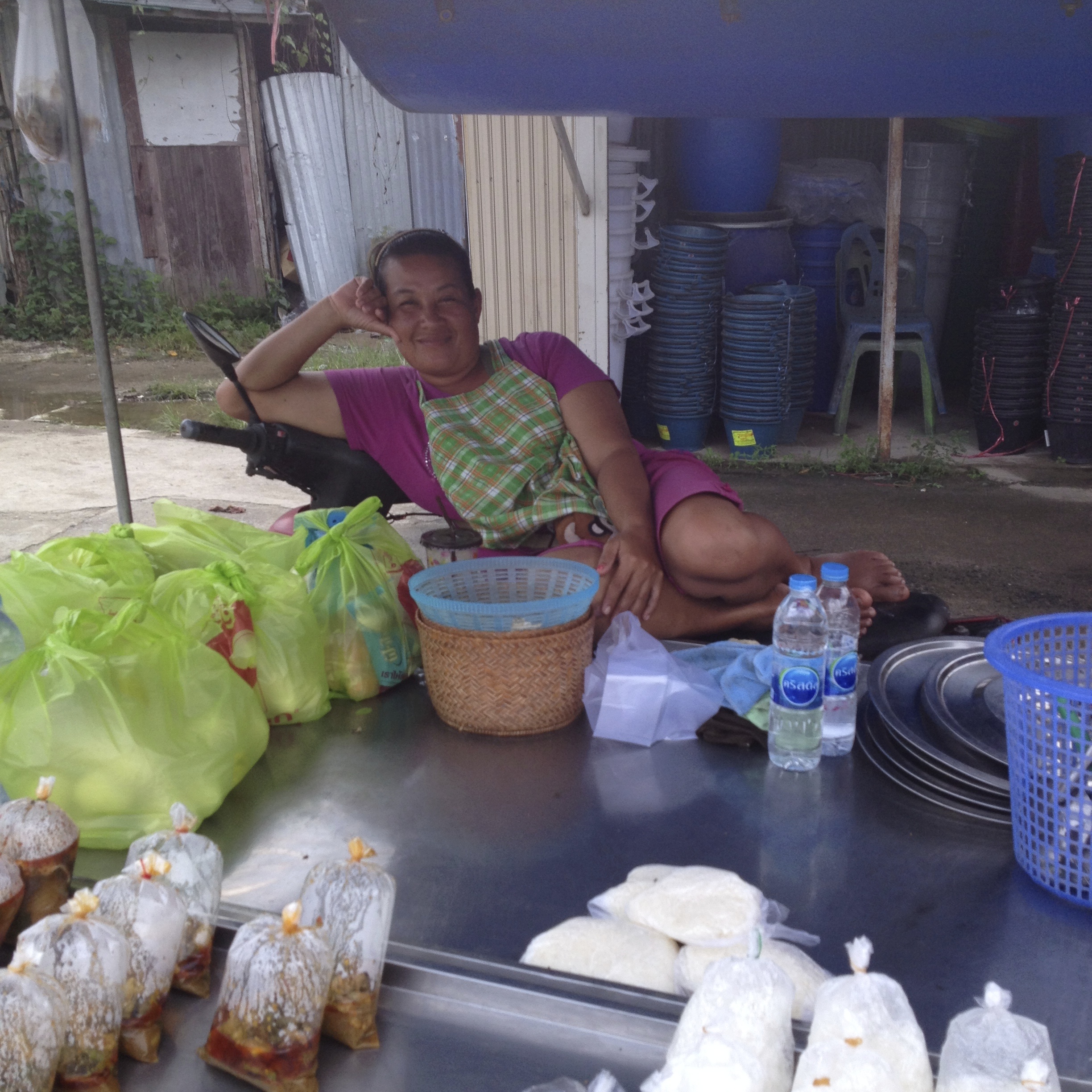
Eager for our attention, the vendor across the way gestures to her pyramid of eggs. I gladly buy some; she is ecstatic to have her photo taken, to have chatted with Samira in her native language. She pecks me on the cheek bidding farewell, pressing her jolly self against me for a friendly hug. Of course, being at the market with a ‘local’ is a different experience. Even our taxi driver has refused to leave us, now willingly laden with our purchases. He chuckles alongside the humourous Samira.

DSC04604

Warm smiles

On other days at two of the larger markets, my husband and I are mostly made to feel welcome. Tea and dumplings are offered, photos taken, stilted but eager conversation. Always we’re asked, ‘Which country are you from?’

“Ah, Canada good, Ottawa?” Our capital they know. Yet on one occasion, we are thought to be suspicious and we’re followed, told brusquely to put the camera away. I comply until I’ve turned the corner.

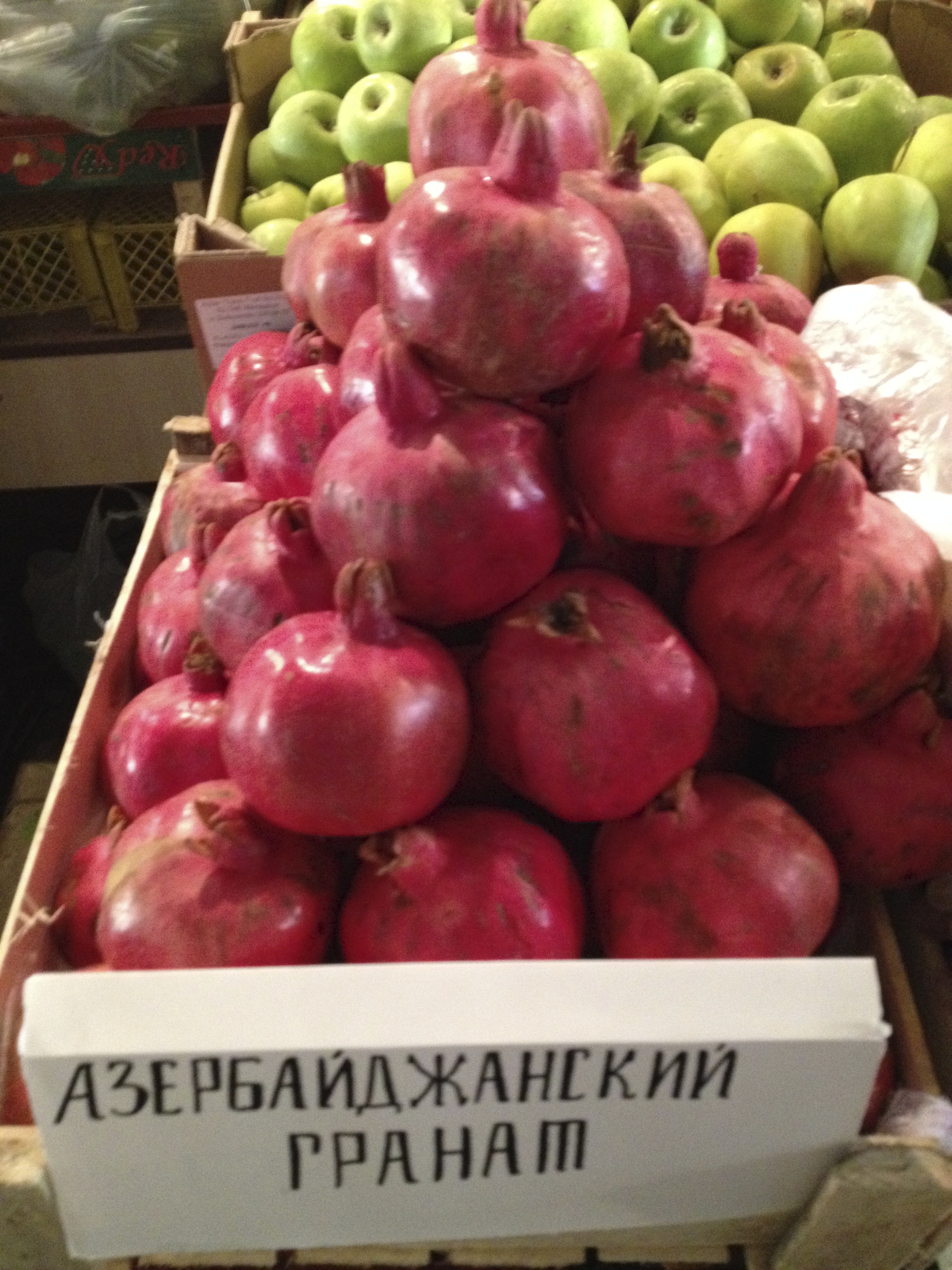
We buy produce that journeyed across the country by train from the fertile region of Kazakhstan, bringing staples such as apples from Almaty. This mountainous area in the Southern part of the country is the ancestral home of the apple… of all apples on earth, geneticists have recently confirmed.

IMG_4236

‘Azerbaijani pomegranates’ and Almaty apples

Many of the ‘greens’ arrive from across the Caspian, grown by the Azeris and the Georgians. The vegetables are plentiful but one day I’m refused service. I’m too choosy about the tomatoes I’m selecting. The vendor shoos me away with a scowl, a holler and a flick of her hand. I’m offended until I ponder, Perhaps her family has memories of the ‘hunger winters?‘ Those that starved, the fate of half of the Kazakh population in the winters of 1931-33, did so because of Stalin’s forced collectivisation.

I regret being picky about which tomatoes I’m piling into my basket. Perhaps everyone should take some over-ripe and some firm, just thankful that there is food.


IMG_3859

The essential sheep’s head

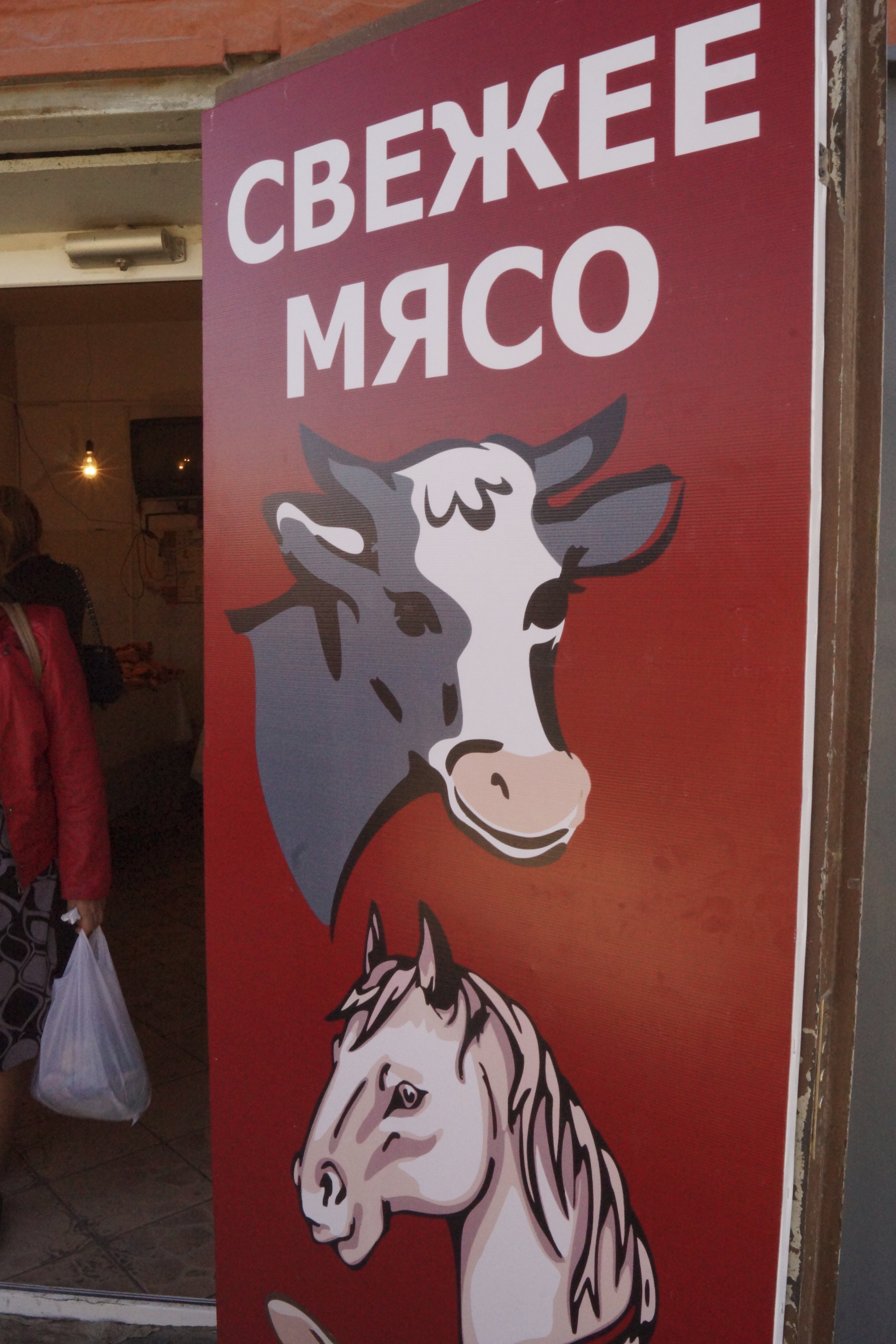
Meat is ample and readily available as Kazakh culture dictates.

Here, they opine that chicken is merely a vegetable; sheep, beef and horse reign. Vital to any celebration, or dastarkhan, a sheep’s head is displayed and served first to the honoured guest. It is then carved bit by bit; a piece of ear given to children, to be careful, to listen well. A smidgen of tongue to become more expressive. The eyes are delicacies, to seek wisdom. The brain, the best bit of all.

The dastarkhan still heeds the ancient ritual of showing respect to guests, to the elderly and relations. Ideally this is accompanied by shots of vodka, with plentiful toasting, usually every five minutes or so. The most senior starts it off and it goes from there. I have experienced this custom often… a toast, a shot (I forego the vodka), a toast, a shot… the third toast always salutes the ladies. I shall miss this tradition, as it poignantly imbues festivities with meaning and respect. Between the vodka, ample food, speeches and dancing if possible, a Kazakh celebration is not to be missed. But more of the ever present meat…

IMG_3861

Bit by bit…

Besbarmak is boiled meat served in large hunks. Shashlik is marinated meat on a stick, often eaten at roadside cafes. Ulpershek is a dish made from the heart, aorta, and fat of a horse. Prepared in a kettle, it’s often shared between sisters-in-law as a sign of unity. Kazy is a sausage eaten in the spring when a cow has a new calf, sometimes served with rice. Mypalau is a dish made from sheep’s brain. Put the brain in a wooden bowl, add marrow, pieces of meat, salted fat in broth and garlic. On and on, go the meat recipes.

DSC04655

‘Fresh Meat’

Kazakh culture dictates that bread is never wasted. Furthermore, Kazakh hospitality demands that one must not leave a house without ‘at least having eaten a crumb.’

IMG_4105

The ‘Naan’ baker

One doesn’t actually see much bread at these markets, but we peek into a naan bakery. The scent of fresh baking from the tandoor enticing us to enter. The baker poses proudly while I openly covet his old, weighty scale.

In our market visits, I had been intrigued by white, stone-like pieces that are displayed amongst spices, pulses and grains. Imprinted with knuckle-marks, they have a haunting story to tell.

In the desolate and remote Kazakh hinterland, once stood the gulag, the network of Soviet era concentration camps. The harsh weather and the impossible distances made escape futile. One such gulag, Alzhir, was solely for women and children. Their only ‘crime’; being, a wife, mother, or child of a man convicted of ‘betrayal of the motherland.’

Local villagers, risking their own lives, secretly tried to ease the prisoners’ hunger by throwing ‘stones’ at them. The guards delighted in this… ‘even your own kind throw stones at you!’ But the ‘rocks’ were actually hand formed, dessicated pieces of cheese curd, kurt. To this day, they are reminders of the repugnant man-made hells and of thousands of lost, innocent lives.

DSC04661

Kurt on display

When I see kurt in the markets, I’m reminded of my Dutch grandmother’s own wartime experiences. She would tell us sternly, yet lovingly, that ‘alles moet op’ – you must eat everything on your plate.

DSC05555

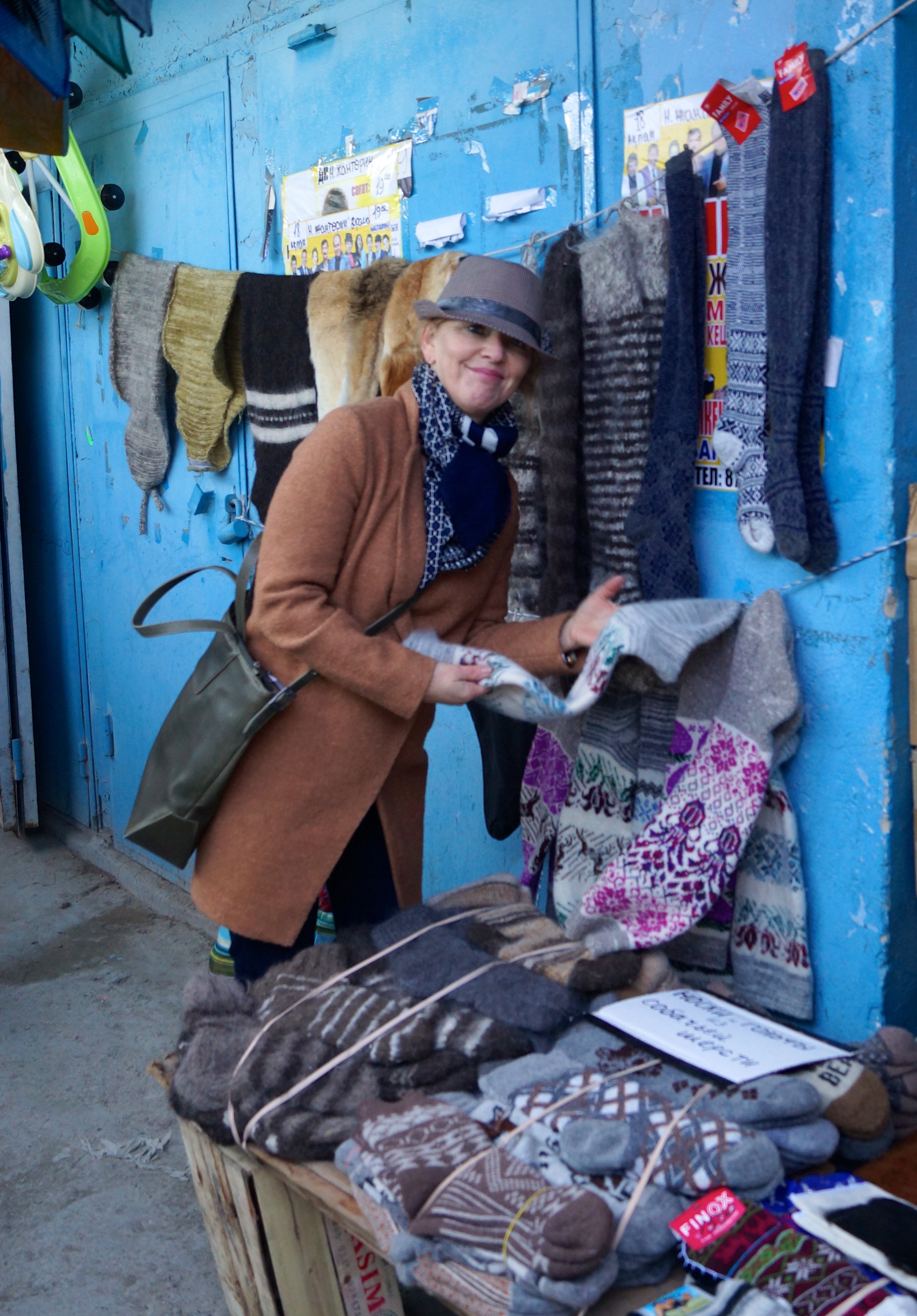
Knitted socks…from women prisoners

On a chilly day a few months ago, it wasn’t food that I bought at the market, but something to warm me. Two things in fact, both reminding of my stoic grandmother. First, a cozy pair of knitted socks, crafted by women prisoners out of dog hair. I remember my grandmother often knitting or crocheting. Through her life she also embodied resourcefulness; drawing from her frugal upbringing, from raising children during the Second World War, to the harsh realities of being new immigrants in Canada.

Across the alley, a welcoming lady nods to her wares; she has crocheted slippers. They are just as my grandmother had made for me. I remember choosing the colour of Phentex I wanted; they are long since frayed and worn.

DSC05522

‘My grandmother’s slippers’


I take my time deciding on a pair, thinking of Margje, knowing she’d be amused at finding ‘her slippers’ in such a faraway place. And the story of the kurt would have resonated with her, having suffered through her own ‘hunger winters.’ I think of her, and of all the ladies whose own trials are etched on their faces. I can’t hear all of their stories, but I can look into their eyes with sincerity and a smile, I can make contact. There is no language barrier to that.

IMG_4111

New friends from Uzbekistan, after tea and dumplings


DSC05539

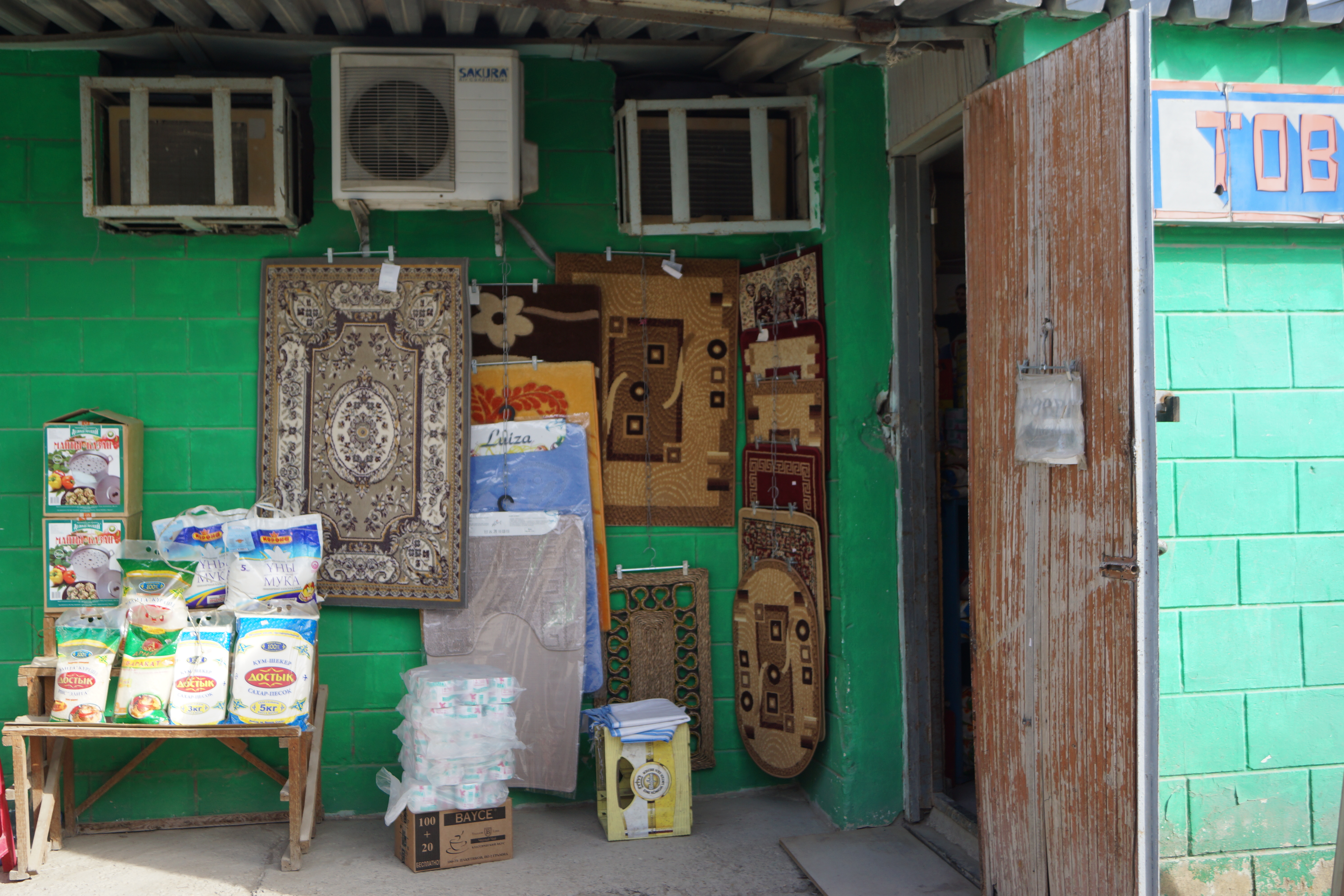
A mishmash of goods

DSC04620

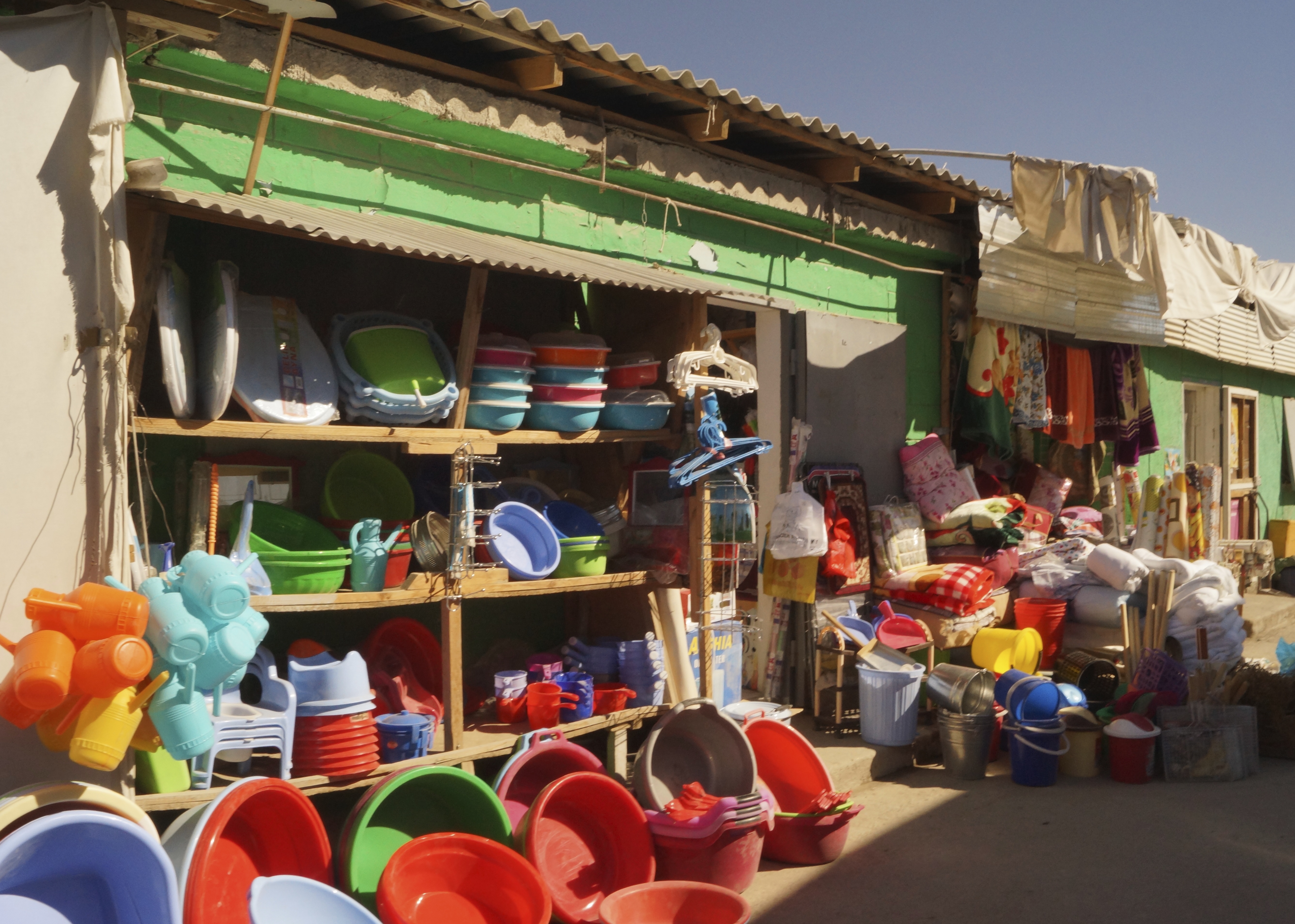
A rainbow of plastic


A lovely Kazakh bride and her ‘prince of the hearth’…

Standard
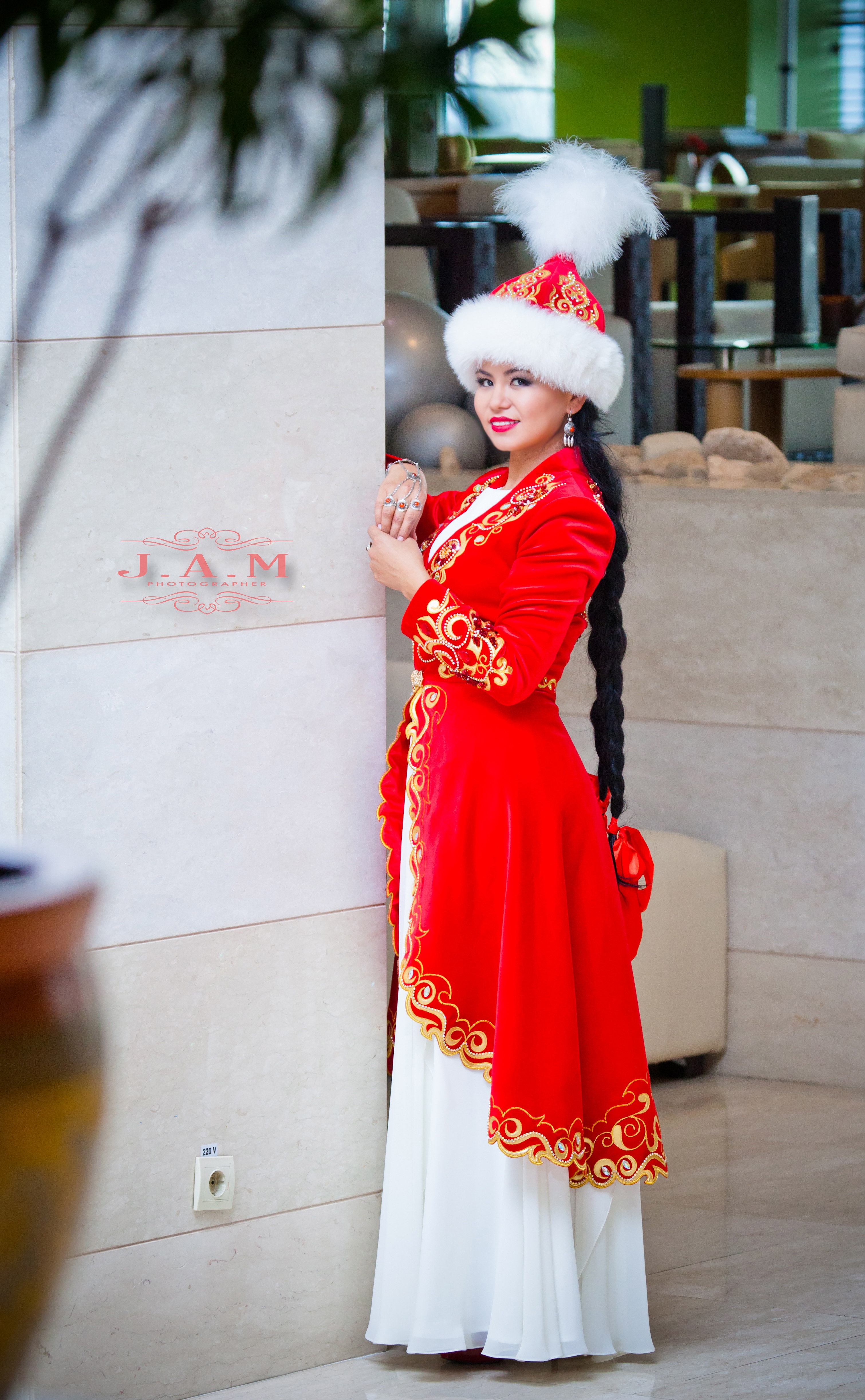
J.A.M. Design (5)-3

The lovely bride, Rysgul at her ‘first’ wedding

I first met Rysgul at our hotel where she works in sales. It was a fleeting moment and our paths didn’t cross again until a recent cocktail evening. I was immediately struck by her warmth and we chatted easily.  When I asked what her name meant, Rysgul replied, “It means ‘kind flower.” Her name suits her perfectly; she has a modest grace and classic Kazakh beauty, embodied in dark enchanting eyes and long, glossy black hair.

“I’m a newlywed,’ she happily announced early into our conversation. After congratulating her, I steeled myself to ask the question, curiosity getting the better of me. “Did you marry a ‘prince of the hearth?’ “I did,” Rysgul beamed, “so yes, I now live with my husband and his parents.’ I was referring to the Kazakh tradition of the youngest son taking the role of ‘prince of the hearth.’ It is his duty to live with and care for his parents.  When one marries ‘the prince’ custom dictates that the bride moves to his childhood home. This new extended family isn’t for a month or a year; it’s a life long commitment. Rysgul explained that she was raised to respect this tradition and is proud, as is her family, that she’s now in this role. When I ventured that this would be considered unusual in many Western cultures, she did not waver or appear to desire it any other way.

Rysgul is a modern woman, yet committed to traditions that bind this area of Kazakhstan together, more so than other parts of the country. “I’d love to hear more about your culture,” I said, ‘and of course your wedding. I’m also curious about your striking wedding jackets and the unique hats you wear.’ Having noticed countless weddings at the hotel, the premier venue in the city, the questions were already forming in my mind.

“Yes the kamzol and saukele, we could do an interview if you’d like?” Rsygul responded graciously. What followed the next day was a delightful two-hour conversation and an outing to the award winning showroom, Nur Shah. It was an unexpected insight into the journey of a modern day bride, one that is still very much layered with tradition.

 Where did you meet your husband Rysgul, how long were you engaged?  

We met in a nightclub though neither of us were particularly in the mood to be there. We dated for about four years, but once you get engaged here it all happens quickly. In Kazakh tradition, a group from the boy’s family visits his girlfriend’s parents, they sip tea and eventually ask for her hand in marriage. A female relative of the hopeful groom adorns the girl with golden earrings. This means the girl is now taken, engaged. My fiancé offered a diamond ring as well. A day was agreed upon and it was official. Typically, an engagement is only 2 to 3 months.

Is anything given to the groom’s family?

Yes, depending on the status of the family, some money is given. It’s like a dowry to compensate for what the groom’s side has spent on new furniture, houseware, bedding items and carpets. There was once the tradition of giving 47 head of cattle for a bride.  This has transformed into presenting a korzhun, a traditional bag with 47 various gifts inside. The bags are decorated with coins, rings and bead necklaces. They are passed down within the family. There are two wedding ceremonies, the first is for me as a send off, which was here at the hotel. All of my friends were here and my husband’s siblings.

Is that when you wear the beautiful kamzol and the saukele?

Yes, the traditional part of the wedding is when I wore the national dress or kamzol. I felt like a princess. The silver jewellery is also important, kind of good luck charms. That’s also when my braids were displayed.

Image

The traditional image with braids displayed

Tell me about that, the knee-length hair that many young Kazakh women have.

It is the custom, if possible, to grow our hair to this length at least until we get married. It’s considered very feminine and beautiful. Yet when we do reveal it, we should off-set it with big bows or even bells, so as to not appear vain.

Will you cut your hair now that you’re married? 

I might, maybe, but my husband doesn’t want me to, it’s well… (Rysgul chuckled coyly as her words tailed off)

I’m sure it looks stunning, to say the least. Is it shown at home?

Only to my husband. When I get home, my outer image changes. I go into my room and change into a caftan type dress, a white kimishek* covers my hair and we always cover our feet. It’s then time to cook the evening meal which I do gladly. My mother in-law will get started if I’m delayed.

So your ‘first wedding’ is traditional. Is it after this you begin life in your new home?

Yes, there was a ceremony after the wedding party, we entered the home to singing and dancing. It’s the custom that my new sisters in-law put a kimishek on my head as I kneel down. A fabric threshold hangs behind us which is white, but a woven red fabric is then draped over that, symbolizing the new marriage. This ‘artifact’ hangs in the home until I become pregnant. That evening there was also a dombra player who offered marital advice through music and prose.

It sounds lovely, and the second wedding?

IMG_3829

A bride in the hotel lobby

That was the next day, Western style, when I wore a white gown that I designed. That wedding was in my hometown. I’m not from Aktau, but my husband is from this area – from the Adai clan. They’re more traditional, from the Mangistau area and very respected. We try to marry from neighbouring clans, but you must prove that your family lines are separated by seven generations.  (I remember reading that it has always been shameful not to know your family lineage that far back. It dates back to the days of Genghis Khan when they were recited in verse.)

Is there a ceremony at the mosque? Did you have a honeymoon? Was it difficult, adjusting to joining his family home?

The blessing at the mosque can be done beforehand. No, we don’t typically have a honeymoon and for me it was quite natural to make the change. Every morning I greet my in-laws with a type of curtsy and a cupped hand gesture, as tradition calls for. (I had noticed this Sufi symbol of a blessing depicted in an ancient mosque and often see references to it.)  But I’m able to be independent and still work, however some brides that are younger may be required to stay in the home. The foundation of our culture is respect for elders, this is ingrained in our tradition.

Your family must miss you Rysgul?

Yes, but I see them often and soon it is the three month mark. They will come to my new home for the final ceremony and bring my dishes and household goods that I’ve collected. Also, my in-laws will give a present to my mother, an acknowledgement that their daughter is now with a new family.

Is there one special present or does if vary?

Well, it depends on social status but in our case, it will be a fur coat.

Gosh how lovely. Is that the reason so many women here wear fur coats?  I’ve never seen so many gorgeous furs.

Yes, it’s one reason and by that time in life, having a fur conveys a certain status.

Very interesting. Tell me, is there any chance that having gold teeth was once a status symbol?

(I allude to the many men and women here in their 50’s or older that have golden teeth. They’re often conscious that this is no longer ‘in fashion’ and hide their smiles.) Yes, exactly, that’s what it was. People melted down their jewellery to have it converted to gold teeth.

Do you plan to have children?

But of course and as you know, we are fortunate as the grandparents help raise their grandchildren. We don’t have to worry about child care.

One last question. How does your society react when a Kazakh woman marries a foreigner?

IMG_5696

Kazakh tradition in every stitch

My parents would have been heartbroken, probably wouldn’t have allowed it in some way, but I do know a few friends who have. They love their husbands and lead a different life. But to a certain extent, they’ve walked away from our proud culture; I could never have done that.


IMG_5694

The lovely Nurbibi indulges me

Late the next afternoon, as promised, Rysgul is waiting, ready for our rendezvous. She directs the hotel driver to Nur Shah, the acclaimed showroom. As we make our way in the rush hour traffic, I’m told that we’re going to the preferred place to buy kamzols for a ‘first wedding’ or for celebrations. The showroom began as a small home business, but the exquisite designs have now become status symbols.

IMG_5725

A short kamzol in black

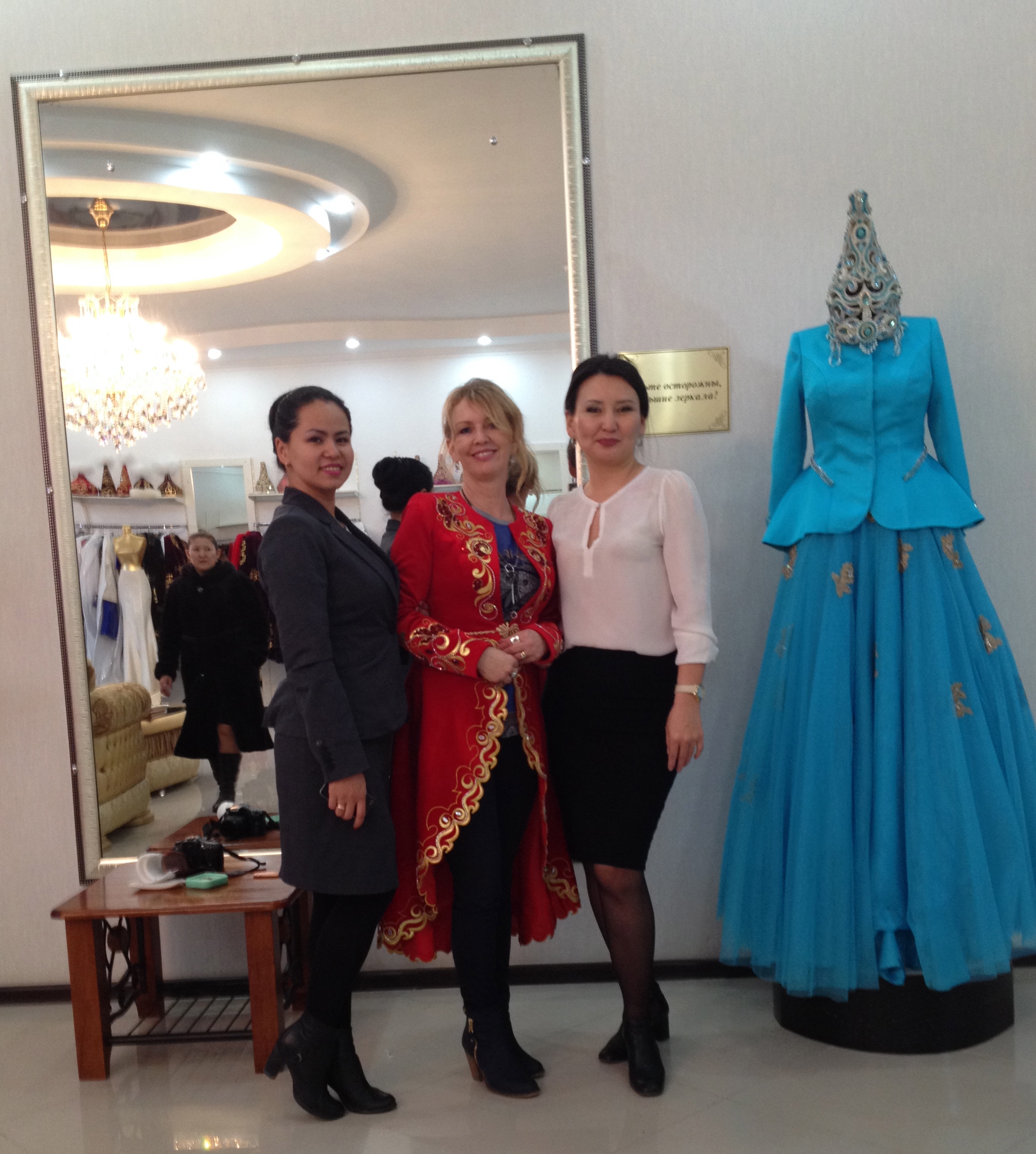
When we arrive at the nondescript building, its drabness surprises me. It offers no hint of the sumptuous atmosphere inside. “It’s our custom when you enter a place for the first time, that one should make a wish.” Rysgul tells me as she holds the door for me to step inside. A massive chandelier hangs in the centre of the room, illuminating a large Persian carpet on the marbled floor. My eye is immediately drawn to the array of exquisite kamzols and elegant dresses. They’re resplendent with glittering stones, jewels and intricate design work that intertwine symbols of swans necks, flowers, even the horns of mouflon sheep.

Here, a woman’s beauty is compared to the graceful curves of a swan and as they mate for life, their likeness is the inspiration for the ever present motif. Stitching on garments and hats also echoes the past, but Nur Shah has expertly incorporated an intriguing modern flair. I can well imagine the excitement a bride to-be must feel as she enters this feast of wedding indulgences.

IMG_5713

With my gracious hosts

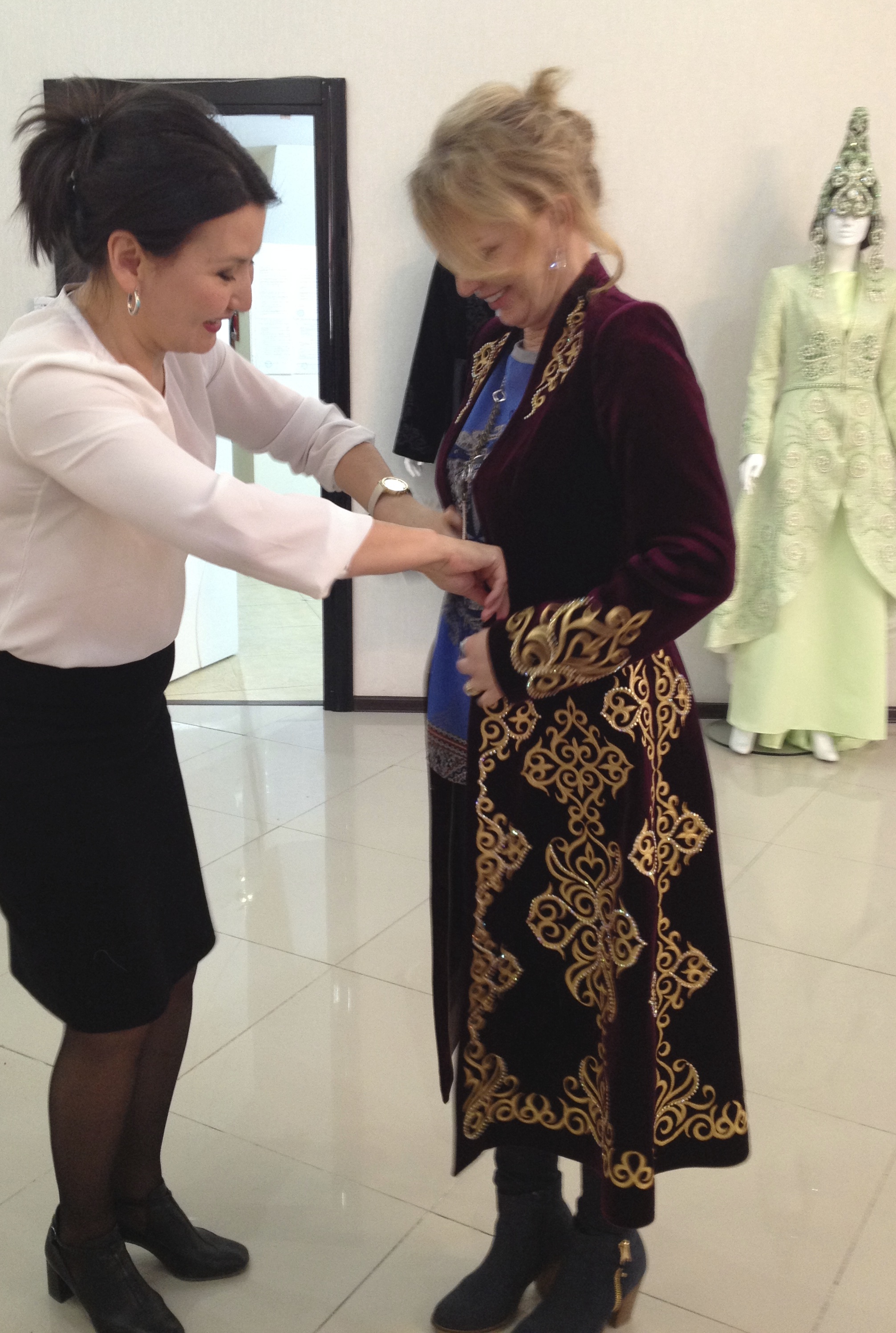
Nurbibi, the lovely assistant, kindly allows me to try on a number of Kamzols. They feel elegant and sensual. I sense the tradition the garment embodies. As much as I admire the saukeles, the pointed hats perch on the upper shelves suggesting they are too valuable to try on, they remain firmly out of reach. The bejewelled ones are breathtaking and if you’re fortunate enough to have been married in one, you will proudly display it in your home. Typically, fabric saukeles either have a fur-like plumage or the more expensive ones feature owl feathers.

IMG_5717

Elegance and tradition

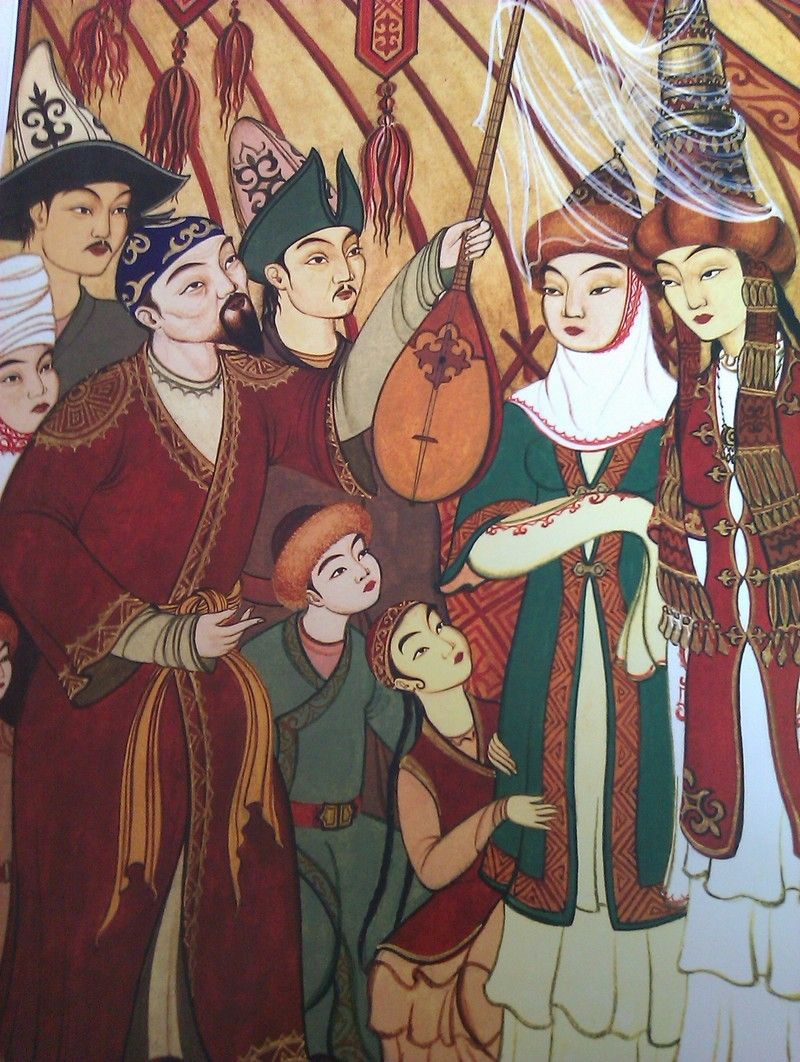
The saukele fascinates me. I’ve read that tribes called “tigrahauda” (wearing pointed hats) once occupied vast territories of Middle Asia and Kazakhstan. In the 1970’s, Kazakh archeologists found an undisturbed burial place of a Saka chief from the 5th century BC. His clothes were covered with golden plates and he wore a tall ‘golden headdress.’ Similarly, something akin to the present day Kazakh saukele is depicted on two ancient golden belt buckles. Both men and women wore this tall, pointed headgear.

Almost two and a half thousand years separate these treasures, yet the Kazakh saukele is still an important element of a wedding ceremony. I ask Nurbibi how long a bride normally takes to choose an ensemble. Rysgul translates to me that it can take as long as a year, but usually a month. “Yes indeed, how would you ever decide!” I say.

“Will you please give my sincere thanks to Nurbibi for allowing me this opportunity, it’s been such a pleasure.” When this is translated, Nurbibi returns the sentiment, a warm smile on her enchanting face. The subtle elegance of these ladies is in perfect harmony with the luxurious items that adorn the showroom… evocative in their modest, yet beguiling beauty.

3sx1cg0f0zvbpqqcvmkh0pbpmc8yqt

An old depiction of a Kazakh marriage.

As we bid farewell and step back outside into dusk, Rysgul asks me if I had made a wish when we entered. “Yes I certainly did,” I assure her with a smile. And indeed I had. I wished this lovely new bride every happiness there is, with perhaps a newborn ‘prince of the hearth’ and a little ‘princess’ as well.


* The kimishek is the traditional white scarf that a married woman wears in the home and elderly women in public. They are often embellished with decoration. Once banned when Kazakhstan was under Soviet rule, the Kazakhs have embraced them again since regaining independence in 1991.

Eleven hours in Istanbul… delight and dolmas

Standard

I’m on a long meander back to Kazakhstan… Calgary, Toronto, Istanbul, Almaty and finally two calendar days later, Aktau.

DSC05422

The Sultan Ahmed or Blue Mosque

And so I found myself spending time in Istanbul, an ancient city I hadn’t yet explored but one which had always intrigued me. How could this great Byzantine city, long known as Constantinople, not be fascinating? Constantine the Great moved his empire here from Rome in 330 A.D.; the city was then already 1000 years old. Now it’s just good old Istanbul, meaning ‘to the city’, but I admit to a certain delightful bewilderment knowing I’m in the once Constantinople. It’s positioned along the Bosphorus river and has long conjured romantic images; of Sultans and their harems, of steamy Turkish hamams, of exotic spices and dazzling architecture.

DSC05480

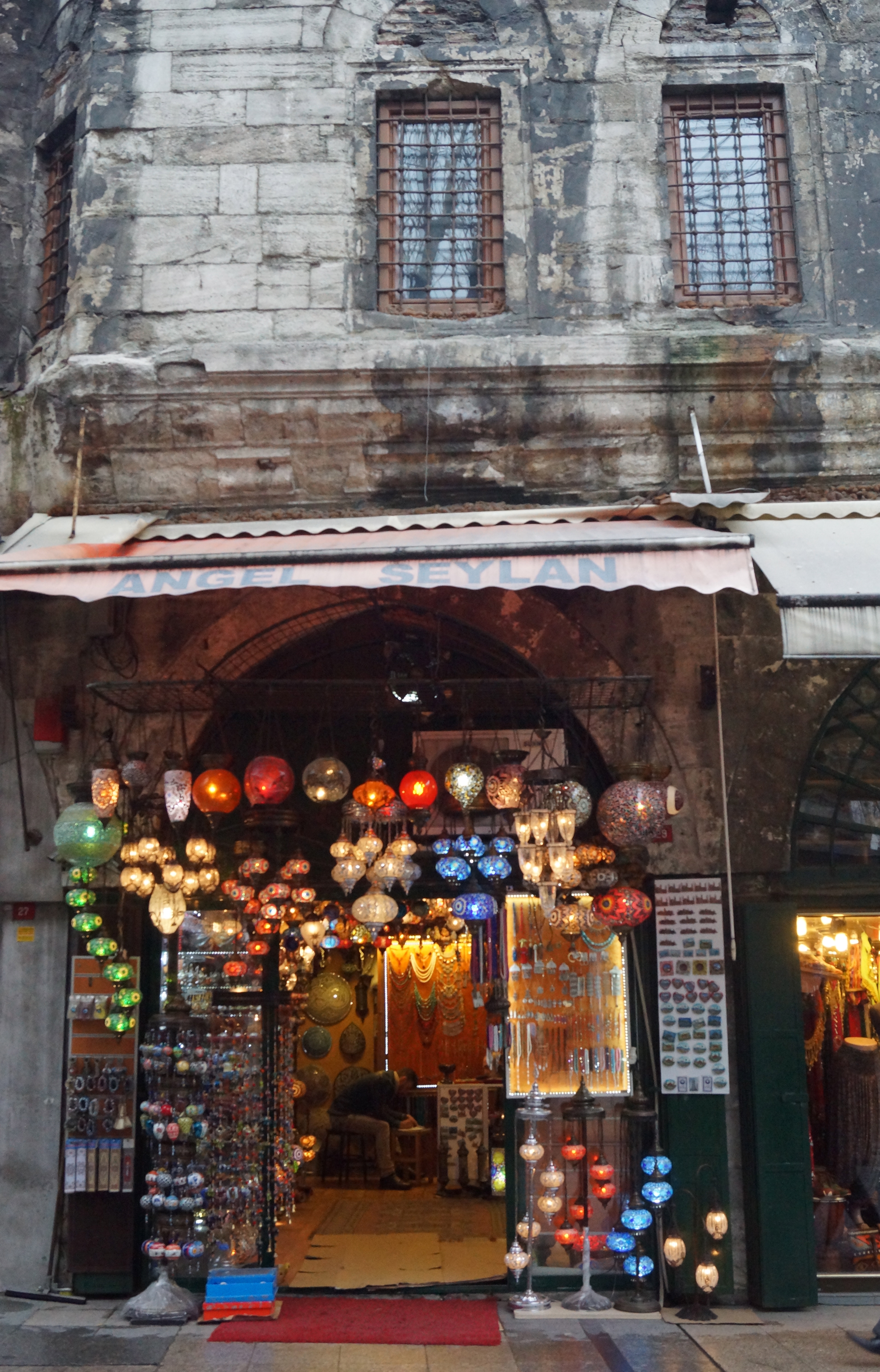
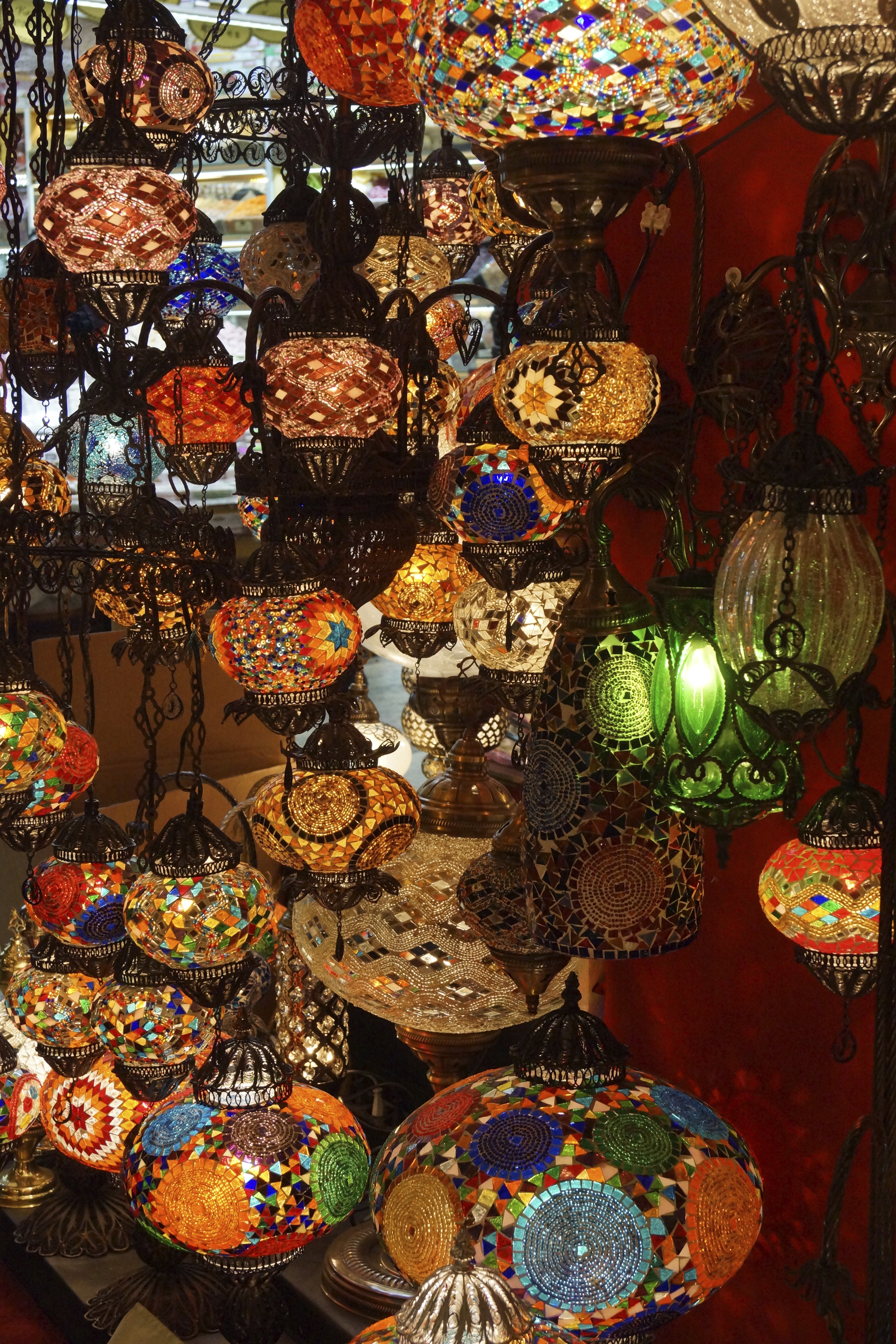
A street side lantern shop

Despite those temptations, as the plane touched down this morning after an over-night flight, it crossed my mind to just languish at the airport for the day. Along with being travel-weary it was rainy and cold, yet this great city at the crossroads of Europe and Asia beckoned; its marvels and mysteries calling to me as it has to travellers for the past 2000 years.

DSC05478

An old city fountain

IMG_5653

Bread and delicious dolmas

As the tram* rattled its way to Sultanahmet, the old city, I was delighted when the famed Blue Mosque and Hagia Sophia came into view, their minarets majestically piercing the brooding Turkish sky. I wouldn’t explore those iconic sights today, I’d leave them for our return here in seven weeks during a proper stay. For now, I found myself relishing vivid street scenes; a rainbow of colour from hand woven carpets, vibrant displays of teas and spices, glass lanterns, to endless mounds of baklava and Turkish Delight. Needing a respite from both airline food and the rain, I ducked into what looked to be a typical Turkish restaurant. Tiled walls, flat bread blistering on an open oven, carpets hanging splendidly and best of all, dolmas; delicious, delicate morsels wrapped in grape leaves. It all greeted me, as did the welcoming owner, ushering me to a seat with a view to the ‘bread maker’.  How did you even consider staying at the airport? You wouldn’t be eating some of your favourite food right now, nor would you have anything to write about, what were you thinking, I chided myself.

“Madam must finish with Turkish tea,” the affable waiter informed me after I was more than sated. He positioned a delicate cup in front of me before I had a chance to reply.

“No charge, it’s from him,” he said, motioning with a tip of his head towards the friendly chef standing between his grill and a counter lavishly displayed with food.

Sağ olun,” I countered with a smile and nod, pleased I had remembered the more informal thank you, as when someone has gone out of their way to do something for you.  Besides, it’s far easier to pronounce than teşekkür ederim, that more proper thank you.

DSC05486

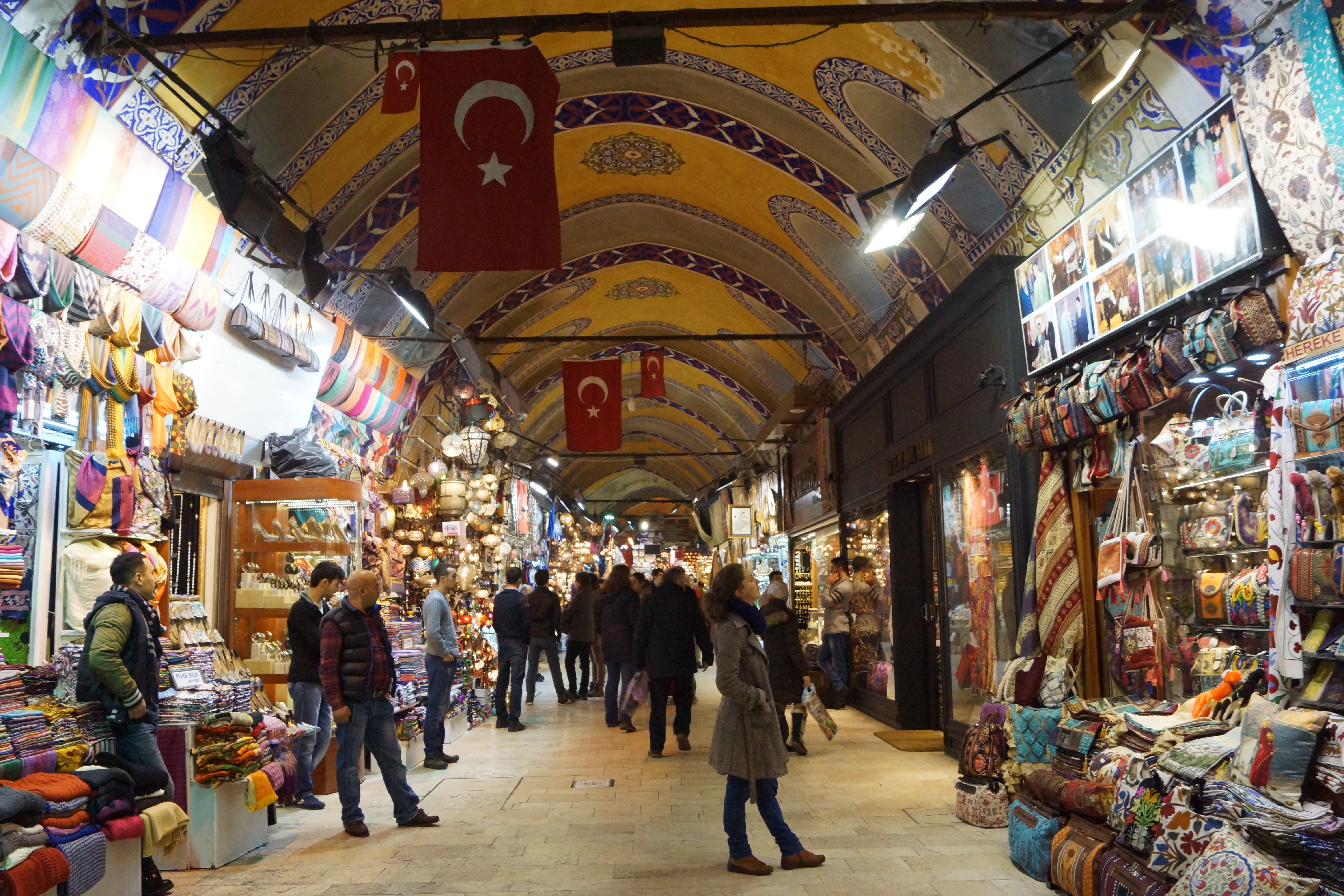
One of the many entrances to the Grand Bazaar

I soon found myself in that one place any traveler must experience if you want to breathe the history of this city. Simply, one must disappear into the Grand Bazaar. The building of the Kapali Carsi began in the winter of 1455, after the Ottoman conquest of Constantinople by Sultan Mehmet. European travellers as far back as the 1600’s brought home news of the bazaar’s unrivalled abundance of goods and exotic atmosphere. Tales that often became the subject of romantic literature. Originally 67 roads wove the bazaar together, each bearing the name of the type of goods found there. The maze, where time seems to stand still, once housed squares, mosques, fountains and 18 gates that were locked in the evenings. However, this seemed superfluous as theft was unheard of, though an incident in 1591 rattled Istanbul to the core when a substantial quantity of gold disappeared in the bazaar. This prompted a closure for two weeks until the culprit, a young seller of musk, was found. Not, however, before a number of tortures had been carried out. Ironically the Sultan spared the theif from torture, but not execution. Other tales abound from those days as the social dictates didn’t allow women to frequent the bazaar, but perhaps a few disguised themselves and made their way in? Apparently one of the Sultans did just this, but as an excuse to eat his favourite pudding.

DSC05496

Dazzling tiled roofs that inspire and intrigue

Nowadays, the Grand Bazaar houses more than 3,000 shops in its 62 lanes, employing some 26,000 people. Each dolap or stall is replete with a sense of history as it sells beautiful ceramics, carpets and cushions, resplendent fabrics, intricately wrought metal, delicate stained-glass lanterns, and of course tea.

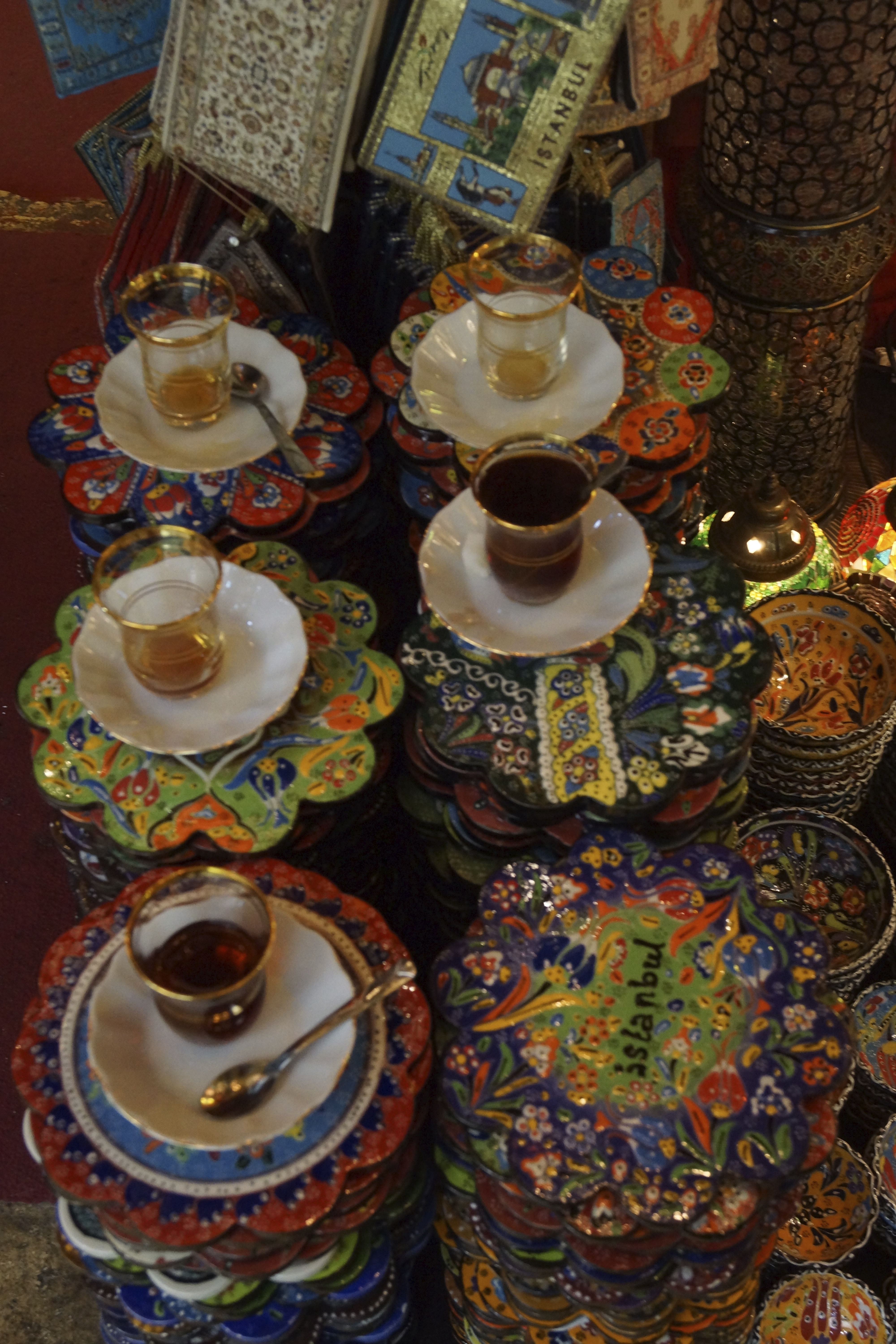
I note the mix of nationalities and languages, musing that Sultan Mehmet would surely be pleased as he had urged the return of those who had fled the city during the siege of the Ottomans, wishing to resettle Muslims, Jews and Christians as one. All part of creating a cohesive, cosmopolitan society and the Grand Bazaar is enduring proof of this. Pausing to take a photo of a grouping of tea cups, I’m reminded I had seen çaycı or ‘tea runners’ out on the street, moving deftly through the crowds delivering the piping hot cups of sustenance to shop keepers, a scene unchanged through the centuries.

Admiring the glass lanterns surrounding the tray, I’m approached by the shopkeeper, his gentle tone a welcome change from the persistent urging that I’d experienced throughout the day. “Where are you from,” is how it always starts, a prelude to the inevitable question as to whether you wish to buy a carpet.

DSC05508

Of glistening lanterns

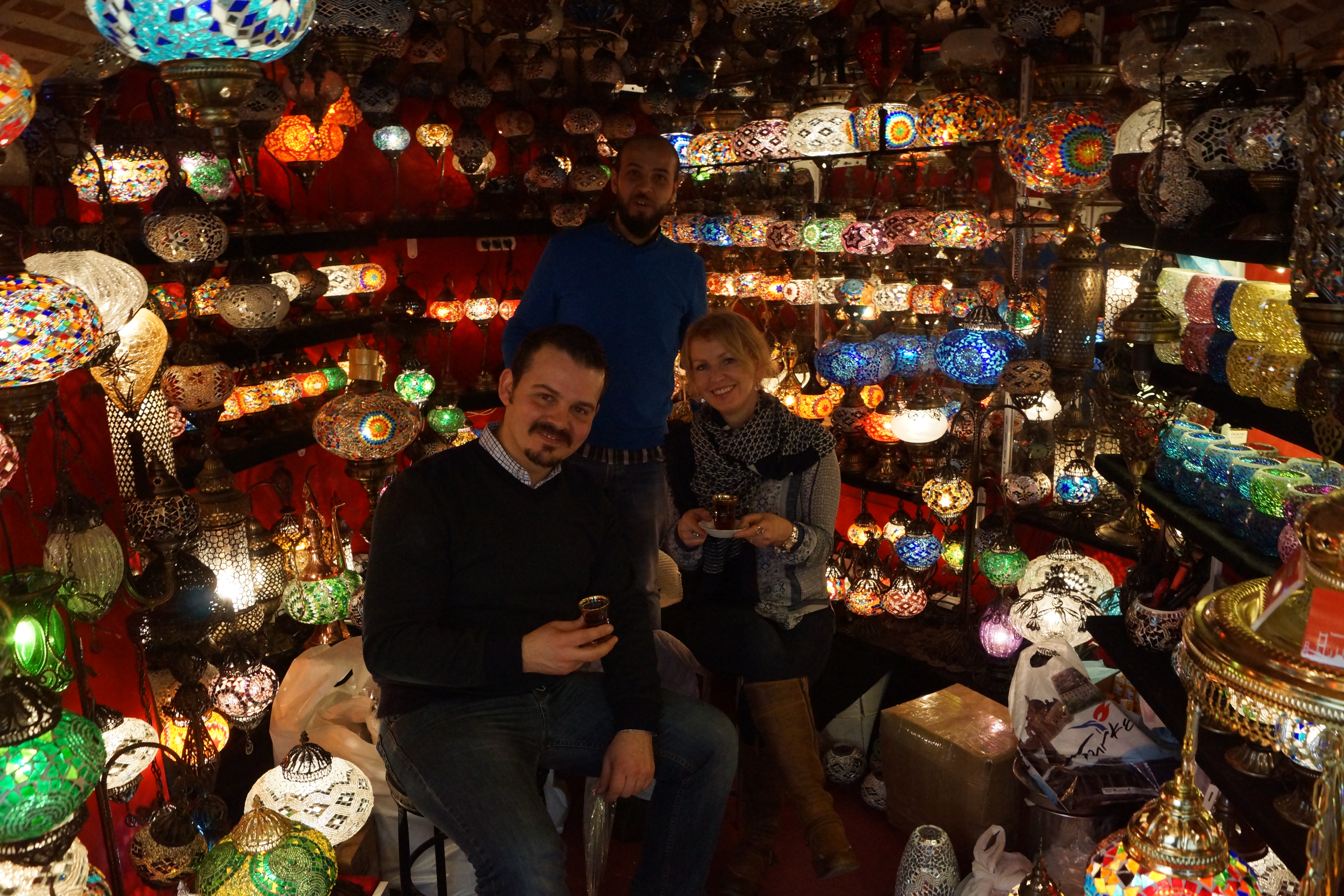
Falling into an easy conversation, the stall keeper introduces himself as Recep as I admire the lanterns and candle holders in his cozy dolap. Eyeing a small holder off in the corner, I envision it on my desk, its mosaic of deep turquoise glass encased in white instantly captivating me. Despite the brilliance of the glowing lanterns, I ruefully admit I can’t carry anything that large.

“Please stay, we’ll have tea,” Recep offers kindly. I’m taken aback yet delighted as I know tea is an integral aspect of Turkish culture and hospitality. After a quick phone call across the lane on a central phone, barely two minutes later, tea arrives. Delivered on a small tray with a triangular handle, the çaycı nods politely as he hands me the tiny cup and saucer, the same I had admired throughout the day in countless shop windows.

As we chat, Recep tells me about the business he’s built from the ground up and I comment that it must be difficult with so much competition, considering the endless shops in the maze surrounding us.

DSC05499

Of tulip shaped tea cups

“No,” he assures me, “there’s enough for everyone if business is done well.” I believe at this point I ‘toast’ him with my delicate tulip shaped tea cup, so ubiquitous in Turkish life that it is often used as a measurement in recipes. And of the tea, apparently Turkey leads the world in per capita consumption of tea, it’s strong and delicious. Here it’s never served with milk and in the Eastern part of the country it’s common to place a sugar cube under the tongue before sipping the tea from the glass. I’ve declined the three cubes on my tiny saucer, but thankful that I didn’t refuse the kind gesture of being offered tea in the Grand Bazaar.

“Recep, I think I’d like that tiny holder in the corner,” I say standing up from the small stool, realizing it’s time to make my way back to the airport. “What is the price please?”

“There’s no price for you, my gift.” Sağ olun was again my heartfelt response. After a warm hand shake, I part from my new friend and navigate my way out into the brisk air.  I hear, “Where are you from miss?” yet again and this time decide to just go with it.  Turns out he’s selling those aforementioned treats… surely I should buy some. After all, who comes to Turkey and doesn’t submit to some delicious Turkish Delight?

By this time it’s rush hour and I join the commuters on the tram, at once appreciating their kindness. Some enquire if I need help, did I know the way? Others notice the city map in my hand and smile.

Beneath the exotic facades and arguably daunting perceptions that recent events have wrought here, a familiar fabric of life prevails. People make their way home relieved to reach the end of their working day, yet gladly offered their seats to the elderly. Sweethearts whisper in each other’s ears. Parents peck their children on the cheek as they hold them closely in the squash of people.

I’ve loved the Turkish people. I felt welcomed, I’ve felt at home.

DSC05505

Recep and much appreciated Turkish hospitality

This evening as my plane lifted off over the Bosphorus, onwards to Kazakhstan, I feel imbued with the mystery of what is still to be explored. I eagerly dig out two books I had acquired that day, already preparing for my visit in seven weeks. One of them is a gem, recommended by the bookseller.  “You won’t be able to put it down,” he warned me, and I can’t.*

I so look forward to returning and we shall try to drop in to see Recep, that is if I can find that stall again out of the 3000 or so! Actually, its Takkeciler No. 7 Kapali Carsi -Beyazit…just in case you find yourself there and want a Turkish lantern (I know I still do) and maybe a spot of tea. Tell him Terry Anne sent you!


* Take the Metro from the airport to Zeytinburnu, switch here to the blue tram line and continue to Sultanahmet. Trip approximately one hour


*’Portrait of a Turkish Family’ by Irfan Orga


52 Countries and a year that is new… with abundance

Standard
IMG_5253

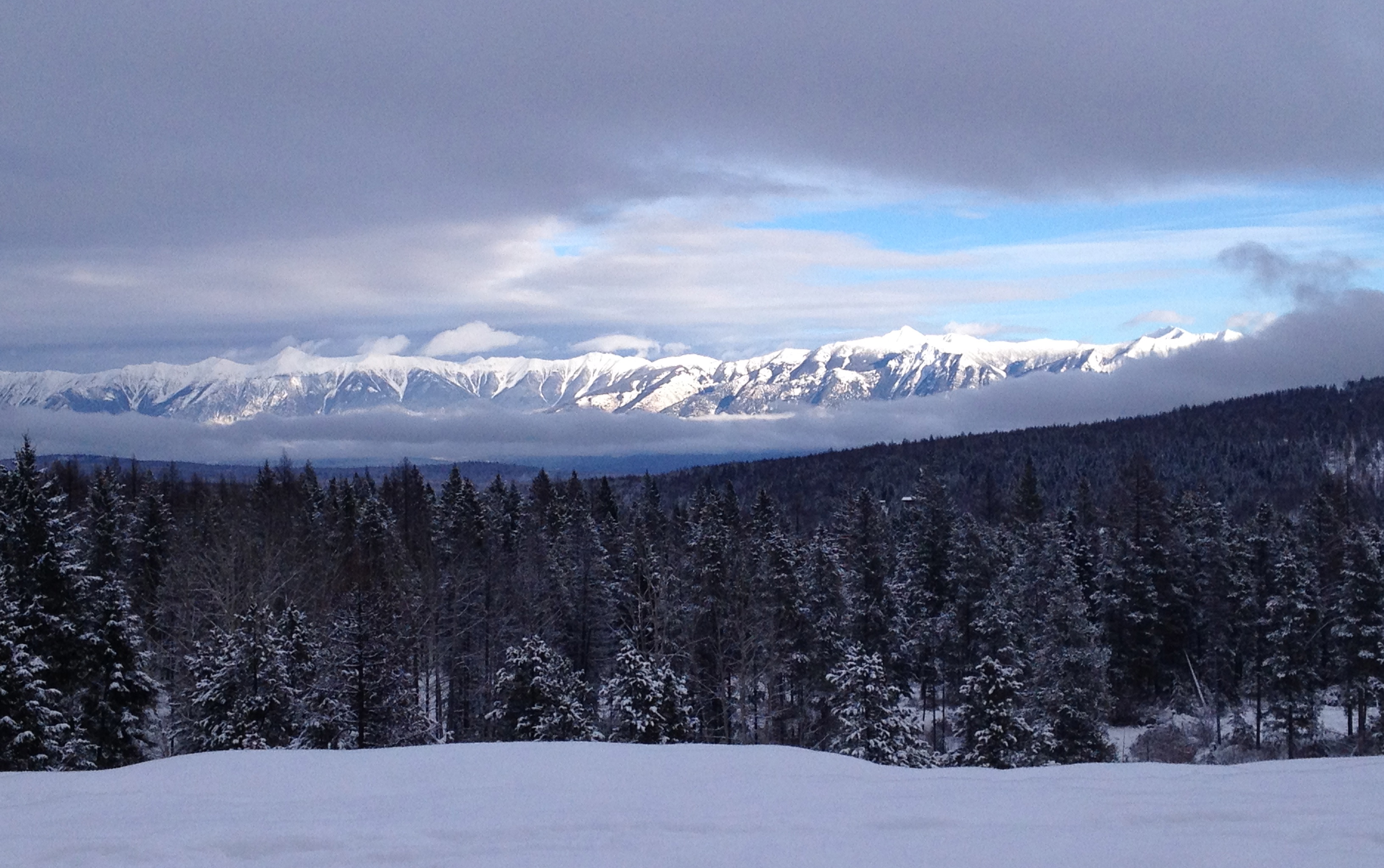
Serenity and reflection while snowshoeing

It seems there’s been an underlying theme this holiday at our home in the mountains; good food and fine wine are a given. But snowshoeing and more snowshoeing, has allowed me unexpected serenity. The snow on the ski hill has been somewhat lacking and so we’ve been strapping on the ‘shoes’ and happily meandering through the nearby golf course and Kimberley Nature Park. The neighbourhood gals and I have also been out and when we’re not chatting, my prevailing thought is of the year that has passed. As I soak in the vistas and admire the snow laden pines, I reflect and give thanks that my dream of writing a blog came to pass.

A New Year’s message from Word Press included a summary of the first year of notes on a boarding pass and those 20,000 plus written words only have meaning if someone reads them. And thankfully you have. In fact, I know that you readers are from 52 different countries, thus far. Imagine how inspiring this is for me, to envision that somewhere in Russia, Estonia or Botswana for example, my blog was discovered… literally, it means the world to me.

I know who some of my readers are of course, but many others I do not. I don’t see who you are when you view a post, but I can see the country that you’re reading from. If you’re curious how a reader ‘finds’ my blog, one way is from the ‘tags’ that I note on each post which materialize in internet searches. I myself recently researched something online and one of my articles popped up, somewhat surreal I can assure you!

The unexpected joy of writing a blog is the communication it opens up with people. It seems I traveled ‘around’ the world this past year with stops in the U.K., Denmark, Sweden, France, The Netherlands, U.S., Turkey, Kazakhstan, Malaysia, Thailand and Hong Kong. So perhaps, dear reader, I met you in one of those countries.

IMG_5549

Snow laden pines in Kimberley

There was the lovely German lady on the train to London and unfortunately we didn’t begin chatting until just before the train approached Paddington Station. There was an immediate connection and I was able to give her my card before we reluctantly bid farewell. “You can have a look at my blog if you’re ever bored,” I said with a parting smile as we each disappeared our own way from the busy platform.

I recall the charming Londoner I met while on the Dickens tour , there were many questions I wanted to ask him. Unfortunately, time doesn’t always permit this and yet I was pleased to have met him, if only briefly. Not long after, he graciously sent a note to notes on a boarding pass. 

There also was the beguiling young person in the cafe in Malaysia who was interested in my travels, as was the couple in Thailand while we chatted over a beer as we sheltered from the midday downpour. There have been so many chance encounters and happily for me, people are receptive and curious.

“How are you able to travel so frequently?

“Do you plan what you write about or is it an inspiration that comes to you?”

“Don’t you get tired of living out of a suitcase for much of the year?”  (yes to that one!)

And pleasingly there are people here at home who are supportive and follow notes on a boarding pass. One such lovely lady is a vibrant eighty-two year old whose birthday I had the good fortune of celebrating just as I arrived back to Canada this holiday season. I was in transition as a few days earlier I had traded my sandals and sun dresses for winter boots and sweaters. Donna Lee took my hand in hers and said warmly, “Thank you Terry Anne for the opportunity to travel with you through your blog. I read every one of them, those interesting insights to places that most of us will never experience.” It warmed my heart and I think we both might have had a tear in our eye.

It means so much to hear sentiments such as these, as I have from many of you whether it’s in person or through a written message. And when I do, I know writing is worthwhile… and it also gives back to me. That was predicted by a dear friend of mine as I procrastinated and swithered a few  years ago.

“Where’s your blog, you’ve thought about it for a year now,” She admonished me with a stern but encouraging voice. Pamela is a life coach and was justifiably focused on my procrastination.

“I know, but I can’t decide on a name for it, I’ve got so many ideas – Bloom Where You’re Transplanted, A Collection Called Life, A Passion for Life, Planes Trains and Notebooks,” I lamented.

“Just pick one and get on with it, this is called paralysis by analysis. It’s time to do it, it will bring you such fulfilment and abundance…”

It was that word abundance, it stuck with me and Pamela was right. This blog, nine months young, has brought me such joy and abundance. Along with the research, travel and writing, it’s also the connection with people that has been more gratifying than I could have imagined; the satisfaction of making an impression, imparting or learning something new, inspiring someone wherever they may be.

IMG_5414

The vista we ‘shoe’ to…the Rocky Mountains in British Columbia

My resolution last year did come true and this year my hope is to secure more articles for publication and then there’s that ‘darn book’ to spend more time on. That is my wish and I hope that whatever resolution you have committed to becomes a reality for you this year. As I know, sometimes it can take longer than expected and often it can seem like an insurmountable challenge, just as this blog once seemed to me. But as I can attest, when you stretch and challenge yourself just that little, you can bloom in unexpected ways.

I’ll be returning to Kazkhstan at the end of the month, however it will be a short ‘stint’ as it seems we’ll be off to live in a different country in the spring. Yes, dear reader, perhaps more adventures in store, more intrigues to write about. Ah, by the way, how did I finally decide on that seemingly difficult task of naming my blog?

There I was in Amsterdam last February, out for dinner, chatting and absent mindedly making notes on a piece of paper all the while. As I arrived at Schiphol Airport the next morning for my flight, I dug out my e ticket boarding pass. Surely it can’t be this piece of paper marked with notes? It was indeed and I remember thinking once and for all, that’s it… notes on a boarding pass. Pamela was pleased and I had finally stopped procrastinating.

IMG_5563

Abundance

I’m ever so relieved I did. But for now, I wish you a new year full with dreams realized and much abundance in whatever you hope it to be. Happy New Year, wherever you may be in one of those 52 countries… and I truly do thank you.  Terry Anne


P.S.  And of those other two questions?

I’m able to travel so frequently partly due to my husband’s work locations and a commitment I made to myself as an ’empty nester’  to seek out new experiences and inspirations.

Of inspiration? Everything I’ve mentioned inspires me and most blogs formulate in my mind for a week or two. Perhaps others for months such as the post previous to this one. The sheer joy of it all; even I don’t know where the next one will take me.

And those countries, just in case you’re curious

Canada
United States
United Kingdom
Norway
Kazakhstan
Netherlands
France
Thailand
United Arab Emiretes
Malaysia
Russian Federation
Italy
Australia
Germany
Japan
Singapore
Denmark
Spain
Indonesia
Qatar
Sweden
Switzerland
India
Philippines
Finland
Bahamas
Jordan
Botswana
Lao People’s Democratic Republic
Mexico
New Zealand
Korea, Republic of
Hong Kong
Panama
Portugal
Turkey
Kenya
Brazil
Israel
Hungary
Colombia
Sri Lanka
Belgium
Slovenia
Isle of Man
Cambodia
Oman
Brunei Darussalam
Estonia
Ghana
Jamaica
and last but not least, Romania

Lipstick palms on Phuket… of botany and the verve of Jack

Standard
IMG_4926

A place of serenity for the writer’s retreat

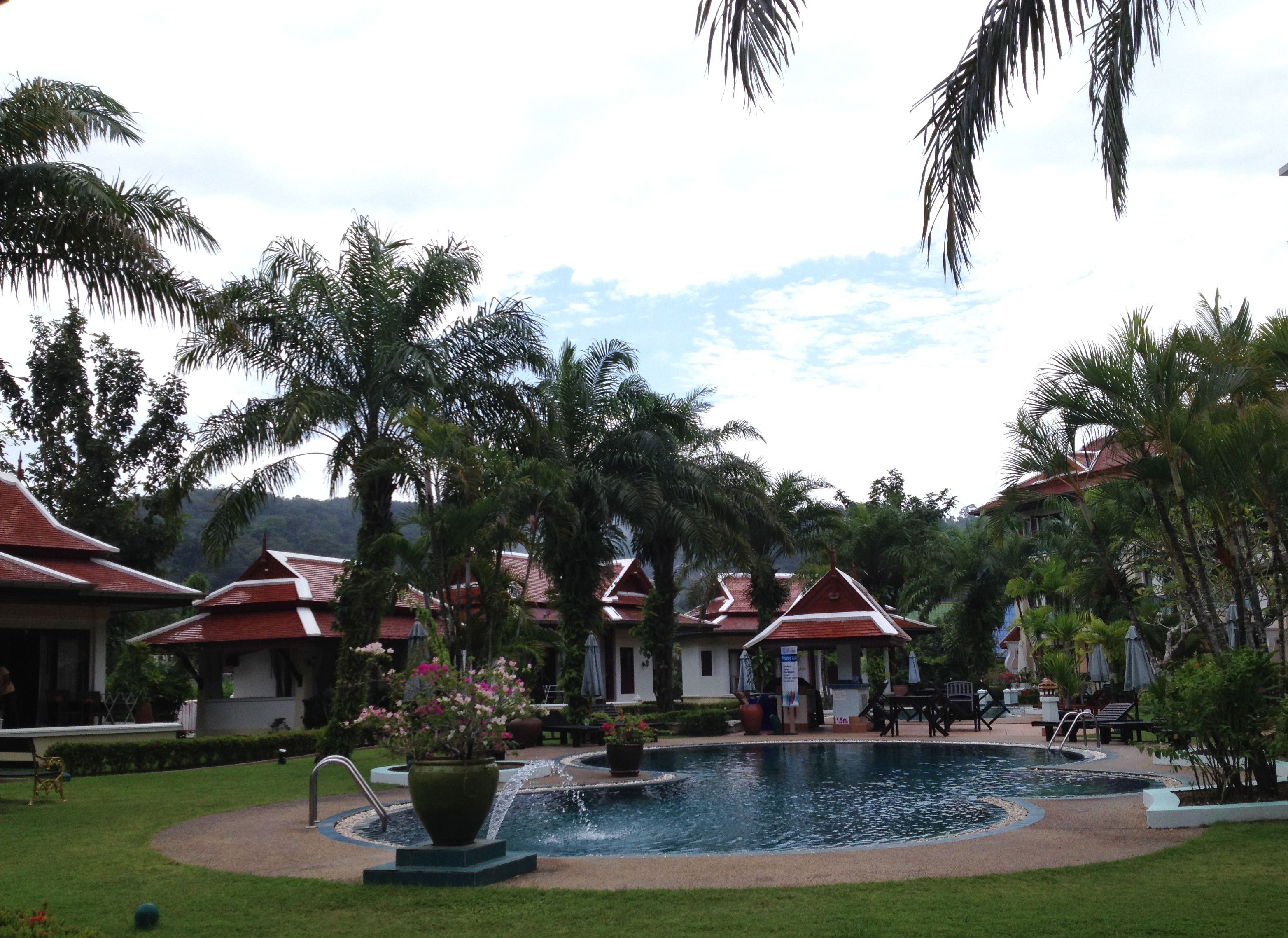
“Do you think someone plants all those ferns in the palm trees?” I ask Jo as we paddle idly in the pool. Another day of writing completed and we were now cooling off after a massage in the nearby massage studio. How will I ever leave this serenity?

“No, they’re epiphytes, plants that live on others. They root by themselves and just grow,” Jo says knowingly.

“See how some of the trees have ferns and those ‘spiky’ plants. And they’re orderly, as if it was landscaped.” I muse as I gaze out to the pool-side palm trees, each massive trunk in a cosy ecosystem with its ‘house-guests’.

IMG_4816

Into the massage studio

“We have a theory in our family,” Jo continues, “trees are like people; some are more fun than others, maybe that’s where the party is, more booze, better snacks?”

“Hah, that’s good!” I say, quite taken by the notion of trees as a party venue.

Jo and I have often chatted about nature, but never more than at this writer’s retreat in Phuket. The garden cascades in all directions from the central pool, a who’s who (or rather, a what’s what) of a botanical garden. The coconut palms reign supreme, tall and imposing over the stockier white washed date palms, bamboo somewhere in between. Frangipani trees dot the lawns and verges, their fragrant flowers a fond reminder of my once Middle Eastern gardens. Those years when the kids played in gardens of jasmine, orchids and rainbows of bouganvilla. When they climbed houses built in exotic trees that we didn’t know the names of… when we drank sundowners with the melodic call to prayer as a backdrop. Gardens have always been important to us; they’ve helped root us to a country, provided solace in foreign lands.

IMG_4925

Lipstick palms

This garden seems to reach out to us writers who are happily ‘entrenched’ here for a week. It is animated yet calming, even the water nymphs call out. One day, a lovely water-lily suddenly appears in its glazed pot, a little blaze of silken petals. As one might announce a birth, I summon the group that morning…”The lily has bloomed, do stop to appreciate it everyone!”

“I love that grouping of palms just there, beside my villa,” I declare in the general direction of Jo as we luxuriate late that afternoon on teak recliners.

“Skinny stalks of subtle lime,” I alliterate. “Burnt orange and lush lemon,” I continue, getting carried away with the literary thing.

“Those are luscious lipstick palms,” Jo happily jumps in, seemingly bursting with botanical knowledge.

“Well they would be, wouldn’t they!” I sigh at the resplendent scene before us, as if to breathe it in for posterity.  “Ah, I think those are the palms that when Europeans first set eyes on them, they were named for the red sealing-wax palm.”  I picture the slow drip of hot wax, the delicate stamp of a signet ring.

The Royal Embassy Resort is owned by Phil, a New Zealand transplant, and his lovely Thai wife, Ari. It’s a secluded, intimate setting and we’ve been treated like royalty. Even by day six, I can’t stop admiring the effortless bounty of nature that surrounds us. It’s also mirrored in the cuisine; delicious offerings served on banana leaves, intricately carved fruit and magenta orchids adorning tall, frosty drinks.

Normally I’m engrossed with the architecture of a country and though I’ve traveled through Thailand before, I am endlessly captivated by the effortless melding of nature into everyday life here. Could it be the stark contrast to Kazakhstan where I now live for some of the year? From the sparseness of the vast steppe to the overwhelming abundance… yet I remind myself that each country has its own beauty and uniqueness. 

The view from our ‘writing room’ has transfixed me throughout the week. Yellow, snow-white and tangerine butterflies dance amongst fluttering palms. Delicate frangipani flowers cling to trees, pink hibiscus blossoms drift in the breeze, birds linger and browse the floral wares: inspiration at every glance.

As if writing and meeting new people weren’t enough to occupy the week, we were encouraged to limber our bodies and minds with an early yoga session on the lawn each day. I had affirmed to our yoga instructors, Anne and Melanie (Anne was the wonderful facilitator of the retreat) that I wasn’t a fan. Much to their delight, I quickly ‘purged those negative thoughts‘. It was difficult not to; with the night dew still clinging to the grass, we focused on ‘a drosti’ and executed the ‘warrior pose’ while glancing at tall bamboo, a favourite palm or gazing out to the misty hills beyond.

IMG_4640

The waterlily has bloomed

Beyond the tranquility of our garden retreat, the neighbourhood slowly came to life. Tuk-tuks puttered in the lanes beyond our view, pans clashed on outdoor stoves, roosters cock-a-doodled, a broom swished across the corner store porch, and stray dogs barked in raucous anticipation of the new morning.  Now this was the way to greet the day.

On day five a new friend, Barb from Halifax, announced that she had received a visitor as she opened the door to her villa that morning.

“Jack came to say good morning, he was right there to greet me,” Barb said as she laid happily in ‘child’s pose’ at the end of the yoga session. I admitted to being envious. We all treasured the rare encounters with Jack and, though he hadn’t actually enrolled in the retreat, we considered him as one of us, nonetheless.

The following day as I opened my door to greet the thick, humid morning, there he was. I was honoured to have been chosen for some personal attention. White hair soft as feathers, black ears erect not droopy, Jack allowed me to caress his silken curves until it was time for yoga. Yes, Jack is a rabbit that we all came to adore.

“Gosh, it must be sad for him to be alone here,” I wonder aloud to Phil one day after an impromptu tour of his admirable collection of Thai antiques.

“Well, Jack’s the only one left; all of his erstwhile mates have been savaged by the neighbourhood strays.”

“That’s so sad, how has he managed to survive?” I ask, reminded of the similar fate that met Pebbles and Bambam, our sons’ childhood rabbits (yes back in that seemingly serene garden.)

“Oh he hides, he’s wily, that Jack rabbit!” Phil says in his lyrical Kiwi strain.

DSC04852

The beloved Jack

There was evidence enough that the beloved creature played an important role at the Royal Embassy. On returning from an outing one evening, sun dipping below the horizon, we came upon Phil and Ari sitting by the poolside. Jasmine, their silken dog lazed on Ari’s lap and in the chair between, completing the family vignette, sat Jack in perfect contentment. I shall never forget that scene, there he sat… a rabbit called Jack on a chair for cocktail hour at peace with his family. It was absolutely heartwarming.

On the final evening at the Royal Embassy Resort, only Barb and I had stayed on. The other writers had flown back to their homes in the U.S., KL and Dubai; the rest had returned to their homes in Phuket, the island they had come to love.  Barb and I made our way to what had become our favourite restaurant, ‘Bua’, perched on stilts overlooking the gentle waves of Kamala beach. Bua, the omnipresent lotus, sacred symbol of this fertile land, rising up from muddy waters to attain perfection. I felt an overwhelming sense of gratitude for the week that had just been.

“Well, my dear, cheers to a wonderful week, we were meant to be here indeed!”  We chunked our coconuts together, setting the Pina Colada aswirl. It didn’t matter who had voiced the sentiment, we would part the next morning knowing we’d made a friend for life.

Early the next morning we took one final walk together, turning left from our resort

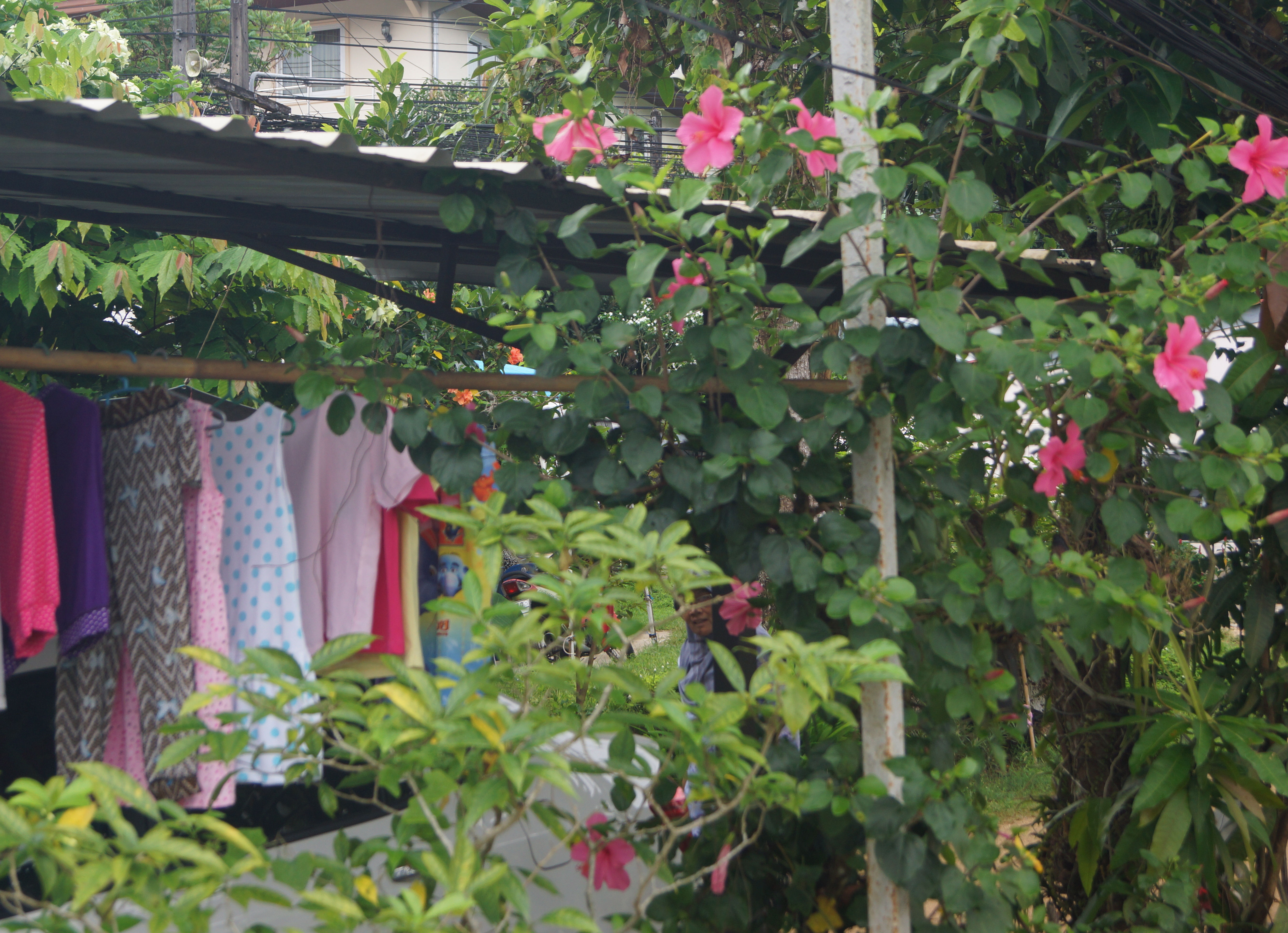
Hibiscus and Saturday morning laundry

Hibiscus and Saturday morning laundry

instead of the usual right, taking us into a ‘normal’ neighbourhood which was just beginning to stir that Saturday morning. Boys cycled down palm lined streets, past lovely homes both grand and simple, some with kitchens and dining rooms exposed to the elements. A mother and grandmother tended to the laundry, graciously pausing to pluck a luscious pink hibiscus for each for us from their garden. As if in prayer, we met our hands to our heart, as they do here to convey a genuine thank you. I will dearly miss that heartfelt gesture and the gentle Thai people who smile so freely… who welcome you to their land with open hearts.

A gift of hibiscus

A gift of hibiscus


We passed yet more varieties of palms that Jo, my botanist hadn’t yet identified for me. They were interspersed with a few spindly rubber trees. Introduced for commerce, rubber trees arrived in Phuket at the start of the century, plantations once covering forty percent of the island.

“I hadn’t realized that rubber trees are tapped like maple trees to harvest the white goo that oozes out.” I slapped the trunk with my palm. “I really hadn’t grasped how it’s transformed into rubber, I got the full picture when I read about it this week,” I confessed to Barb.


Barb, in front of yet another variety of palm

Barb with yet another variety of palm

“Thank goodness it wasn’t just me, I hadn’t realized that either until I was here,” she conceded. As I snapped a photo of Barb in front of yet another variety of palm, I vowed to improve my botany knowledge for the next trip.

DSC05328

The view at The Indigo Pearl

It was time to depart and I left the quiet, unique resort to spend my last two nights at the Indigo Pearl. With only a small inkling of what awaited, I had booked the resort online, splurging a little at my husband’s encouragement, yet I had not imagined the sheer luxury or the captivating history. This resort, rather unexpectedly pays homage to the tin mining industry that had once been so important to the Phuket economy. The lobby and restaurants were opened to the verdant grounds and scattered amidst this stunning backdrop stood fascinating remnants from bygone mining days.  Old tin presses become art, tin florets hang on walls and sit on taps, untold flirtations integrating design and history.

Tin becomes art!

Tin becomes art

My suite overlooked the pool; fronds of massive, milky palms flapping like wallah-less punkahs over my patio, I was now truly in another world. And then I noticed the bathtub; perched on the patio and posed towards the verdant vista, candle already burning with exotic oils filling the air. Truly, how can I leave this paradise!


The beauty of a treetop spa

The beauty of a treetop spa


After a back and neck massage in the treehouse style spa on the second day (where even the chilled towels are proffered with magenta orchids atop), I venture outside the gates… it’s time to head to the beach. And as wonderful as it had felt to be ensconced within the walls of the pampering five star hotel, I was happily back into the heady chaos of Phuket street life.  Vendors jostle for business, aromas of barbecues waft through the air as the Andaman sea crashes its waves onto the pristine shore.

I find the perfect spot on the white sand and settle myself. But something isn’t quite right; I conjour sweet memories of my boys building sandcastles and frolicking in the sea waves. Images of a family holiday on Phuket tug at my serenity, urging to be let in. Wonderful memories, now lingering and bittersweet in my solitude. No fellow writers to share my thoughts with, no friends beside me with whom to relate these golden images.  This experience has run its course I confess to myself, though seemingly not before I cheer myself by having my second massage of the day… yes the second!

A bathtub with a view

A bathtub with a view.

Come on this is ridiculous, you should be finishing those writing assignments, completing that gift list, even sending your hard working husband a postcard!

But no, recalling that I had strolled past a thatched roof structure, housing twenty or so rudimentary low, wooden tables, I am drawn back by the promise of one last Thai massage. It’s full with foreigners in varying degrees of un-dress, it just doesn’t matter here!

”Only 300 Baht (under 10 bucks) OK?”  And I yield to the matronly Thai lady who catches my eye, her hand enticingly swishing her bottle of oil, a welcoming smile on her expectant face.

“I’m in!” and if not on a new spiritual plane, at least I’m soon cheered!

Someone recently mentioned a study that showed most people’s first deep sigh comes seven minutes into the massage; mine was at two, at the most! Relaxing and more ‘real’ than the resort experience, I succumb. Kids run about as moms and grandmothers alike knead and cajole the ‘stress’ out of us spoiled tourists. They keep a watchful eye on their brood during the hour long session, chatting in Thai to their colleagues beside them, nattering at the kids as they play simple games with leaves and sticks. Vendors bells ting ting as dinner time approaches. The local mosque’s call to prayer echoes in the air.

View to the Andaman Sea from the massage hut

View to the Andaman Sea from the massage hut

The massage is glorious. The sound of the waves just a few meters away is natural mood music. The view of simple fishing boats bobbing and coconuts swaying on a nearby palm tree further encapsulate the mood, but it’s time to go home. I smile, barely managing to pick myself up off the woven Thai mat, slowly slipping on my flip flops. Dodging the daily late afternoon rain, I opt to have a quick Singha beer at the cafe across the street and happen to chat to a couple from Germany. They’ve just arrived on the island and of course I suggest the Royal Embassy Resort to them.

“They even have a pet rabbit named Jack,” I tell the friendly couple. “He likes to be petted,” I say fondly, already missing the little guy.

Coconuts hidden under massive fronds

Coconuts hidden under massive fronds


It’s time to go back through that gate that takes me to the opulence of the Indigo Pearl, though somehow I don’t really want to leave this scene where people chat freely, where everyday culture is revealed, where one is absorbed into the pleasantly chaotic scenes. So I stroll wistfully through the gates returning the smile from the security guard, with one last glance at the tranquil sea. It’s my last night here and I might just have to have one more soak in that glorious tub… 

A writer’s retreat in ‘Siam’… a market wander

Standard
DSC04942

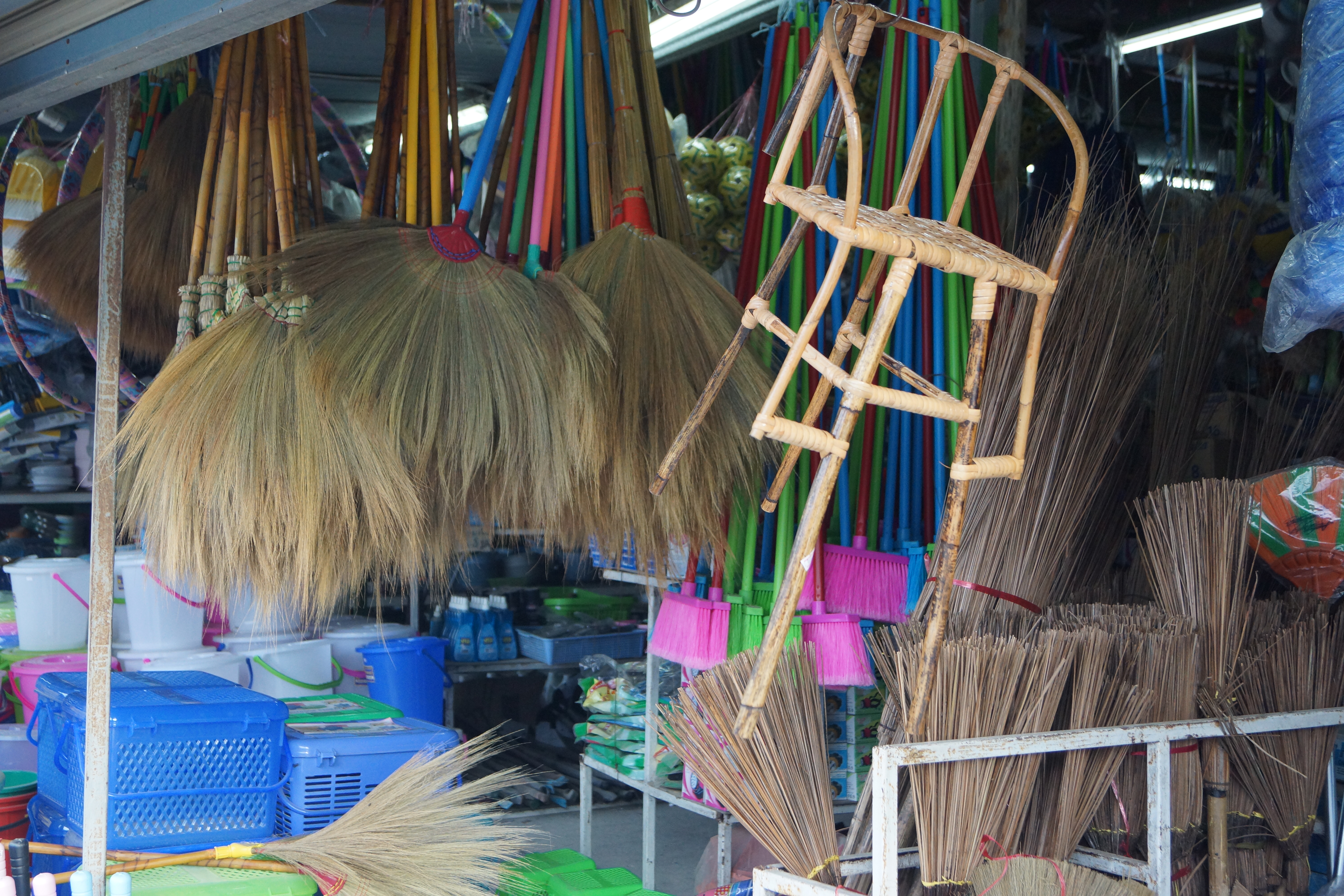
An entrance of brooms and hanging baby chairs

In the humid labyrinth of aisles, back corners and shelves, I yearned for that special piece to present itself. To call to me, to beckon escape from this musty, neighbourhood market. We were on a writing assignment to find something elusive or inspiring to write about in this potpurri of, well… everything.

I passed the welcoming display; a hodgepodge of wispy brooms, sponges and spades, of dust pans in yellow, pink and blue. I noted tickly feather dusters, hoses, and hanging baby seats… wicker tightly bound. They perch precariously on many family ‘vehicles’, the ubiquitous scooter.

IMG_4593

A ‘bike vendor’ with the market’s entrance beyond

There were knives, rakes, tape measures and plastic prayer alters. Rainbows of stacked carpets, bento boxes, scales… and pots and woks and saucepans. Of vases, washtubs, fans both new and defunct… and rows and rows of glasses waiting for champagne and beer, dejected and dusty. Past plungers, packs of straws and Chinese waving cats for prosperity… for luck.

Still, nothing spotted that spoke of a keepsake from this writer’s retreat, from a nation once known as Siam. A country of lush bamboo, tall palms, temples and tuk-tuks. I wished for a mommento – the fragrant garlands and orchids don’t last.

The humidity climbed, fellow writers melted as we shared my small woven fan when we converged somewhere between the plastic stools and ironing boards. Could they not plug one of these fans in, we despaired as we eyed the myriad of oscillating cooling devices. Is the time almost up, can we escape soon?

No there was more. In the corners lurked hula hoops, parasols and porcelain of fake delft blue. The tool section stacked with clunky hammers, chisels, trowels and wrenches. They competed with dull saws, plugs and keys… and long, dark, rusty nails. My father would love poking around these crammed shelves, examining pipe widths and plyers; a handyman’s trove of treasures.

My mother would peruse the rice steamers, the Thai cushions and then announce she’d buy a cooking utensil. Something to ladle with, to stir with… to playfully chase those naughty grandchildren with.

Mercifully our time had elapsed and I manoeuvred through the tight aisles out to the welcoming sunshine, defeat admitted as I dabbed my drenched brow and neck.

IMG_4594

Steamy pouches of spicy sauces

And then I spotted it, dangling from under a vendor’s umbrella. He was parked there, just on the left, selling delicacies of fish, skewered meat and sauces in tiny, steaming pouches. Offering rice in banana leaf parcels, a toothpick to close.

The object was forlorn and worn. Small and intricate, stitchings of green and orange. It wanted to join my collection of gleaned treasures from far away lands and adventures, from gifts received.

Only fifty baht was taken with a genuine smile, with a Kob Kun Kaaaa. I tucked it quietly away and made my way back to the writing group, a sly grin embracing my face. I’d found it. My small, delicate rice vessel speaks of days gone past, of workmanship under thatched roofs, of Thailand.

IMG_4603

My friend and mentor, Ms. Jo at lunch

Each day is unique at a writer’s retreat and on this day, after the market and writing session, we left the resort for a working lunch in a restaurant on the sea. It was a gloomy afternoon, ideal for sharing our ‘market writings’ as we dined on grilled shrimp, spicy calamari and icy Chang beer. Unique interpretations of our assignment; some mysterious, many funny, a few suspended reality and suddenly we were transported through a secret portal to an alien ‘space’. Yet another was deep with metaphors, sad and brooding, like the stormy weather that was closing in on us. Words enchanted and rolled around us… just like the melancholy waves rolling towards us. Beguiling and inspiring, just as the day we were having.

IMG_4619

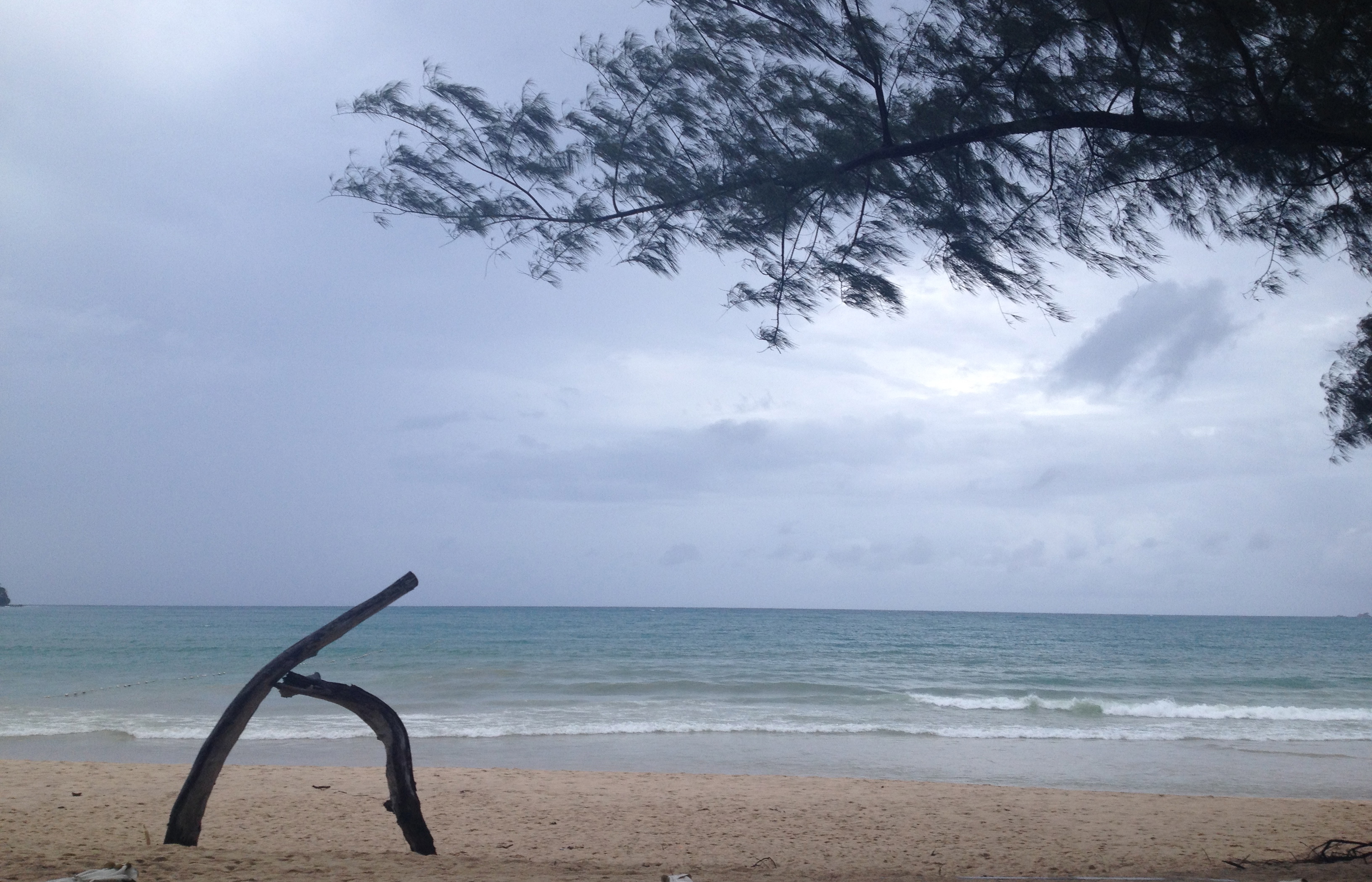
The brooding sea on a Phuket beach


Waiting for the dombra… with musical musings

Standard
DSC04578

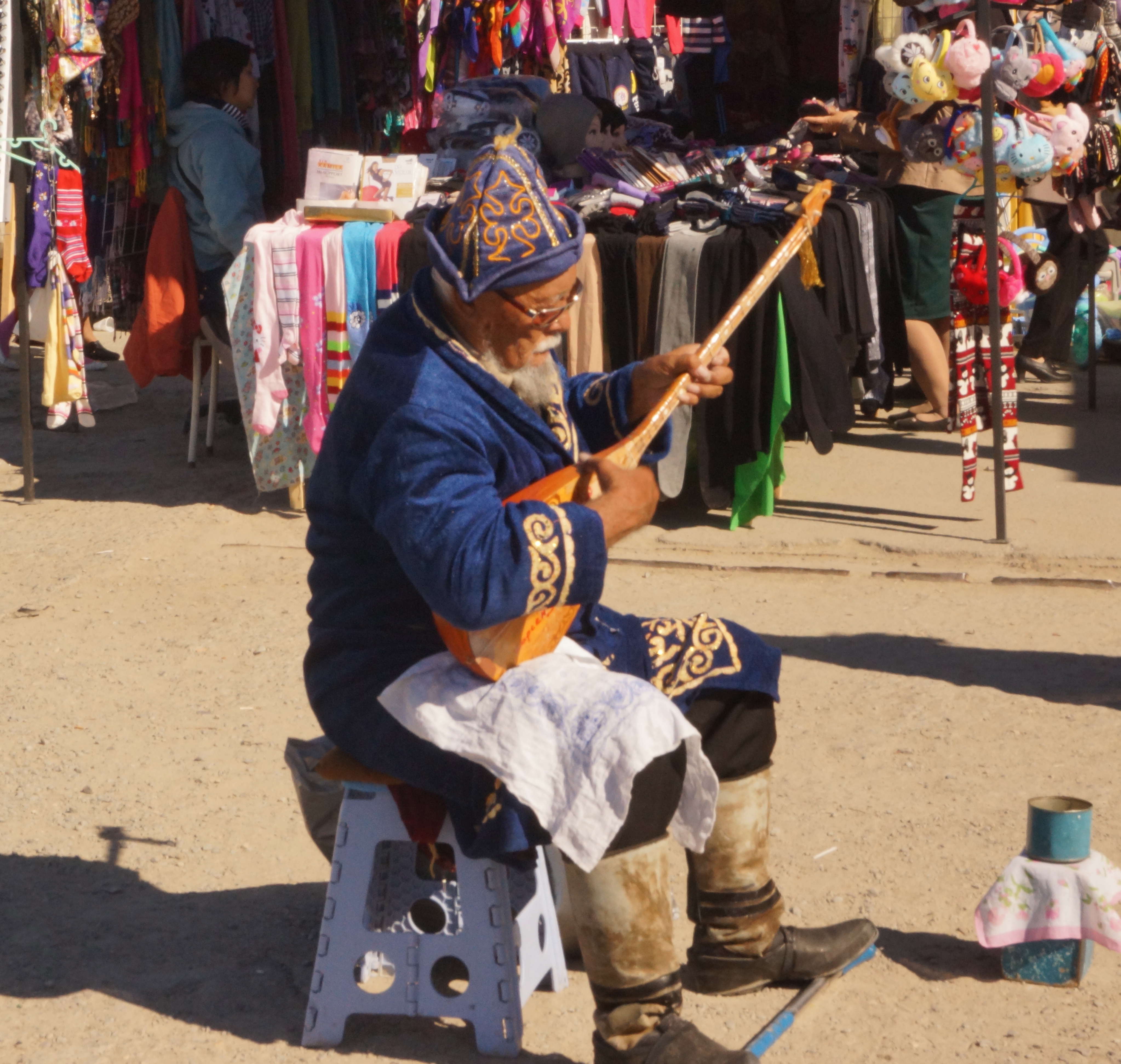
A dombra player serenades at the entrance of the old market

Call me crazy, but I had obsessed about it since I arrived in Kazakhstan… the dombra. The national instrument features in historical depictions and even on building gables, but I hadn’t actually heard one yet. Then last Saturday as we entered the old city market, there he was; an elderly fellow, resplendent in his costume, strumming his dombra. Few took notice except us; two ‘part-time tourists’, eager for culture. No it didn’t sound brilliant, a little twangy and scratchy, but then could you expect more from a two stringed instrument? As I placed a few tenge into the man’s pot, the musician glanced up and smiled. I stepped back to appreciate, intrigued with the simplicity of the tune. Yet I imagined that there must be more to this skinny long necked lute than his gentle strumming would suggest, perhaps it was the wrong setting?

On our recent trip into the ‘outback’, I had attempted to set the scene with some authentic Kazakh music. After jumping into the 4 x 4 and hearing the young driver’s stereo system, I innocently thought of dombra music. Even though Bon Jovi, Sting and the odd Russian ballad was on his playlist, I had the audacity to ask nonetheless…

“Sergei, would you mind playing some dombra music, pazhalsta?” He smiled politely, chuckled and shook his head decisively. All the while he must have been thinking… NYET!  You silly foreign woman, don’t you realize I’m a 25 year old with a very decent truck and stereo, not to mention I’m Russian! We don’t play dombra music, that’s Kazakh and so not cool!

Complete cultural faux pas on my part… no dombra music on that journey then!

I can’t help it that I love music of all kinds and for me, the music should compliment the time and place. My kids would often cringe in an Italian or Thai restaurant when I’d suggest that the ‘music should really compliment the menu and surroundings’. They were used to my pursuit of music authenticity. Ud music in Oman, Mozart in Salzburg and maybe it wasn’t culturally authentic, but it was always Tom Petty while sand-duning in Qatar. So this week when the newsflash came through that there would be a dombra performance at the local philharmonic hall, I could barely contain my excitement. I summoned hubby home early from work.”We’re going, be home on time!”

Actually, Bruce is usually quite accommodating with these things. When we lived in Scotland he surprised me with front row tickets to a Fiddler’s Rally, a romantic indeed!  There were the fiddlers and accordion players in their kilts, mesmerizing us with Strathspeys, Marches and Reels; bagpipers in the back row droning at opportune moments. As memorable as it was, I’m ashamed to admit that my enduring recollection of the evening was of an old kilted fiddler, front row centre. In the passion of playing, he ill advisedly crossed one leg over the other, a few gasps were heard from the crowd as he revealed more than we wanted to see.  A wee nudge from a fellow musician, the leg went back down, and the mercifully the music played on.

sc000a78de

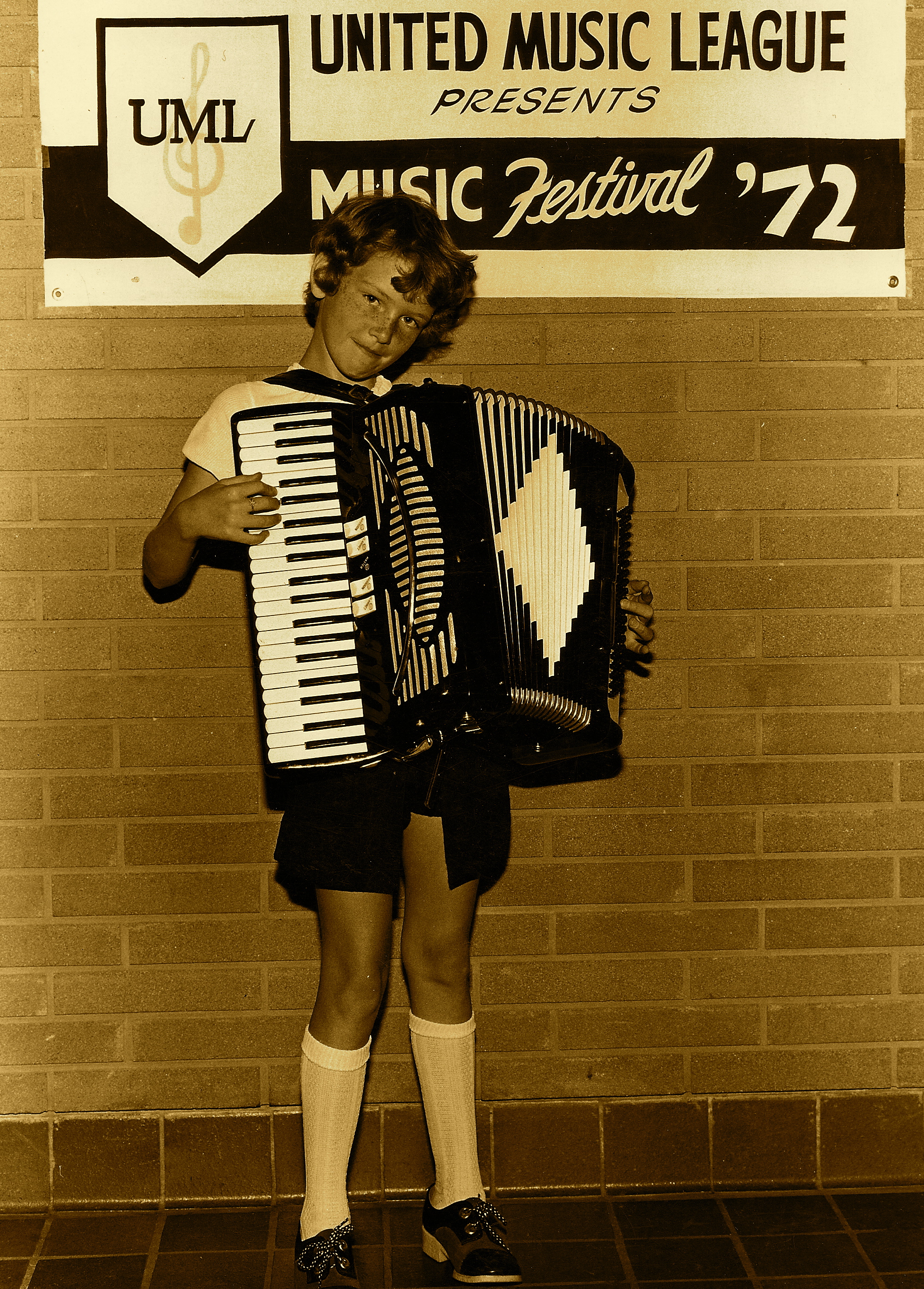
My young performing days

It is however, far more difficult to cross one’s leg while playing the accordion. I should know as I am one… a proud player who has been teased about it throughout my life. I was only eight when my mom ‘gave me the gift of music’. There I was, a skinny wee thing, lugging my massive Italian squeezebox up and down the stairs to my lessons. More often than not, I was reprimanded by Ms. Bergan for not having practiced enough, yet I did eventually perform in a concert or two. Certificates prove that I was part of a duet called Two Freckles, yet I would set it aside for sports and other pursuits. I can still play that beloved instrument which is stashed away in a closet, ‘set free’ maybe once a year. I lug it out of it’s tattered blue case and summon a tune or two on its aged keys. I’ve since learned to play the piano, yet there is nothing quite like heaving those bellows in and out as a rollicking song somehow materializes from that mass of buttons and keys. No, it isn’t glamorous, but I tell myself we’re a select bunch that can play.. that reminds me to thank my mom for those long ago lessons!

A second chance in the 'spotlight'

A second chance in the ‘spotlight’

As I got ready for our dombra outing, I recalled what I had read about the intriguing instrument, vital to Kazakh culture. It’s an essential part of their oral and musical culture; excavations of ancient cities have revealed terracotta statuettes two thousand years old, plucking similar instruments. Nowadays whether it be a staged performance or a traditional gathering in a yurt, the dombra represents the heart and soul of the Kazakh nation. Musicians tour the country vying to outdo each other, eager to share their virtuosity in styles that vary from region to region.  Would any of them be performing this evening, I wondered. Yes, they’re as integral to this culture as the bagpipes are to Scotland, as the sitar is to India. Or, as it’s Octoberfest this time of year, as oompah music is to Germany.  Which reminds me, allow me one more musical digression if you will.

DSC02158

Finding the music in Hamburg

I was in Germany, almost two years ago enjoying a ladies Christmas Market trip. The previous day had included choral music in a cathedral in the beautiful northern town of Lubeck, yet I felt that I hadn’t experienced that defining music that would encapsulate my travel experience. And so the last day found us in Hamburg’s Christmas market, steamy mugs of glühwein warming us in the frigid December air.

DSC02160 - Version 2

Any ideas on the name of this ‘stick’ instrument?

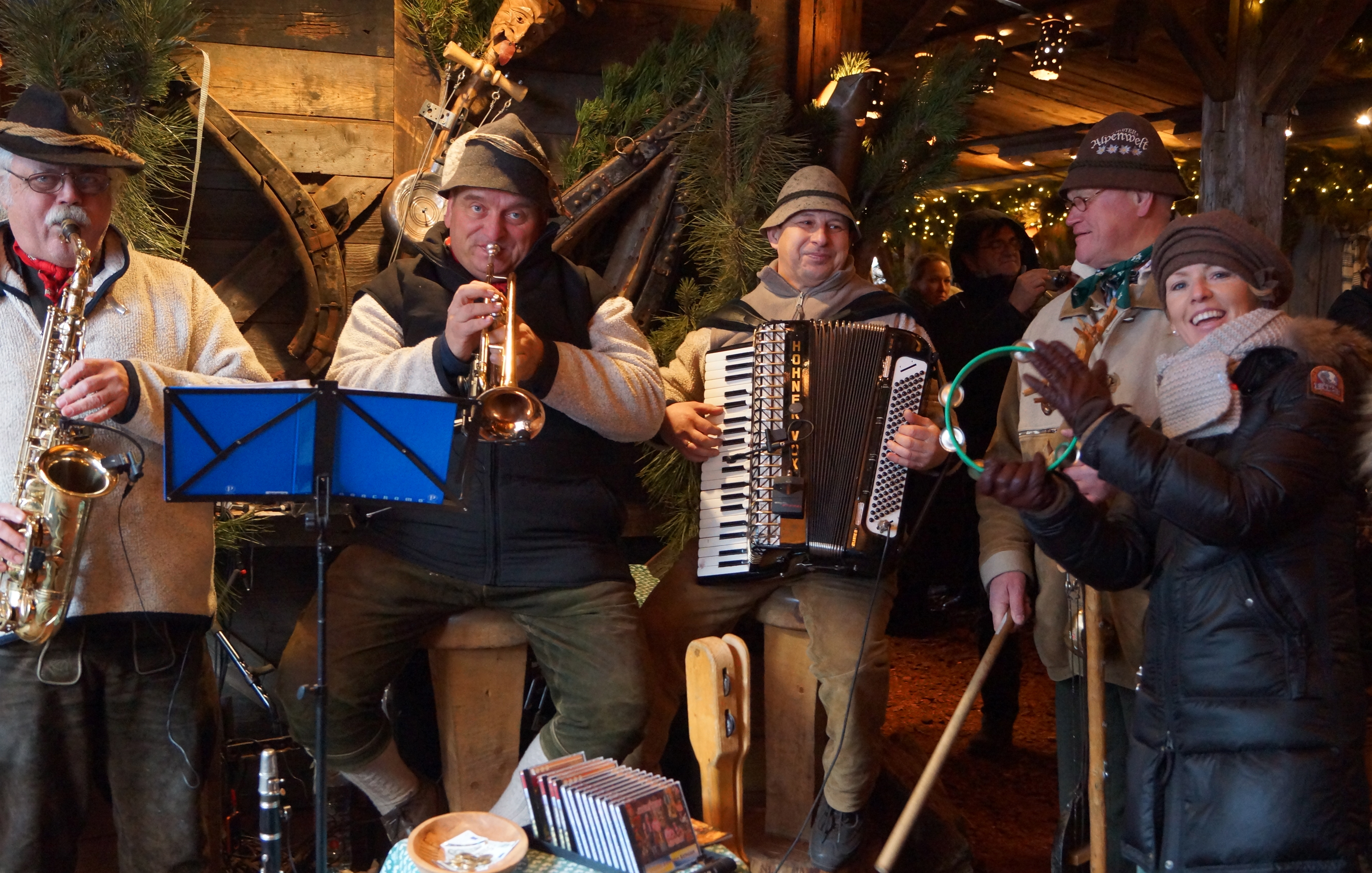
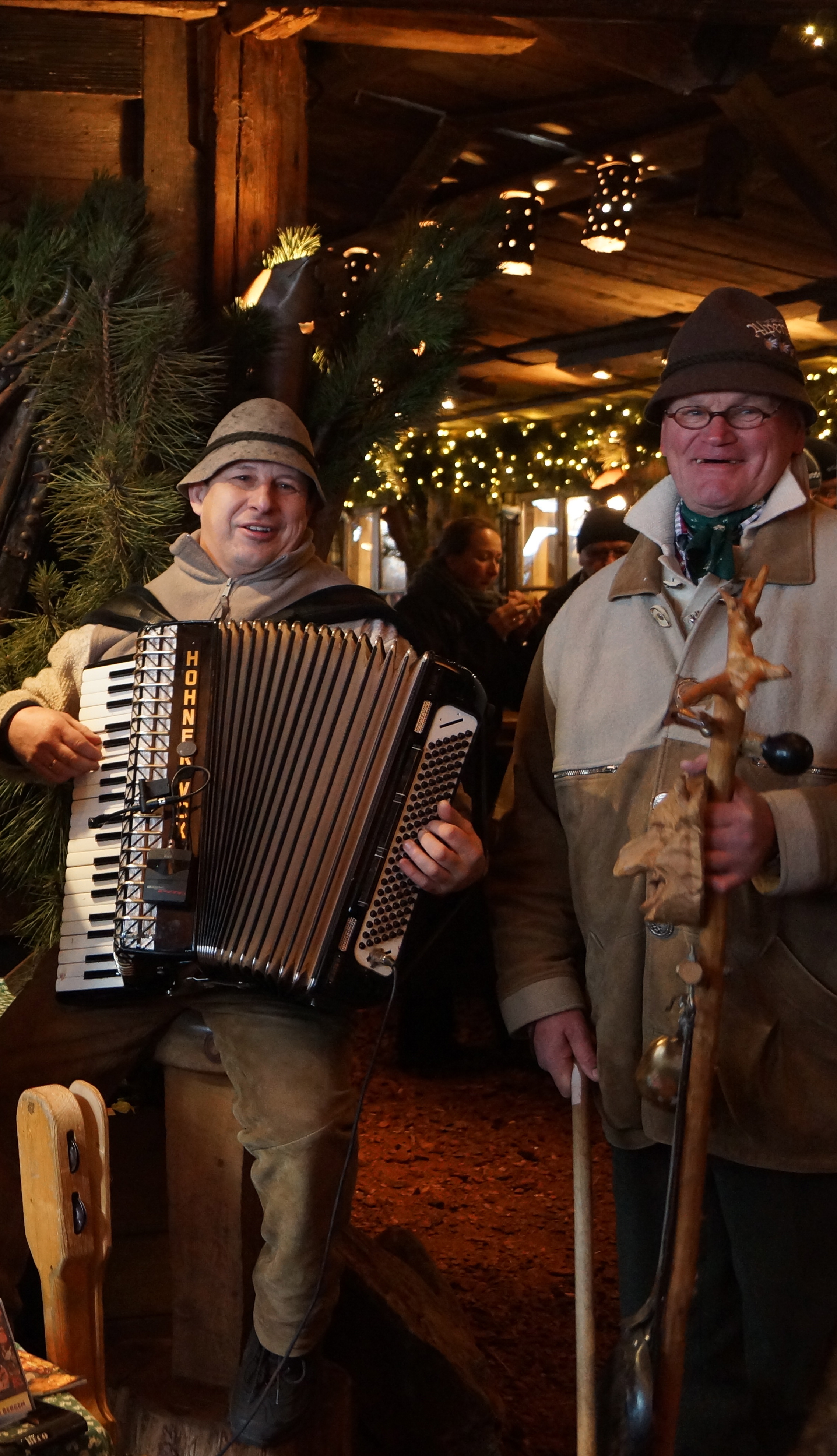
We wandered through the fairy tale atmosphere where every festive delight surrounds you; from the folksy hand carved decorations in evergreen stalls, to endless creations of marzipan, to the twinkling tanenbaums and painted nutcrackers. With food so irrisistedly delicious you smile as you compliment it with yet another mug to keep you warm. All of it was perfect and then we heard it! It was the music that I had so longed for; horns blasting, accordions blaring and a ‘stick a thumping’. Five minutes later there we were… dancing, twirling and shaking tambourines. Singing, laughing and soaking up the moment; musical and cultural perfection that I had hoped for. I then considered my trip complete.

But back to the dombra, surely you’re curious about the concert after all this rambling?!

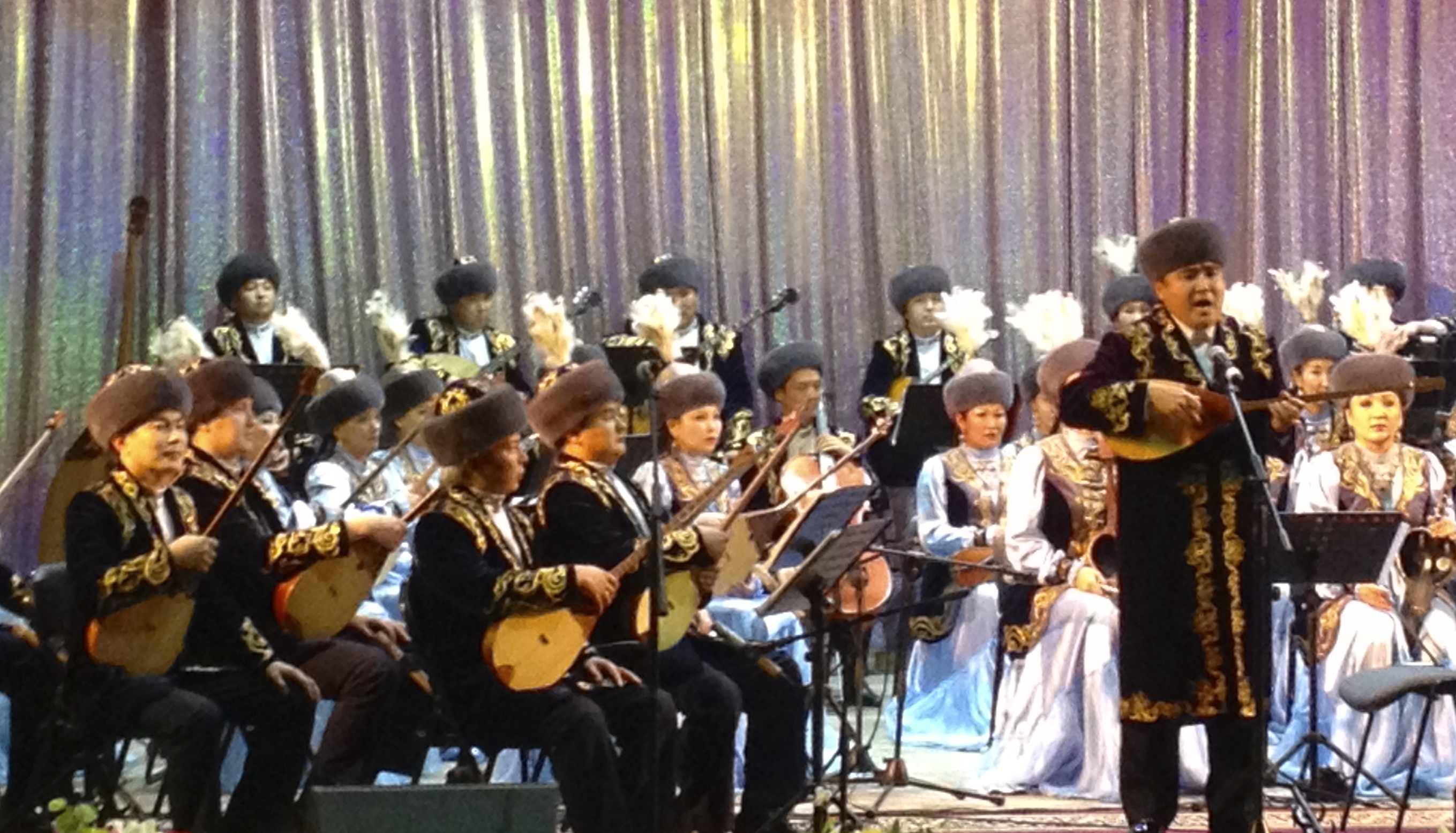
It was brilliant, simply brilliant. We had expected simple musical fare, but bouquets of flowers decorating the stage and richly dressed musicians hinted otherwise. When the statuesque compere took the stage, her diction was lyrical, rolling and guttural, beautiful even if incomprehensible to us. Her flowing red dress and fur-lined ‘saukele’ with a feather-tipped ‘spire’ transported us to a different world.

Rows of male dombra players to the left and, to the right, in pale blue flowing dresses, an array of ladies with two-stringed kobyz ‘fiddles’ nestled in their laps. Violinists, drummers, bassists and accordion players, all poised to respond to the precise commands of the conductor. The music was of the country and it flowed like the wind ripples through the steppe, like horses rush on the prairie. My imagination conjured winter sleighs and cozy yurts. It was truly music sculpted by the landscape and the culture of the open plains.

IMG_4144

An Akyn with dombra players to his left

Dressed in full-length boots, deep blue tunics and fur-brimmed hats, the dombra players were mesmerizing. Their style was at once simple and evocative – profound and lyrical.

Image

The lovely Compere, hostess of the evening

images-1

The iconic Bibigul

And then came the Akyn, tall and broad in a long Kazakh robe and fur hat.  These minstrels of bygone years once traveled to nomadic camps to entertain and enlighten. The Akyn tells tales that range from epic battles, to rich folklore to simple village gossip. I could hear it now in the music. First his dombra punctuated his words in rough accompaniment, then gave forth an eloquent display of virtuosity, widespread hands flashing across the strings. The crowd responded in the time honoured way, the way an audience around a camp fire or village square might have yelled out… “it can’t be so!” or “tell us more Akyn!” or simple whoops of approval.  I didn’t understand the words but realized that this interaction was steeped in tradition. The Akyn was the master of the story, the dombra his canvas, the audience his confidants.

And so it continued, different styles all telling of a vast musical heritage, unbroken across the centuries. Dombra masters such as Serzhan Shakrat and young pretenders alike were given their place in the programme. Our favourite was without a doubt the young soloist who played with such delightful arrogance; clearly vying for deserved notoriety and acclaim. Beloved opera star Bibigul Tulegenova had obviously won the nation’s heart long ago. This great musical icon was surely the star of the evening, presented with bouquets of flowers after each song and lavishly lauded in closing speeches from admiring dignitaries. However, what touched me were the countless young people in the audience who rose to their feet the moment the revered Bibigul was introduced. Cameras poised, videos readied, they nudged each other as if in disbelief that the great star was before them. That in itself was comfort; that the respect and love for this music is very much alive and will continue to be passed on to new generations.

We were dazzled by the absorbing and unique atmosphere. There were more than a few glances in our direction as locals sensed that we were ‘visitors’. They smiled knowingly as if to say, “This is our heritage and we’re proud to share it with you.” We were honoured to be there.


An adventure steeped in time… of camel caravans, limestone sculptures and peace

Standard
DSC04244

Embracing silence in The Ustyurt


They say that in the Ustyurt area of Kazakhstan, you will be cured of your vanity, your petty desires…

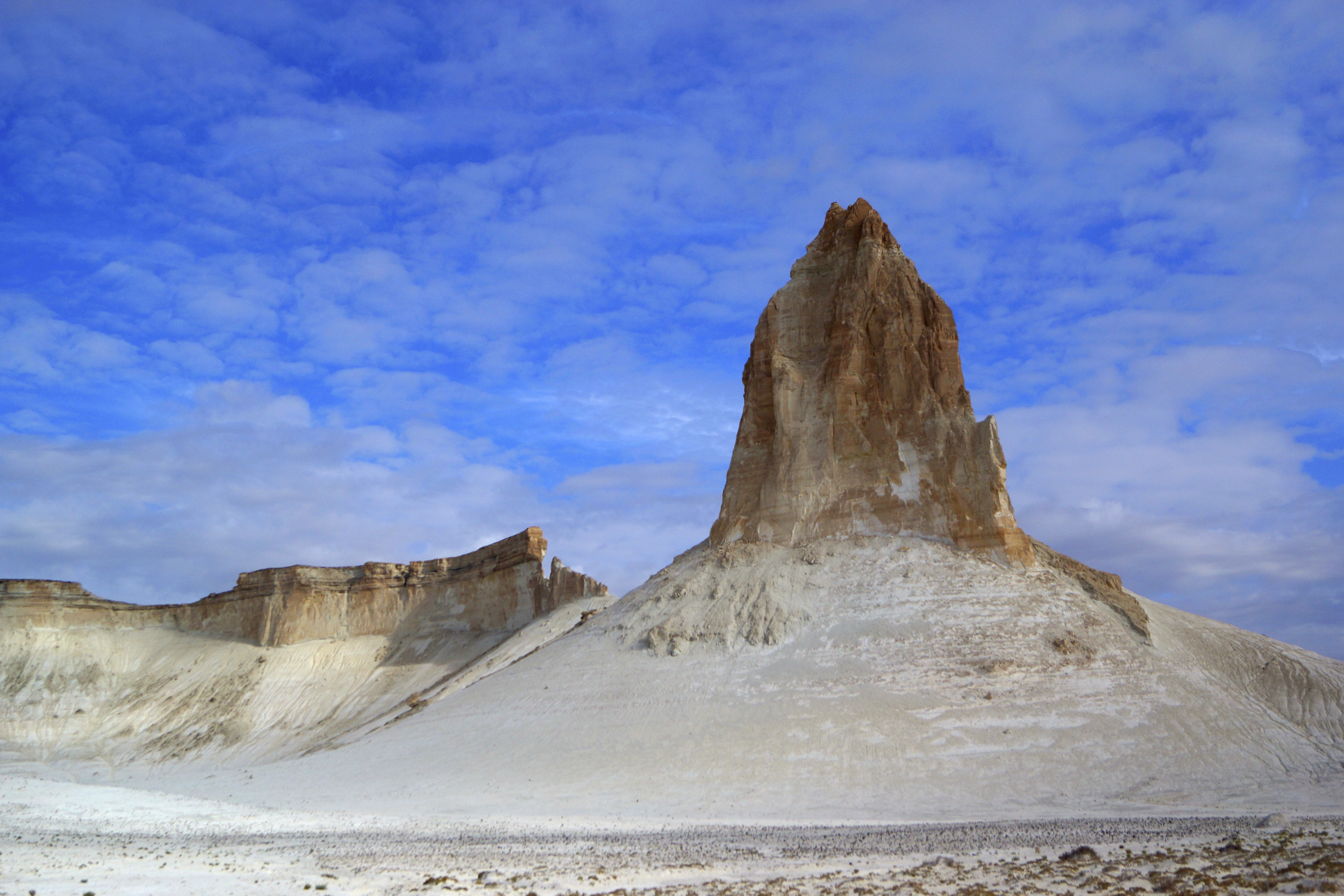
I understand why – so dramatic is the scenery, so soulful is the silence, so humbling is the history. It lingers in the ancient sea bed, it lives in the chinks of rocks.

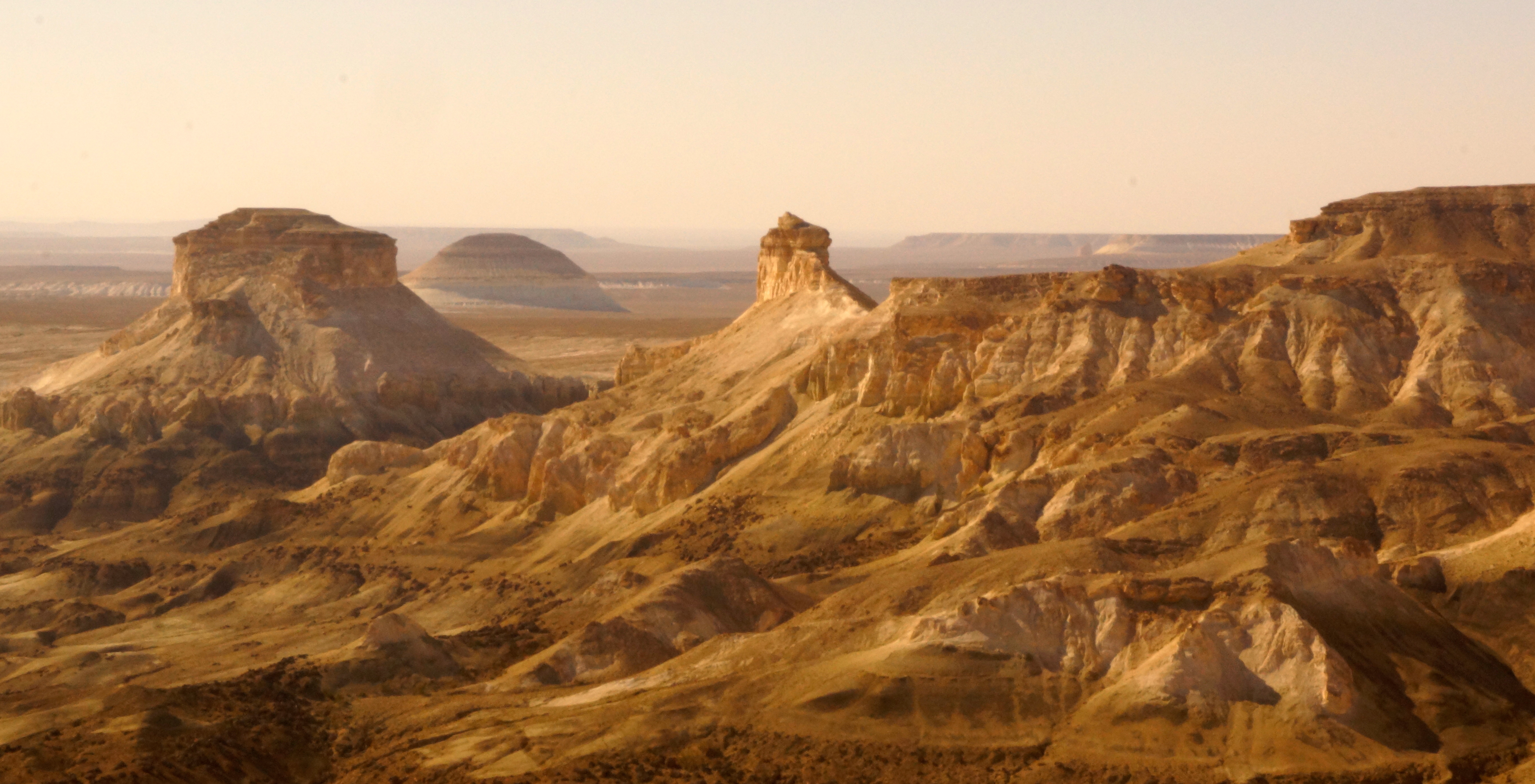
The silence was all embracing, only the noise of travellers disturbing the chalk and limestone mountains; hewn of tawny whites, creams and gelato pinks. Muted tones in the rocky sculptures of castles, arches and chalky yurts… a tapestry of life in pastel hues.  Yet a lime green succulent bloomed defiantly on the parched, desert floor. A dash of violet showed off in the distance.

DSC04281

A ‘yurt’ and a ‘fortress’

I’m sure it was forever this beautiful, but it wasn’t always this silent. Once the water flowed and the tides crashed. Sharks swam and fish gurgled.

DSC04423

The Bakty Mountain, tawny whites and gelato pinks

Caravans with countless camels trekked along the ‘silk route’. Laden with bounties of sables, silk and honey, falcons, birch and slaves. These caravan tracks of the Manqystau were well trodden, ‘ships of the desert’ shuffling to and fro, east to west… west to east. Merchants traded, a mingling of cultures and religions, of Indian and Babylon goods. Clay bricks that reveal secrets of roadside settlements, fortresses and homes.

Yet, uncovered layers hint at Stone Age migrations; those long ago nomads following tracks of gazelles, antelope and sheep.

DSC04214

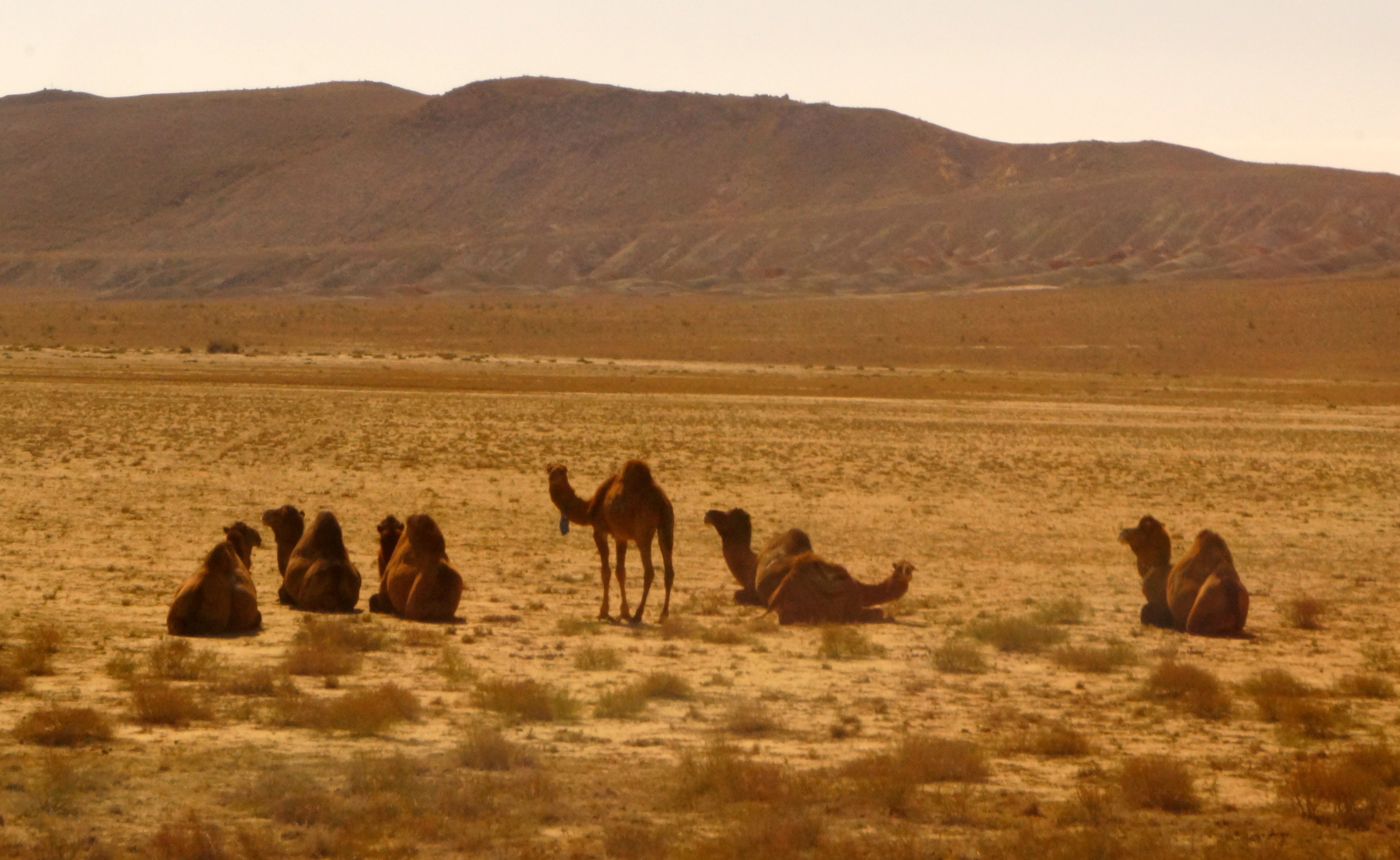
“Ships of the desert’

They live on still, graceful mouflon sheep prancing through the steppe, antlers of forebearers crumbling into the cracked and crusty earth. One and two humped camels shuffling through the sand, steppe eagles gliding overhead. Horses foraging for survival, herders tending torpidly.

A breathless trek to a high outpost. Through remnants of a stone walled fortress, where animals once were hidden, sheltered from enemy tribes. That safe haven, now a portal to a view of peaks. Peaks reaching to the desert sky, piercing the autumn breeze, drawing the glance of a soaring eagle.

DSC04360

A pinnacle piercing the desert sky

We camped in the shadow of a yurt, erected by nature itself. Its domed roof echoing our small, intimate, manmade shelters.  Now the valley was alive with crackling embers and sizzling meat. With campfire chat, Russian and English washing across the chill desert air. Yet deafening stillness… in the surrounding cliffs, in the moonlit crevices, in the dark holes of sleeping lizards.

DSC04496

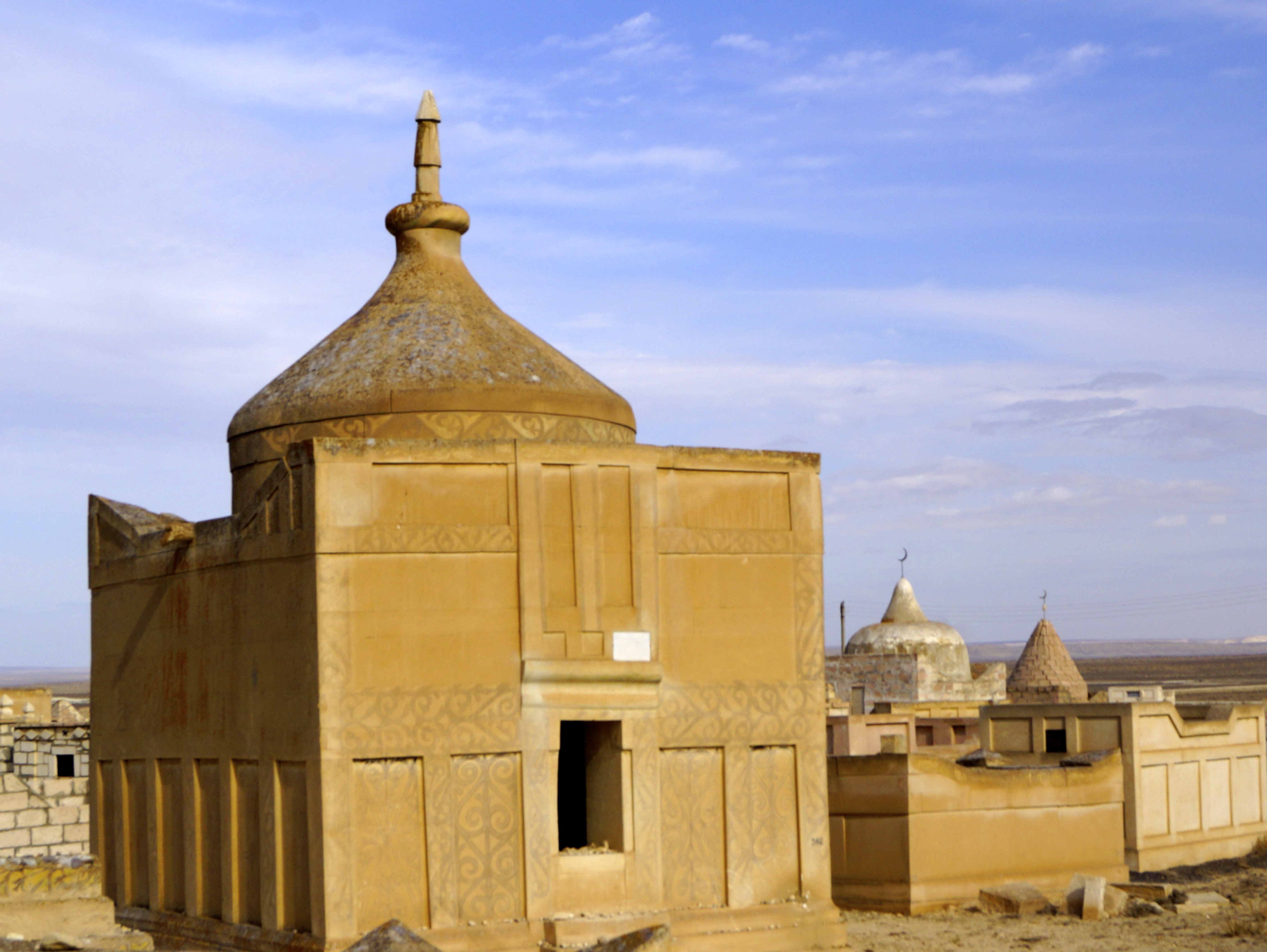
Mausoleum at Shopan-ata

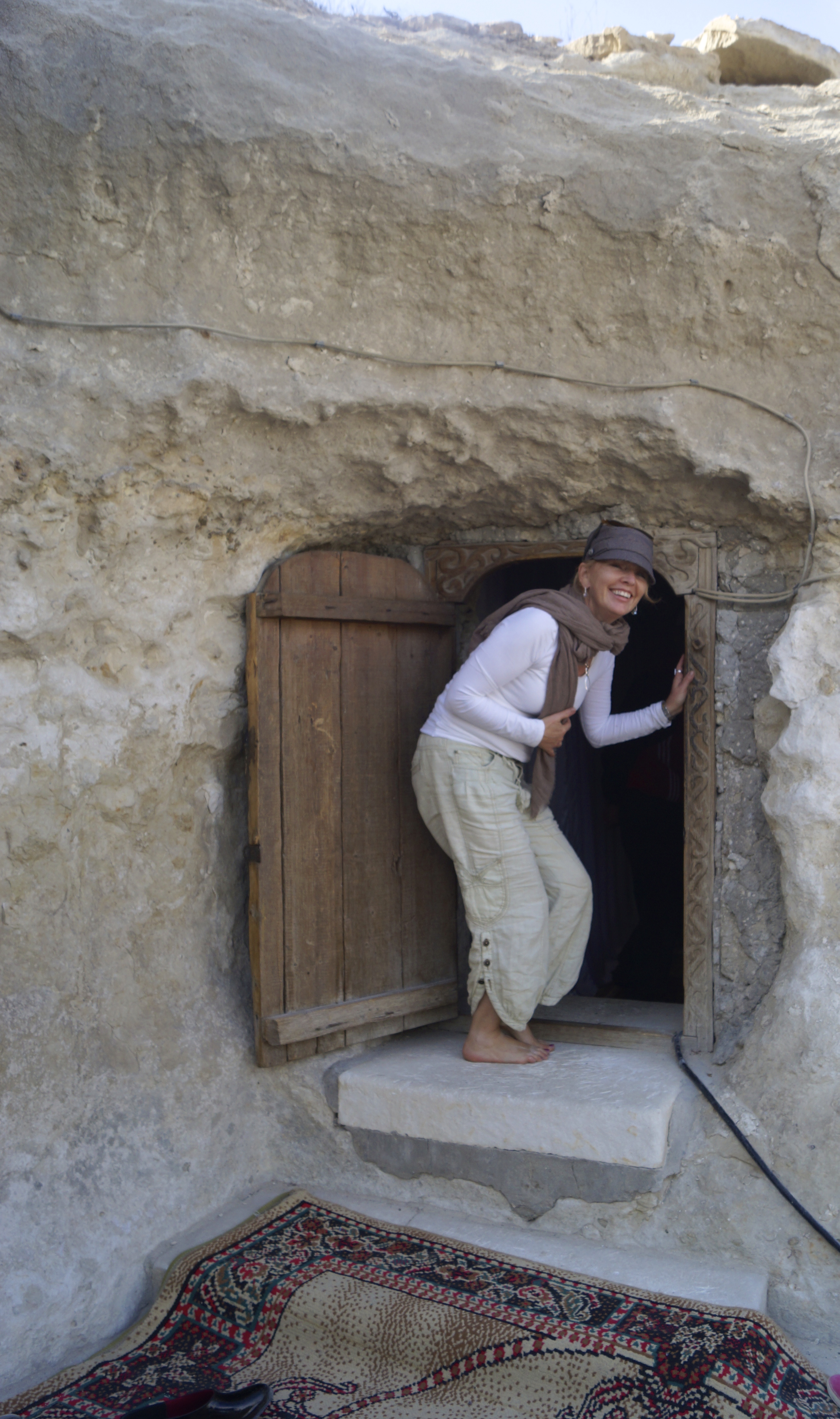
And it ended where it was meant to; in a sacred place.  The Manqystau ground is so. Legends hold it was blessed by as many saints as there are days in the year. Shopan-ata, an underground mosque where we were welcomed, shoes slipped off on rich carpet, beckoned inside. A maze of recessed spaces and cool in the caverns half light. Lizards dart in and out of niches. Sufi prayers etched on worn stone, a carved open palm for happiness. Our departure, a gifted white linen cloth, blue stitched for blessings. On the trail of pilgrims, since the fourteenth century. A place where all can enter, of any religion or creed.     Peaceful… as it should be.

DSC04483

The Necropolis of Shopan-ata

Outside that tiny carved door, near that hallowed ground, grows a mulberry tree.  Wrapping it’s wizened limbs around sinking tombstones, a scene unchanged. Did it once nourish those worms that would become silk…it is the mulberry leaves they eat.


Perhaps the pilgrims that rested here, had traveled this route. Perhaps they gazed at the same wondrous sights, in awe of the luminous moon, endless stars.


DSC04476

The underground mosque at Shopan-ata


DSC04261

On the ‘high outpost’

There is no perhaps… the wonders and vistas were theirs and they are ours. And that, is a joy, a joy to be had in the Manqystau.


DSC04258

Sculptures in the silence


Ode to a vibrant city, recalling transition and the help of serendipity

Standard


IMG_2527

‘Dining’ in Memorial Park at Boxwood Cafe

Sadly, my new found love affair with Calgary is to be interrupted; for now at least.  Having returned not quite a year ago, I’m about to pack up again. Yes it’s all too soon, but simply, my husband and I aren’t prepared to continue living at the opposite ends of the earth.  He’s been commuting from Kazakhstan, which is where I plan to join him at the end of August. Admittedly, I can think of far more ‘exotic’ places to become acquainted with, but adventure comes in many forms it seems!  That, however isn’t what this post is about…not quite yet anyway.  It’s about this great city, the transition woes that I’ve experienced and the start of settling and healing, thanks in part to a chance encounter.

IMG_2552

The cupola in James Short Park, now surrounded by glass. It marks the spot of the James Short School from 1905

Calgary was my home from 1982 to 1989.  After College, I loaded up my ’77 Camaro and headed to the ‘big city’, knowing it was where I wanted to be.  I’m living relatively close to where I was then, in the inner-city.   In my opinion, it’s the only place to be for someone who is often here on their own, as I’ve been this past year.  It’s vibrant and interactive.  It’s ideal for walking and cycling.   And it’s a changed city since I left when a mere  600,000 people called it home.  It’s now much more international and ‘hip’ with endless festivals, markets, and events.  Yet at the same time, it’s still a city that is caring and personal, despite a burgeoning population of 1.2 million.

I’ve often wandered to sit and write in one of the many vibrant cafes, which seem to be in endless supply along with bars and restaurants.  I’ve looked at this city from the viewpoint of ‘someone that returned after 24 years’, but also as a newcomer.  Inevitably, I meet people eager to chat, many of whom are from elsewhere but have chosen to call Calgary home.  I’ve been charmed by people’s warmth, the small town feeling and sense of cohesion and belonging.   That cluster of a fort and tents that would become Calgary, was established by the North West Mounted Police in 1885 and initially called Fort Brisebois.  This settlement at the confluence of the Bow and Elbow River has come a long way indeed. It was recently named by the New York Times as one of the world’s top sights to see, imagine that!

IMG_2556

The Barley Mill in Eau Claire. Reminders of the wooden buildings that were built during the time of the nearby Eau Claire and Bow River Lumber Company

I was on my own this past weekend and found myself out exploring in the gorgeous weather.  People were reading, playing and ‘dining’ in the park.  Kids played in water parks, people enjoyed music festivals and markets.  I experienced a city in perpetual motion of cycling, walking, long boarding and busking.  People of all ages but definitely many young and hip.  The average citizen of the city is now in their 30’s. They are active, globally conscious and oh so ‘switched on’.

I spoke to one such ‘hipster’ only in his mid twenties, at a 17 Ave. restaurant. He told me they were endeavouring to only use produce from a nearby flood affected area; to help them get ‘back on their feet’.  He then proceeded to point out the elements in the restaurant that have been reclaimed so as to minimize their carbon foot print.  I’ve noticed this change in attitude time and time again here.  I don’t think many of us had those concerns at the same age as we partied through the ’80’s.  I’m impressed!

Outwardly, it’s also a vastly altered city from when I Ieft in 1989.  The landscape is rapidly changing with an increasing number of tall towers and condos soaring over the compact inner city.  In fact the skyline is dotted with cranes, building for the future.  But thankfully there are still some charming vestiges of the ‘old’ Calgary and I sincerely hope they remain. Stately homes and buildings from the early 1900’s

IMG_2522

Beaulieu or Lougheed Mansion, 1891. The Lougheeds hosted many social gatherings and visitors, including the Prince of Wales in 1919

such as the Lougheed Home and Memorial Park Library (the first library in Alberta), not to mention many that  proudly still stand on Stephen Avenue Mall.   And there’s also the quirky and timeless images to be found such as the Galaxie Diner, the Plaza in Kensington or the wooden Barley Mill at Eau Claire that is now dwarfed by skyscrapers.

And as I cycled along the Bow River on Sunday, I mused over the phases that I’ve gone through in settling here. It hasn’t been without its trials, despite seeing family more often.  One would think being ‘home’ should be an easy adjustment.  But, we know from writers like Robin Pascoe in her book Homeward Bound, that repatriation is often a struggle for expats. It warrants the need for discussion and understanding of what re-entry has in store for us.  “It has a cycle of its own and mercifully, it ends.  It just doesn’t end overnight…”, Robin reminds us.

How true that is.  For me, it was last September when the ‘honeymoon period’ came to an abrupt end and I found myself in ‘crisis mode’, about two months after I had moved back.

The irony wasn’t lost on me. Early one afternoon that month, I had cried on my son’s shoulder.  I was an emotional wreck as I sat at my desk trying to concentrate on work.

“What am I doing here, not that it isn’t great to be here with you, but..?”

The iconic Plaza Theatre in Kensington

The iconic Plaza Theatre in Kensington

With more tears falling from my already swollen eyes, I lamented that I was missing my life of four years in Norway, my friends, my job, not to mention my husband.  And for the first time in 20 some years, I didn’t have a return ticket for the end of the summer; that seemed to be what pushed me ‘over the edge’. Normally at that time I’d be departing from our vacation home in Kimberley after an eventful summer, off to my ‘other life’. No, now I was staying put, in Calgary and I wasn’t coping very well.

A festival and Market in Haultain Park

A festival and market in Haultain Park


In a role reversal, my twenty-two year old had comforted me.   Heeding his heartfelt and sage advice, I had no choice but to pick myself up and get on with the task at hand. I had a deadline to meet. A cross-cultural presentation to prepare and here is where the irony lay. I needed to research and prepare a one and a half hour presentation that would inform and inspire a client in the Oil and Gas industry who was soon moving to Calgary. It would be a synopsis of life in the city, the advantages of what this ‘Cowtown’ has to offer. And so in tears and overwrought, I began the work, perplexed at the irony of doing this just as I was experiencing the worst day thus far of repatriation.

IMG_2545

A wooden ‘cowgirl’ sign that has survived, for now.

IMG_2573

The city skyline, looking out from Mount Royal

However, as time passed and I worked into the wee hours of the morning, my mood changed. Yes, I could attest to the colourful mosaic the city embraces due to people here from all over the world.  Absolutely, the restaurants are second to none.  Naturally, the Calgary Stampede attracts people worldwide as does the nearby Banff National Park, and so on and so on.   By the time I finished at 3 a.m., my mood had lifted dramatically.  I pressed the ‘send’ button and the presentation was transmitted to, of all places, Norway. Four days later, I presented to a delightful gentleman from Bergen. With each of us focused on my presentation on a computer screen, I would do my best to convince him that his two year stint in Calgary would be an enjoyable experience.  Of course he was a skier, being Norwegian, how far was Banff?  Yes, he was looking forward to dining out without it costing a small fortune  (no, I wasn’t missing that aspect of Norway!)  And yes he loves cycling and are there bike trails?  ‘Only’ about 800 km. or so I happily assured him.  And so the presentation went well and it helped remind me that there was so much to do in the city. I had to accept where I was, move forward and take advantage of it.

I return to the day after that 3 am. finish.  And this is where serendipity comes into play and how it also helped pull me out of my melancholy state, out of that ‘crisis stage’.

A  ‘wee’ story within…

I decide the next afternoon that I need a walk but don’t get very far.  I’m tired from the 3 a.m night before and still emotionally jaded, so decide to turn back and have a late lunch on 17th Ave.  I make my way to our new ‘local’, 80th and Ivy. Serendipity is a wonderful thing that thankfully seems to present itself at times most needed, for on this particular day, the friendly manager greets me and we chat. Normally, I, (we) sit in the bar but today he suggests I sit in the restaurant. It’s comfortable in a trendy, minimalistic way and it just so happens to be six dollar wine and twelve dollar pizza Tuesday. Perfect, it’s now 3 in the afternoon and I’m looking forward to a glass of Shiraz and a small designer pizza (the pear and gorgonzola is amazing!)

I’m seated at a table for two on a long, leather bench seat that extends to other tables, one of them being where two lively women are sitting.  Once I’ve eaten, I pull out my Moleskin and proceed to write.  As I do so, the chatter and laughter of the two ladies, one empty table down from me, happily pervades  my concentration. They’re infectious and admittedly, I begin to eavesdrop just a little ( please tell me I’m not the only one to have ever done this!)   I notice a colourful gift bag perched on their table. Something is being celebrated and when I hear snippets of a new romance, I’m curious. I look over and the older lady of the two meets my curious glance. She has vibrant eyes, framed by a stylish, short haircut. Her strawberry blonde colouring is similar to mine and I’m soon to discover that her trendy hair style is thanks to the other lady of the dynamic duo.

The Calgary Tower

The Calgary Tower

And they will tell me that though they’ve been client and customer for almost twenty-five years, this is the first time they’ve gone out together. That’s clearly a shame as they get along fantastically and I’m soon to join the fray.

Karen and Melissa Jean are intrigued by my story that begins to enfold an hour later. I’m impossibly happy to have met these ladies and I feel comfortable enough to share my ongoing ‘transition blues’.  I’ve now joined their soiree and as it’s already 6p.m., the dinner crowd is making their way to the nearby tables. By our lively chitchat and uproarious laughter, it’s clear we’ve been there awhile. Blame it on the six dollar glasses of wine and the endless stream of stories we all have to tell, but it feels like we’ve known each other longer than a few hours!

Through the trials of cancer and divorce, of retirement and leaving the suburbs, of relocating internationally, of leaving the city to a small town to be with that long lost high school sweetheart (who does look pretty hunky on that little i phone screen), it was one topic after another.   At one point, I suggest to Patricia that her accent is twinged with a note of Scots, ” I should know I’m married to one”, I say.  

“Aye lassie”, she says mischievously, laying on a thick Scottish accent, “I’m originally from the West Coast.”  

80th and Ivy, our 'local' now decorated for the upcoming Stampede

80th and Ivy, our ‘local’ now decorated for the upcoming Stampede

“Small world”, I reply excitedly “that’s where my husband is  from.” And there we go, off on another tangent.

“Terry Anne, you’re a gift from above”, Karen would quip intermittently as the evening wore on and the wine kept flowing.

“No, you two are the gift I needed today. You don’t know how I needed this respite, the laughter and the friendship”.  I tell them genuinely.

“Oh no”, pipe up my new friends, “it was meant to be, it was serendipity!”

As we all live in the same neighbourhood, we walk Melissa Jean a few streets down to her high-rise apartment. She laughs endlessly like a love-struck school girl. In two weeks, she’ll be happily ensconced in a new relationship at 50 something.  A new lease on life through decisions made on her own accord when she faced cancer and decided life was too short to settle for second best. I admired her as she was bold enough to take the plunge to a new life; a sentiment not lost on my ‘supposed hardship’ at the moment.  It brought me to my senses so to speak and I realized I had to make the most of my situation, despite living apart from Bruce.  It was time to ‘turn the page’.

The downtown city lights twinkle behind us, a reminder that the reason we live in an area where you can readily walk and you just might chance upon an afternoon and evening like today. A chance encounter where the joy of women and friendship revitalize a confused soul. The joy of having conversations you didn’t know you’d be having, with people you can’t imagine not having met. Twenty-four hours ago, melancholy had gotten the best of me.  The transition of the move had overshadowed the simple pleasures of being home; I felt the anticipation of not knowing what was around the next corner. As we neared my townhouse and said our goodbyes, Karen promised we’d meet again soon.   Perhaps a monthly ‘Tuesdays at 80th and Ivy’ we both agreed.


And since then, there’s been mostly joy and contentment being here with family and friends in this fair city. Yes there have been some lows on the roller coaster as I coped with some family issues over the months, but I know I needed to be here for those and I’m so thankful that I was. In retrospect, there isn’t any place I would have rather been.  I also had the privilege of being able to hop on a plane and ‘escape’ to visit Bruce in Europe.  What we have found however, is that each time he’s returned here, it’s becoming more difficult to part.  It’s time to live together again and let a new chapter begin.

globally-ranked_peace-bridge

The Peace Bridge designed by Calatrava

I know after spending August in Kimberley, I will again be on a plane.  That old familiar transition stage will start all over again as I move to the ninth country I will have lived in.

This time I’ll be missing Calgary. However, we’ve invested in a modest pied-e-terre that will perhaps become our emotional anchor to the city.  One of our sons will live there, but there’s a ‘wee’ room for us to call our own for when we visit.  And just outside the door are the walking and cycling trails, great places to wine and dine, we’ll be able to hear the Calgary Folk Festival from our balcony, the lights will twinkle on the frozen river and on and on. I truly now appreciate the privilege it is to come from this part of Canada, from this city. I’m grateful to embrace it as my own and hope it will give me the solace I’ll need, for the ‘interesting’ days ahead.


*Calgary was initially referred to as Bow River Fort then named Fort Brisebois by Inspector Ehphem Brisebois. He was the Mountie overseeing the new fort at the confluence of the Bow and Elbow River, during the brutally cold winter of 1875 – 76.  Colonel James Macleod then renamed it Fort Calgary after Calgary Bay on the Isle of Mull in Scotland.


Two backpackers, post restante and a collection…

Standard

We left with backpacks, cameras and journals; that’s all that was necessary really.  Not a cell phone, a tablet or a computer.  Yes, it was wonderful last week to Skype with my son in Thailand and WhatsApp with him today as he sat in a thatched hut in Laos. But I feel privileged to have travelled with the promise…I’ll write soon.

IMG_2354

Two backpackers in India, circa 1989

Understandably, it was wrenching for loved ones to wait for letters and postcards to arrive and hopefully read that all was well.  But that was the beauty of it; to receive that correspondence and devour those long awaited words.  First eagerly, but then more slowly to take in every detail. Those letters could also be secreted away and brought out again and again,  just to feel closer to that person so far from home.

We had planned only a basic itinerary for our six month backpacking trip.  Yet it was enough to inform our parents to send a letter to Poste Restante Dehli on such and such date, then to Kathmandu by another date… and on and on.  That was our only means of communication, we agreed only to resort to collect phone calls if necessary.

IMG_2335

Poste Restante as a return address on an original Aerogramme

Poste Restante is French for ‘post remaining’ or mail that is held.  One could also refer to it as General Delivery.  At the time, walking into one of these main post offices on the other side of the world was an experience in itself.  They were often dark and musty with a uniformed postmaster sitting with disinterest behind an untidy, wooden desk. Not wanting to be disturbed, it was usually a performance for your mail to be located as he hunted the tall shelves, layered with endless cubby holes.  You waited with anticipation yet also with trepidation.   Will there actually be anything for me, did they send it in time?  And if they had, you did not carelessly tear open the envelope. You found a place to open it carefully, then read, hoping all was well back home. I have a distinct vision of the steps to the Poste Restante in Hong Kong; crowded with backpackers eagerly reading their long awaited letters from home.  Not only did we correspond frequently with our parents, we also received many letters in return.

A long letter on parchment paper from Nepal

A long letter on parchment paper from Nepal


And thankfully, every one of them was kept.  Each letter and postcard recounting the tiny details one forgets through the years. To read them now evokes images and memories that electronic gadgets will never replicate.  They are now hidden away, somewhere safe, in the hope that one day they’ll be appreciated for what they represent.  A time when words were chosen carefully and written in your most presentable penmanship.  A time when words were savoured. In fact as travellers, most evenings we would happily write by candlelight which would shed a more romantic sheen on the often basic hostel we found ourselves in. Updating our journals or writing long letters on carefully chosen stationery became a relaxing ritual, with the added comfort of knowing how much pleasure they would bring. Once they finally arrived on the distant shores of Canada and Scotland.

It seems my love of paper and stationery was with me even before I jaunted off to Asia.  For some reason I can’t explain, I have always adored it.

The first paper collected, the iconic Florentia from Italy

The first paper collected, the iconic Florentia from Italy


My collection began on my first trip to Italy when I was 18; that lovely ‘Florentia’, with its paper of finely embossed gold, woven through vibrant flowers and leaves.  I remember it was displayed on my desk once I returned home and I couldn’t bring myself to use it.  It was just too beautiful.  I now wander into the tiny shops when I return to Italy and find it impossible to not treat myself to just one more bundle of notes or calling cards, anything will suffice really.  And I gladly use them now, as often as I can!

My compact souvenirs, stationery

My compact souvenirs, stationery


That first purchase prompted me to also collect hotel stationery. That one sheet of paper and envelope encapsulates a moment in time and place, each with a unique letter head and often foreign language.  It evokes the sights admired and the time enjoyed, in a place you’ve been fortunate to have visited.   And so I admit, since that backpacking trip in 1989, I have taken just one piece of paper from each hotel.  However, nowadays, I often have to ask as it appears that

Letterheads that evoke a time and place

Letterheads that evoke a time and place


stationery is a dying art, much to my dismay. Though I’m sure the demand has diminished, what with those handy tablets and computers! Of course we couldn’t live without them, however there’s nothing I’d like more than to reach into my mail box tomorrow and discover a waiting letter. Post marked from Asia, with stamps that hint of where it’s from, with an address that’s just yours, with an exotic letterhead…ah, one can but dream.  Let’s see if he reads this!