The breathtaking Bugaboos… a welcome home to a ‘cathedral in the sky’

Standard


I’m now in Canada, dear readers, and I apologise for my absence from these pages. Through my last blogs, you’ll know we left our Indian home of two years. We travelled through Greece, Scotland and England, then a two-month stay in The Netherlands, before finally, beautiful British Columbia greeted us. It was as if our dear mountain home sighed with relief, “Ah, you’ve finally returned.’ It had been nine months.

So, we’re home, perhaps to live (to be decided) but nonetheless, the transition of almost thirty years overseas and now having one address is ongoing. You can read more at Monday Morning Musings.

IMG_8897Call it a welcome home or an initiation back to Canada, recently I was enticed into an overnight hike. Really, it was into a wonderland of chiselled granite at 2230 meters, into a rapture of beauty. It was a profound privilege, yet, it had to be earned.

The world acclaimed Bugaboos are at our doorstep, a range within the great Purcell Mountains – the Rockies are just across the valley. We joined many others who journey from around the world to hike and take on some serious climbing. My hiking partners promised that I would manage the ascent, but as is often the case, I’m the weakest link… the little engine that ‘hopefully can’.

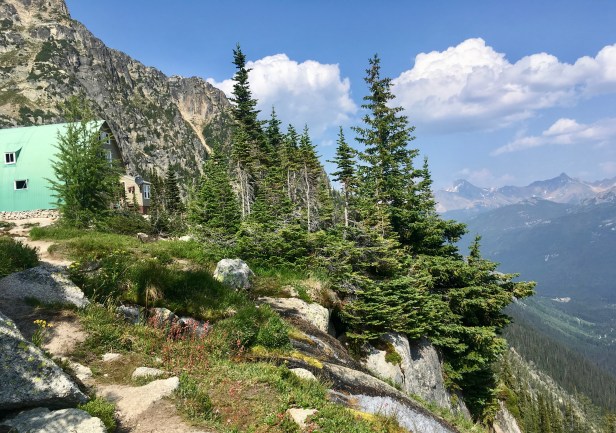
The hike’s end point was to a hut that has seemingly been dropped from the heavens onto a granite outcrop. Flanked by a glacier and granite spires piercing the clouds, the Conrad Kain hut will take us about four hours to reach. A little nervous, I comfort myself with my badge of honour; that eleven-day hike back in the day to the base camp of Annapurna in the Himalayas. There have been many hikes since, but gazing up to this ‘hut in the sky,’ it seems a little formidable.

It begins easily enough, a gentle meander through aged forest and feathery ferns, past dainty wildflowers and lush meadows. That pleasant amble gives no indication of what will soon be asked of us. To tread carefully along steep granite steps and narrow edges. To grip chains for safety and ladder up a boulder. To climb higher and higher, the small green dot of the Kain hut ever-looming in the distance to encourage our progress.

We break in much needed shade for lunch, a carpet of pine needles and knobbly tree roots our bench. We chat with other hikers and guides who encourage their charges up the mountain.

Our unofficial guide is friend and neighbour, John Parker. John exudes calm encouragement, yet there is a task at hand and there isn’t time for idle dallying. But then, this was John’s work and his passion, the commitment to his lifelong career shows as he leads a steady way. “You’re doing great,” “Take small steps on the steep ascents”, he encourages me. By the fourth hour of the hike, I need all the inspiration I can muster.

IMG_1012

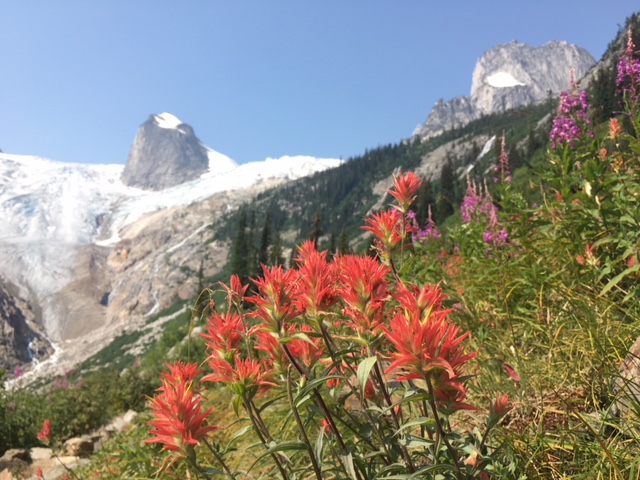
My legs are seizing up. My back is aching. Thankfully, my breathing isn’t as bad as I feared, but I am now w i l l i n g each step, hoping for the end. And then, as if nature senses that it’s time, one of the most glorious views reveals itself. A meadow of wild flowers opens up, a crystal-clear melt-water torrent rushes from the glacier, and we cross a simple metal bridge to the final climb to the Conrad Kain hut. Without a doubt, it is one of the most beautiful sights I’ve ever seen. Anywhere.

IMG_8908

Perched on a granite prominence, the hut with its green arched roof contrasts with its backdrop of glaciers, vast fields of ice, rugged and cracked, harbouring crevasses of the deepest cobalt blue. The hut and the enveloping landscape beckons me as I trudge up the final metres. It seems to say, “You’ve made it, welcome!”

The four of us unburden ourselves of our packs, add our climbing poles to the collection already outside the hut, and hug each other. “Well done, Terry Anne. You’ve achieved this,” John congratulates me. Sonya and Bruce do as well, and I admit to feeling like a school girl who has gained some respect from her teacher. Later that evening, I’ll hear more about John’s students and his career, but first we take in the buzz of the hut.

We’ll join about thirty other people who will spend the night on mattresses lined edge to edge over two upper floors. Sleeping bags claim their spots. But it won’t be a quiet night, what with the snores of exhausted climbers or 2 am alarms set for pre-sunrise departures for distant climbs. Head lamps light the way, for many early trekkers, the hut a staging point for serious climbers. Ropes are wound, helmets wait at the ready, crampons packed, quick-draws checked and counted, ice picks hang nearby.

The communal dining room, with its million-dollar view, is a place for sharing climbing stories and discussing routes, for reading and games, and replenishing weary bodies with freeze dried food. Though wonderfully, Bruce and Sonya on cooking duty would out do themselves – our dinner and breakfast warmed in the hut’s vast kitchen was just what my weary body needed.

Happily, it’s happy-hour, Sonya and I retreat to the side of the hut, exhausted but gleeful. A tin of glacier-chilled wine is our reward… and of course, that view. Surely, Conrad Kain would approve of his eponymous mountain abode. They say that Kain brought glamour and imagination into the sport of mountaineering as few guides had before him.

For nearly thirty years, the Austrian born guide, saw peaks as the personification of  beauty, as living entities to climb – firstly in Europe, then New Zealand and Canada. With his short, stocky stature, the climber achieved more than sixty first ascents, including the Bugaboo Spire in 1916 which now presides over us and the lesser spires like a grand citadel.

IMG_8919

We exhilarate in this cathedral of nature, and while Bruce and John hike upwards to the Applebee camp for a closer view of the ‘citadel’, Sonya and I stay put, entranced by the view. I recall what I had read of Conrad Kain. He eventually settled nearby, largely earning his living as a trapper, a hunting guide and an outfitter. His passion for communing with nature was steadfast. Kain once wrote, “Life is so short, and I think one should make a good time of it if one can. The only thing I enjoy now is Nature, especially spring in the mountains, and letters from friends. Sometimes I think I have seen too much for a poor man.”

Apparently Kain’s principles kept him poorer than he might have been and despite his achievements he sought no fame. With a grateful look across a beautiful alpine scene, he was known to have remarked, “It occurred to me that after all I was a rich man, even if I had no money.”

IMG_8159

I feel that now. The sheer beauty of this view is truly priceless. And somehow, it’s all that much more special because of the effort invested in reaching it. As I watch climbers trek off to the campground, a rainbow of tents pitched on a natural rock plateau, and as others ready their gear, I understand this world a little more. I now appreciate why one of our sons and his girlfriend are passionate about hiking and climbing. I more easily see why, when my husband and another son came back from trekking in Nepal a number of months ago, Bruce remarked, “It’s the sheer uplift of the soul… being part of primal wilderness.”

A few hours later we linger over our well-earned dinner that we had packed up the mountain. I ask John more about his career, surely a celebration of the great outdoors, as he helped design the curriculum for Outdoor Education Ontario, in his particular school. It offered high school students the opportunity to grow, to learn self-reliance, to move out of their comfort zone through outdoor pursuits.

IMG_8192

John Parker

“It might have been rock climbing, hiking, wayfinding, canoeing, winter camping or Nordic skiing. They learned confidence and independence. But I had hoops they had to jump through to earn their place on these trips; they were real achievements.”

John relates the life-changing impact the program had on students, the passion he still feels as a retiree is clear. “Years later, I’ve had calls from former students wanting me to know that I inspired them to become teachers themselves. They’ve told me how the program turned their life around. You really bond when you’re in the wilderness, barriers drop and kids confide in you. And I made them journal their experiences for self-reflection.”

As we listen to John reflect, I can’t imagine there isn’t one of us that doesn’t wish our children had been part of an outdoor education program. Our sons were avid sportsmen and yes, we were often outdoors, but studies show there is something intrinsic and vital about the connection, the challenges, and the healing of nature.

It’s still light outside at 2200 meters and as much I’d love to stay awake to watch the moon rise over the whites of the glacier and the grand citadel, it’s difficult to keep my eyes open. It’s only 9 pm.

The door opens and in bursts a climber, “Ah you’re back,” someone at the table exclaims in a German accent.

“It was awesome, been out for 25 hours straight,” the climber says. He’s draped with ropes and his tired but satisfied smile speaks volumes.

I say goodnight to my own climbing buddies, but realize I have just one more question for John.

“Did your students call you Mr. Parker on these trips, in those outdoor classrooms?”

John answered me in his usual charming, warm tone. “No, I was usually J.P.”

“Ok, J.P, thanks for the day and leading the way… just amazing!”

I don’t yet know, that descending tomorrow will be even worse than the climb. That I’ll take a tumble and that once I’m down the mountain I’ll gaze back up at it in awe. Already missing its serene and hallowed place.

But for now, my aching legs climb the ladder to the loft and slip into the cocoon of my sleeping bag, joining the long rows of sated guests. But still no sight of the moon – only a glacier and a glorious granite spire to lull me to sleep. It takes about two minutes.

Like those students of J.P’s, I feel a sense of achievement and fulfilment. Even though I had stepped out of my comfort zone, through this hike I have re-discovered what it means to be… home.

IMG_8978

*Where The Clouds Can Go, by Conrad Kain, first published in 1935, is meant to be a very good read.


Letting it flow… snippets of writing the day away

Standard

IMG_7370

The wind and cloudy skies have dampened the mood of the city today, yet it’s been an inspiring Friday thus far. Sitting in a cozy cafe close to the elegant Denneweg, I muse on the creative day that has been.

My co-author of Monday Morning Emails Jo Parfitt is away, and so I stepped up to host her monthly Writer’s Circle. It is only next door after all, my solid hunter-green door just a few steps away from her lovely Den Haag home. I arrived first, greeting familiar faces and a few new arrivals– writers bond quickly, a shared love of words and stories connecting us as snugly as well-bound novel.

A writer’s circle or workshop often warms up with a ‘speed writing’ session, putting pen to paper for ten minutes… your free flowing thoughts, loves, despairs, perhaps challenges, and hopefully some joys, are prompted to flow forth. Today I decided to give the exercise a slight twist. In that curiously circular way, I was inspired by a friend’s blog that was in turn inspired by a virtual writer’s circle held by Jo. In her blog Up In the Air, Nikki Cornfield had reminded us of how enlightening it can be to write of the seemingly mundane,

“Easy, I thought, but being a writer where’s the fun in telling you “I fed the dog” or “I brewed some tea?” That’s when I paused and took a real hard look at what there was to love about the place I lived. It took some doing as it was a pretty dull weekend, but I like to paint a picture with words so here we go… look around you, smell the roses, as there is real beauty even in the humdrum. I will never look at hanging out the washing in quite the same way again…”

And so this morning we let it flow, breathing life into vignettes of everyday happenings – cleaning up after the dog and stopping to reflect the stages in life it had faithfully witnessed with the passing years or donning a tour guide ‘hat’ for visitors or maybe the abrupt, loving appreciation of a town when one’s relocation is imminent. And who would imagine that tidying one’s ample stash of  knitting wool could bring comfort and a reflection on how precious life is after the loss of loved ones. We also enjoyed an ode to yoga, how the wonder of a class can embrace vitality and soften smiles, even for the teacher. The snippets were beautiful in their simplicity, but infused with raw emotion.

So here goes. As the clouds roll lazily over the somber Dutch sky, it is the perfect afternoon to write a few of my own snippets from the simple pleasures of our week passed.


Kayaking the canals of Den Haag


Then we were kayaking. The sleek, slender boat gliding and rustling the fields of water lilies – delicate vivid white petals against murky, pea-soup canals. Boats lined the waterways, some rather grand, but most were old peeled-paint affairs, their worn timber evoking the toil of fishermen and weathering of stormy seas. We glided through tunnels, ducking my head in sudden alarm at pigeons, and poop, avoiding fluttering wings and the mild stench.

Then out again into the brilliant sun. Paddling past fine tall houses, spires of heaven-reaching church towers, shaded tree-lined boulevards, and bikes and bikes aplenty. We passed ‘invitations’ to snack; a bell to ring for an ice cream to be delivered to your boat or maybe you’re in the mood for patat, french-fries lowered to water level in a basket. The pulley system works well, I’m taken by the simple novelty of it. On a sunny day after all, the waterways are often a place for making merry. If the sun shines, it’s great to be on the water!

“This is nice,” I said understatedly, turning to my kayaking partner with a smile. We’ve paddled the pristine lakes of Canada, the chilly fjords of Norway, now the narrow canals of The Netherlands… joy indeed!


Strolling and soaking it up… and new herring with Mom


She has always loved herring, the Dutch way; chopped onions over raw, slinky fish. Despite my Dutch heritage, I can’t bear them. But to Mom, it’s a delectable delight that awaits her return to the country of her childhood, like a fond friend.

The setting was the harbour of Scheveningen on a festival day. A day of marching and trumpeting bands, bright flags fluttering from ship’s rigging, vendors offering pancakes and poffertjes, old trinkets, porcelain blue and white, and of course that herring that cause for a festival.

Mom and I were lingering over this and that, when some lovely ladies caught our eye. They wore their beguiling baby blue capes and delicate bejewelled headdresses with pride and aplomb, tradition on display. No, they are not worn much these days, more for weddings, funerals and days like today the friendly locals related proudly to us. A day where vestiges of the past are showcased for posterity, celebrating Scheveningen’s proud fishing heritage. In fact today’s Vlaggetjedag (Flag Day) heralds the first herring catch of the season, traditionally presented to the King or Queen.

From one distraction to another, a drai orgal, a colourful traveling organ, chimed its merry tunes. The sound evoked a child’s ferris wheel, its lyrical melodies exuberant and hopeful. I could see memories flooding across mom’s eyes playing out scenes from her childhood. I imagined her as a ten year-old, in the days before she immigrated to a new land, dark curls bobbing as she skipped alongside the wondrous contraption. “A dubbeletje for your music Meneer!”


Delft and its master, the esteemed Vermeer


We take the tram to Delft. So easy. Jump on the tram not five minutes from the apartment, and twenty minutes later we alight in one of the loveliest small cities in the country. Wend through a narrow lane, over a tiny bridge or two, and before you lies such a pretty picture. And so timeless, had we perhaps stepped back into the scene of a Dutch masterpiece?

Tall gabled homes squeeze cozily wall to wall, like fine aged town folk, framing the generous main square over which they preside – the ever-so-tall church spire at one end, the ornate city hall at the other.

Church bells peal and chime a lyrical melody. Silken, adorned horses wait patiently rigged at the head of a carriage for touring. Bright waxen, yellow wheels of cheese stack neatly in the shop windows of the square. And blue and white porcelain too – of every imaginable size and function, arrayed to entice and please passing tourists.

It is all typically, wonderfully Dutch, perhaps what a visitor might expect and I channel this scene to indulge in a little time-travel; back to a certain citizen who lived his creative life along these cobbled streets. The great painter, Vermeer, captured the light and the people of this charming town in exquisite reality, portraying them in their own seemingly mundane tasks. He was one of the great Dutch masters. Yes Rembrandt, Hals and Van Gogh are also revered, but for me, it is Vermeer who inspires me to write.

Sunlight strains through brooding clouds, a play of light on stone and cobbles. Baristas deliver coffee flitting from table to table, some patrons now partaking of a late afternoon glass of wine. And still I linger, the light inspiring me to write of my favourite Dutch painter, Johannes Vermeer. I reflect on his life and works, and a clear image of his widowed wife comes to me. And so, I write in her voice…

December 30th, in the year of Our Lord 1675

My Dearest Mother,

It has been just fifteen days since we buried our dear Johannes and I lament still that your fragility prevented you journeying here to Delft. We live day by day. Johannes has left us surrounded by paintings, most of which he tried in vain to sell. It is my firm conviction that our financial stresses led to his illness… and oh how we miss him.

Eleven children now mourn for their father as we persevere in our family home in Papenhoek, just off the town square. Rooms brimming over with pigments and palettes, with brushes and easels. How my dear Johannes adored this home and his beloved Delft with its bustling port and its skilled artisans  – the tapestry weavers, the earthenware potters and the beer brewers. There are many wealthy citizens but alas, not the Vermeers.

And I despair, for these distinguished burgers have not seen the genius of my husband. Yes Johannes Vermeer is recognised as a good painter, yet now his forlorn studio echoes with paintings bequeathed to me and some to you dear mother. But indeed, I wish they had been sold.

I see some beauty in them of course, yet I find the scenes almost frivolous. A milk maid pouring milk from a pretty jug. A lady penning a letter, receiving one or even reading one in earnest. I often asked what was the intention, so ordinary did these scenes appear. Our Johannes would explain, “Liefde, one must think of the symbolism. Notice the map in the foreground, the ship sailing, the letter in my subject’s hand. It is news of her loved one, this Golden Age has taken him to the East Indies to trade spices and even our fine Delft blue and white,” Johannes would explain patiently.

“And look at the objects I have staged so well,” he would elaborate, pointing with his painting stick. “The apples for temptation, the walnut cracked in two for wanton adultery. The feathery hat for frivolity, or the organ piano being caressed by a woman’s hand.” Goodness dear mother, all this talk would force me to blush. I who have given birth to more children than I can count!

But I do understand his use of light and of colours. Indeed was he not a master? Only the finest pigments were procured. The deepest of blues – indigos from India, Laapis Lazuli from Aghanistnan, or fine cobalt. He loved spanish green, earth green and that haunting umber – a green brown from Umbria in Italy itself. And of course there was always ochre- red to replicate the abundance of bricks in this fine city of Delft.

Yes, he played with these colours and created hues of lights that only he could conjure. Light that was bright, filtered, soft and shining. Or perhaps watery and smooth, gleaming, even falling. Yes the ways of light are cunning and Johannes knew them well.

Dear mother, you shall soon have your choice of a few of his works. Perhaps you would like a particular small pretty painting of young woman with pearl earrings. It bears a slight resemblance to our dear Rosa, she is mourning her father terribly. For myself, I am only interested in the Little Street painting. This is who our dear Vermeer truly was. A simple man who gazed out to that scene from his studio and often remarked, “life is captured in the seemingly mundane, the precious simple moments.”

And so I must sign off for now, the bells at noon have tolled and the children will soon be asking for their bread and cheese. I shall write often dear mother. Please know you are in our thoughts until we see you soon.

Your loving, Catharina Bolnes Vermeer

And with this, the inspiration of the morning has worked its magic. I have conjured and imagined, mused and written.

And I challenge. Poise a pen over a blank page and let it flow….

IMG_4868 2


Wherever I may hang my hat…

Standard

IMG_6585
I’ve hung my hat for a short sojourn in The Netherlands. The suitcases are unpacked and the few collectibles I’ve trailed from India — through Greece, Scotland and England —  have found their rightful, if temporary spot. The furnished apartment feels more like our home as books (always too many), a lovely scented candle, and an old, smuggled Indian globe now stamp it as our space… for just a while.

Throughout our global life, I have taken care to connect the threads that make our lives feel settled and substantial, wherever we may be. In leaving India, I made sure to cut those threads with care and appreciation as they bound us with a sense of belonging. Now here in The Hague, I find that I instinctively make the connections that will ensure we are grounded, only if it is to be for two months. I have always held that it is a privilege to experience another land’s traditions and culture, and carve your own special space amongst it.

And how could I fail to make those connections here, this land where my mother and first son were born. It’s a place where the cadence of the Dutch language is welcoming and the streetscapes seem as familiar as a well-worn wooden clog (shoe).

I feel myself lingering as I explore, appreciating and embracing in an almost heightened sense — the colours are more vivid, the buildings more dramatic, the scenes of every day family life reach towards me with a tender poignancy. Yes I remember fondly that it was once me cycling with my toddler, perched in the front of my bike through our quaint town of Oudewater. Now I wander down pretty cobbled streets recognising these as the rituals of reconnection, of embracing my new yet intrinsically familiar surroundings.

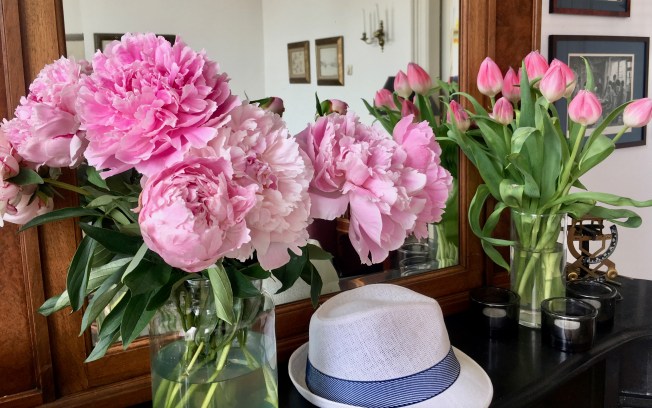
And of course as we’re in a country so abundant in blooms, a home isn’t a home without vases of tulips and peonies, so prolific at this time of the year. I’ve deviated from my predilection for white flowers, allowing rosy pink bloemen to flourish in the room — the fragrance of delicate peonies perfume the air amongst antique furniture, eclectic prints and tall sashed windows.

And one doesn’t have to venture far into the neighbourhood to also be beguiled by the scent of heavenly roses. They blossom prettily, adorning doors of blues and greens with lovely displays of pinks, reds, yellows and whites.

Our temporary abode is on a lively street, with embassies and lovely homes dotting the area. Wealthy merchants once called the ‘Archipel’ home, amassing great fortunes from ships plying the Dutch East Indies route loaded with rich commodities. These streets once echoed with the passage of the traders’ fine carriages — now it is with the tinkle of bicycle bells, the liveliness of chatter, the sing song of birds and chiming of church bells. Just along from us, past the forest, the cycle trail leads to nearby Scheveningen. It’s where sea meets endless sky and gentle dunes.

IMG_6442

Our second story apartment looks out to a cafe that spills onto the broad sidewalk, the pastime of soaking up the sun with a coffee, a glass of wine or a pilsje is the norm. As chatter drifts up and I gaze out to the narrow, bricked homes nestled side by side like a child’s play town, I notice the poem on an adjacent wall.

Poems grace the walls of a number of buildings in this area of The Hague, perhaps a project to inspire and provoke. I find them marvellous — they cause one to stop and ponder, maybe even to construct one’s own.

I find myself purposefully wandering the cobbled streets to savour these verses, or to marvel at overflowing flower shops, or perhaps to admire benches doubling as resting places for potted flowers, and to take in the array of two-wheeled family ‘vehicles’ awaiting outside quaint homes. Cycling is intrinsic to everyday life — to get to school, to work, to shop, to cycle for the joy of it, and the Dutch have mastered bicycle infrastructure and design. I find myself also hopping on my borrowed omafiets (grandma bike) just because I can… to feel the breeze, to hear the cozy chatter of families as they pass on busy bike lanes.

Have I missed India? It was a cherished place to live for two years and we soaked up the colour, the unexpected and the history. The experience was like one of the treasured antique necklaces I bought from a local jeweller in Bangalore; intricate, imperfect, but ultimately beautiful as a whole. You cherish it, but it has to be removed and tucked away in a special place – in my memory and into the mosaic of my life. No, I cannot imagine not having lived there.

To live here now, for a spell is simply a joy. If it happens to only be for two months, we’ll embrace it with open arms, many vases of tulips, long bicycle trips, visits from family and we’ll say our many bedankts for the time being. And for the opportunity to live by my friend and co-author, Jo Parfitt… Monday Morning Emails can now be shared a doorway away. Even a place to welcome a visit from my mom!

IMG_6701 2.jpg

And just across the street, the poem on the wall of Hotel Mosaic inspires me to sum it up, it reads…


This Is Just To Say 

I have eaten 

the plums 

that were in 

the ice box 

and which 

you were probably 

saving 

for breakfast 

Forgive me 

they were delicious 

so sweet 

and so cold…

William Carlos Williams 


If I had the chance to place my own words on the wall, I believe I would pen…


This Is Just To Say

Your tulips and roses

and cycles 

so aplenty,

already fill

my vases,

and my soul.

Forgive me

I have chosen the last

bunch of peonies from

the bloomewinkel

they were so fragrant and full,

oh, so perfect…

Terry Anne Wilson


An ancient Greek meander… Ode to Hydra, part two

Standard

IMG_5722 2

Dearest Hydra,

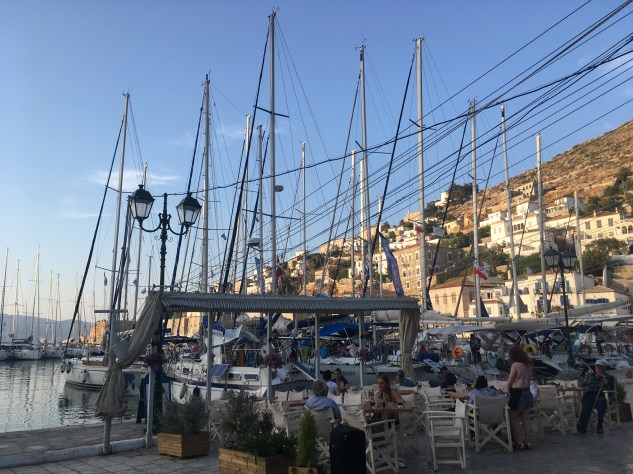
You enticed me first with your short ferry cruise from Athens… and curiously, the mention of mules on your small island. No cars, only mules, and of course the promise of an island haven on which to repose, to relax.

What I couldn’t have known until I was ensconced in your soulful presence, is that your beauty is partly due to the quiet – the absence of engines, of horns, even of the tinkle of bicycle bells.

Except for sharp hoof strikes on polished cobbles, goods carried along narrow tidy lanes, the dissonant soundtrack of daily life is soon a distant memory. A feeling of tranquility and joy seems to pervade me, to pervade everything.

Straining against a heavy load, a porter breaks the silence, taut muscles in practiced manoeuvres, smiling new arrivals walking expectantly beside the laden cart. His gentle exertions fill the ancient lanes with purpose, echoes of your long continuous existence. I marvel that even the colours of these indespensible ‘vehicles’ blend prettily with your hues, Hydra.

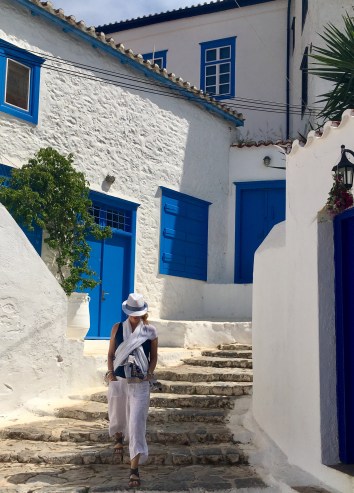
Indeed your island is a perfect paint-by-number of myriad soft colours against a backdrop of dazzling whitewash. My favourite palette of blues and greens, gracing doors and shutters, even those wagons which often mirror the establishment they’re parked alongside. Brilliant splashes of bouganvilea complete the picture… as do ‘pops’ of plump lemons, milky greens of olive trees, and soft pinks of oleanders.

“Torrents of colour,” is how I believe Nikos Ghika, the Greek painter, referred to your charming, colourful canvas.


Ghika is one of many artists who spent inspired years in your embrace, as did some of his creative friends: Craxton, Leigh Fermor and Henry Miller. From the 1930’s, those years of visiting and living in your embrace were undeniably their muse, “…the courtyards, the gardens, one above the other… the long and narrow walls which followed and embraced rocky land beyond, the prickly pears, and the wild greens and the thorns. The fig trees like chandeliers. The almond trees like thin scarecrows,” Ghika wrote fondly.

IMG_5743

Most certainly, your tranquil beauty beckoned from far and wide, including Canadian songwriter and singer Leonard Cohen, who penned his beloved ‘Bird on a Wire’ from the window of his island villa. Like many artists in the ’60’s and 70’s, he claimed your bohemian paradise as home. Didn’t he once endearingly quip, “There is nowhere in the world where you can live like you can in Hydra… and that includes Hydra.”

Like Ghika’s home, Cohen’s abode became a retreat for creatives and still today people arrive to your island – to write, to paint, or like us, to seek a tranquil interlude.

A repose found often in the shade of the majestically old tree in our preferred spot at the Xeri Elia. The storied restaurant and taverna welcomed Cohen often and we’re told his melodies filled the restaurant’s charming square. Photographs inside recall those happy times.

Even Sophia Loren smiles from the taverna’s lively photo gallery. Her ’50’s portrayal of a brash, beautiful Hydriot sponge-diver, propelled your island onto the international stage. I know that sponge farming put bread on the tables for your islanders in those post war years, your sea-given harvest reaching the far corners of the earth. Your merchant fleet had answered the call and turned its expertise from trade to war – it was sponges that then kept your maritime economy afloat.

Yet now dear Hydra as we lunch in the languid afternoon stillness, despite the import of tourism, we sense the intimacy of the island. Children pass through the square, a  confluence of narrow lanes – a dutiful kiss for a grandfather lunching with a friend. Tethering his mule, a porter breaks for refreshment, delivering the day’s happenings from the harbour. Children clutch precious art work, mothers converge, chatting briefly before streaming off to their familiar lanes.

Pushing my open journal across the table, I revelled and relaxed in the dreamlike silence as my partner’s pen captured the scene.

” We lazed in the heat of the day, cat-contented in the dappled vine-shaded square, half-heard music washing over the flagstone courtyard, gently lapping against white-washed walls, doors and windows picked out in cobalt blues and hunting green. The noise itself seemed hushed and chastened by the midday sun radiating from your cloudless Hydra sky. We sit dream-like in this noon idyll, words half-heard, music and muffled chatter, weaving  the fabric of our day.”  

You captivated us both dearest Hydra. And oh, how I’d love my fedora to hang here for a tranquil season of writing, a celebration of your treasured stillness and your inspiration… until we meet again!

Fondly, Terry Anne


IMG_5748


An ancient Greek meander… in the footsteps of a father, part one

Standard

IMG_5619

I had loved Rome, Paris and Istanbul… but Athens! It is profoundly special and awe-inspiring in its expanse of history and graceful beauty.

It was the perfect choice for our brief interlude. Keeping in mind that we would be laden with a pile of suitcases as we moved from India, we wanted somewhere en route to our destination, ideally warm, and a contrast to Asia. Greece was the perfect choice… and there was another poignant reason.

My husband’s father had been a classical scholar, a longtime philhellenic; a professed lover of all things Greek. George Greenaway Wilson was a didactic dad who took great joy in sharing his love of literature and military history, his bookshelves crammed with the works of Aristotle, Socrates, Plato, Euripides. He notably earned a Doctorate in Classics in his later years, studying the Ancient Greek language in parallel to better read the texts. Visiting Greece often with Bruce’s mother, Isabella, they had mostly forgone the tourist streets in cities such as Athens, Heraklion and Kalamata, preferring the clubs and haunts of local Greeks.

“He would unleash his Ancient Greek to the bemusement and delight of patrons in back-street tavernas and working men’s clubs,” Bruce recalled fondly, visualizing the scene with amusement.

IMG_5620

I had heard some of these stories through the years yet now being here, I could more easily imagine George as he transformed into Georgios during his visits. Bruce’s mother was very much a willing accomplice to the twice-yearly forays to Greece and Turkey.

“I can see why your mom loved it here so much,” I proclaimed on the first afternoon as we lingered over a languid lunch of Greek salad, spanakopita, bread, olives and a carafe of local white wine. “And how could you not, the food is enough to never want to leave!”

We were sitting in an outdoor taverna, Scholarkheio, a family run restaurant since 1935 situated in the quaint streets of Plaka. It became our local ‘go-to’ and from that first long indulgent lunch, the stress of the move from the past few months was lifted; a sense of recovery from the planning, packing and heartfelt farewells of India.


“Mom loved it here,” Bruce confirmed, as we imagined them walking these streets. “The sun and the heat. And the very drinkable cheap wine of course! There was never a problem with Dad luring her along with him,” he said, refilling our tumblers with local wine.

I understood this immediately. Athens is alive with colour, great food, wandering minstrels, and of course even arrays of Greek sandals to choose from! And wonderfully, it is a very approachable and walkable city. At its heart are the magnificent buildings of the Acropolis, overlooking the ancient settlement since 450 BC or so. Life radiates gently below – the charming streets of old Plaka, for dining, browsing and shopping. The ancient Forums and Libraries, the most excellent Acropolis Museum, and parks where grand sculptures rest amongst silvery oaks, fragrant olive and eucalyptus trees – I was quickly beguiled and in the city’s thrall.


Yet Athens is not a trivial holiday experience, it is humbling if one sets the span of a life against its timeless presence. It speaks of the founding of democracy and art, poets and scholars, and theatre of the great odeums where orators and actors guided and chided the world into independent thinking, towards democracy itself .

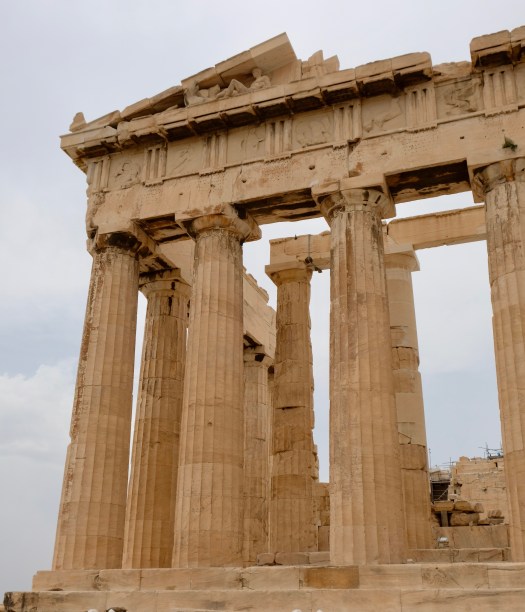
We stayed in the shadow of the Acropolis. The breathtaking view of the Parthenon held us spellbound as we lingered over drinks that first evening on the rooftop bar of the Herodion Hotel – feeling close enough to reach out and touch its aged, elegant marble. Its Ionic columns still evoking the power and refinement of ancient Greece. But life then, as now, plays out on the stage beneath its glorious prominence, fanning out over the plains and hills of old Attica.

After climbing the limestone crag of the Acropolis (literally ‘highest point of the city’), the magnificent ruins stood before us. While there is evidence that the hill was inhabited as far back as the fourth millennium BC, it was the astute and forward-thinking statesman Pericles (495 – 429 BC) who coordinated the construction of some of the site’s most important structures and others that followed: the delicate Temple of Athena Nike, the grand entrance of the Propylaia, the Erectheion with its maidens columns – all stunning even in the fractured mosaic of their sun-bleached remnants.

I thrilled in the ruins, content for them to hint at the once glorious past. My engineer partner suggested that he would rather see the Parthenon fully reconstructed and on that point I had to protest. I loved imagining it in my mind. Like all Greek temples, it was richly ornamented in vivid natural colours of blues, reds and golds. Statues honouring Greek mythology posed dramatically – Apollo and Athena Nike the goddess of victory,  Zeus, Hercules and the messenger god Hermes. I can imagine the beautifully adorned women in their flowing tunics, the chiton or the sleeveless peplos, maybe a himation (cloak) for cooler winter months. Perhaps their exquisite gold jewellery glinted in the sun as they strolled the temples with offerings of incense and honey-dripped sheafs of wheat.

We had visited the excellent Acropolis Museum before the site itself, its trove of treasures depicting everyday life, allowing ones imagination to easily meander to that time. In fact I learned that meander, one of my favourite words, comes from the Greek meandros, the ancient Meander River which was exceptionally winding and twisty. The meander design was a common theme, replicated on pottery, clothes and jewellery. As one of the most important symbols of Ancient Greece, its connotation of unity and infinity in continuous interlocking lines represents eternity, an unbroken flow of things, like the meandering of life. And to this day it permeates Greek design.

The Parthenon is the crowning glory of classical Greece ethos and standing in the midst of it, we understood George’s deep appreciation of Greek philosophy and its role in the dawning of democracy.DSCF5838

“I wish he was here to share his knowledge, bring it to life for us,” Bruce said with a tinge of regret. “He always thought he was better suited to this time. Perhaps it was the philosopher-warrior in him, the deep thinker and the stoic.” His maxim might have been a quote from his favourite general, Thucydides, subject of his doctorate, who said that ‘The State that separates its scholars from its warriors will have its thinking done by cowards and its fighting by fools.’ Having once been a soldier himself, this resonated.

“I wish I had asked him more questions while he was alive,” I lamented and Bruce agreed. “I feel the same, but he’d be pleased to know we are now trying to understand his Greece.”

From the high outcrop, it’s possible to understand how Athens became the dominant power of the numerous Greek States, though nearby Sparta was long its rival as were the Persians and even the Venetians, to name a few.

But beyond the impressive and dominant Acropolis, the daily life of ancient Athens played out on the gentle hills and plains below; in the temples and agoras where people gathered to trade goods and ideas, and in the odea where orators spoke and playwrights provoked their audience into thought. These impressive outdoor auditoriums were often set into natural bowls in hillsides. The Theatre of Dionysus was created in 530 BC, believed to be where ‘drama’ and ‘theatre’ was first presented, where Thespis (yes where the word thespian derives) was likely the first to perform in a play. The impressive Herodeion is a later structure, from 161 AD. It’s stone-chiseled seats could accommodate 6000 spectators and still hosts events during the Athens Festival.

“Oh to have been here to see Luciano Pavarotti, Elton John, even the Foo Fighters,” I commented to Bruce, remembering this is also a backdrop for world class performers… the Greek god drama and theatre, Dionysos, must indeed be smiling!


Our last day finds us meandering through the Roman Agora, the Tower of the Winds, and past Hadrian’s library of 132 AD, complete with music and lecture halls. I sit happily on a bench and contemplate… Athens is a lot to take in.

IMG_5587I muse over the people I’ve met and how they all showed me something of their kind nature. The lovely mother I happened to chat with as I appreciated her daughter’s May Day laurel that her father had crafted. And the waiter at Scholarkheio who found one of my camera memory cards and tracked me down to return it. Or the shopkeeper I met as I perused modern day chitons. We connected immediately.

“Do you feel like you’ve been here before?” She asked, as if she could sense how connected I felt, how I was claiming Athens as my own, even to having my own chiton.

Taking out one of George’s books that I had thought to pack at the last moment, I read quotes from the great poet and playwright Euripedes who lived around 400 BC. How fresh, how poignant his words are still today. And I think of George who was always one to ponder…

Nothing is hopeless, we must hope for everything.

It is a good thing to be rich and strong, but it is a better thing to be loved.

There is just one life for each of us: our own.

Experience travel – these are an education in themselves.

Yes, the last one particularly rings true to me and as much as Athens has thrilled me, it’s time to meander to the small island of Hydra… to be continued


Charm, colour & susegad… the many facets of Goa

Standard

IMG_3563

For as long as I can remember, the allure of Goa has intrigued my traveller’s mind. Was it browsing National Geographics’ as a teenager; coveting photos of pristine beaches, glossy palm trees and ‘hippy hide-aways’ in a tropical paradise? Or perhaps that Goa, with its distinct Portuguese culture, architecture and cuisine, is said to feel like you aren’t really in India – so much like Pondicherry with its French history – a destination within a destination.

But of course Goa is part of the rich diversity of India, and its west coast location placed it in easy reach from our southern home in Bangalore. Naturally Goa beckoned and after two visits, I had most certainly fallen in love!

It wasn’t only the beaches that beguiled me, but the romance of that old Portuguese charm. Clanging church bells in quaint town squares, white spires reaching to palm-fringed skies, tangles of narrow crayon-hued streets and ageing villas, glorious even in decay. And the colour! I was utterly captivated by the embrace of colour; vivid, exuberant, unrelenting colour.

And infusing all of this is that Goan spirit of s u s e g a d. Derived from the Portuguese word sossegado for quiet, it evokes the laid back atmosphere that permeates Goan life.

The legacy of the Portuguese

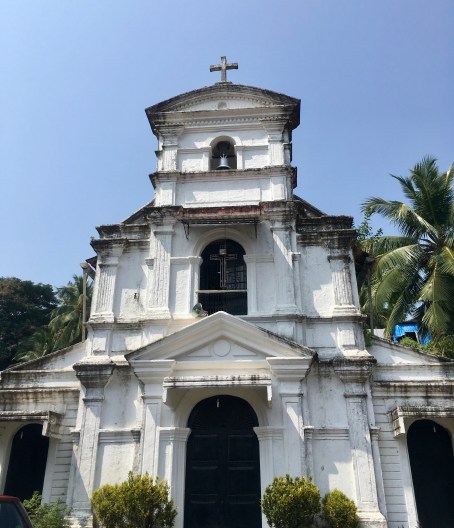
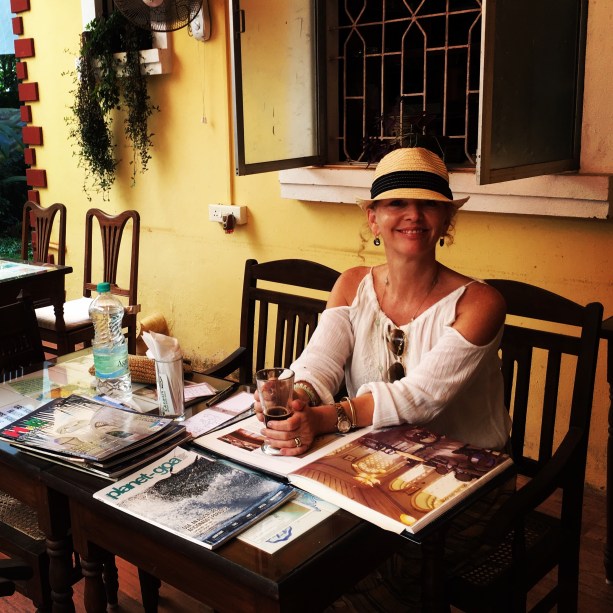
Fontainhas, the old Latin Quarter within the city of Panjim (or Panaji), was love at first sight for me. During Portuguese rule, each urban resident was obliged to paint their house after the monsoon rains and it’s clear this tradition has continued. Many of the 18th and 19th century homes are still arrayed in pale yellows, ochres, greens and blues, with dashes of reds and whites. On two separate visits I stroll these streets until I’m intimate with the tidy back lanes, the tranquil siesta times, the aged villa from where gentle strains of violin drift, and the best verandah cafe for morning coffee. I also return often to Fontainhas’ lovely whitewashed chapel.

IMG_0671

The pretty Chapel of St Sebastian, built in 1818, is white as mandated – the gaiety of colour was reserved for homes. The small church contains one of only a few relics remaining as testament to the Goan Inquisition, a crucifix that originally stood in the Palace of the Inquisition in Old Goa. It’s believed that Christ’s unusual open eyes struck fear into the hearts of ‘heretical’ suspects brought before the Inquisitors as they awaited their often tragic fate.

Nearby, in the heart of Panjim, the larger St. Mary’s Basilica is also striking, presiding over bustling streets from its hillside perch. A busy tourist spot, I overheard a conversation debating whether, with so many churches in Panjim, it was worth visiting  the UNESCO Heritage site of old Goa. A bystander implored, “Oh yes, so many churches are there, so beautiful.” And so we went. And yes, one must!

We journeyed through small villages on windy roads, arriving in Old Goa to a dizzying collection of vast cathedrals, chapels and convents. Often framed by tall Cook pines, colossal palms and fringed by forest, the effect of so many religious buildings is unexpected and impressive. I understood why it was once referred to as Rome of the East. 

The Portuguese made their headquarters here with the population reaching 200,000 by 1543. The number and scale of churches constructed to serve the settlement is staggering and our eye is drawn from dome, to spire, to bell-tower. Might I be in Rome, Lisbon, perhaps Barcelona? We wandered a few hours marvelling at the architecture, attempting to imagine ourselves in that distant, majestic past. Yet it was also a troubled one.

Malaria and cholera epidemics were especially cruel to this city. By 1775 a mere 1500 people remained. In 1759, the viceroy decreed a move to the future capital of Panjim, the once glorious city abandoned with the hope that 10 kilometres separation would make the difference between death and survival. The site became known as Velha Goa, old Goa, and Vasco de Gama who had first arrived to these shores in the late 15th century, surely would have been heartbroken to know the tragedy that had struck the settlement he had envisioned. His arrival, and then of Naval commander Albuquerque, to battle and usurp the ancient Hindu kingdom of the Kadamba and Vijayanagara, resulted in control of the regions’s lucrative spice routes. The predominately Catholic empire lived on until 1961 when Goa was annexed by India.

To the beaches

IMG_E3553

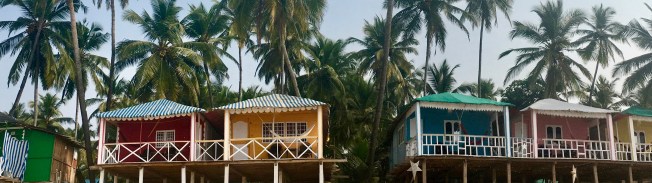
For many, the draw of Goa is its forty-some kilometre stretch of beaches. Yet deciding which beach to spend time on can be daunting. Between the north, central, and the south, the beach culture varies widely – lively with vibrant night life, atmospheric fishing beaches preserving something of local life, beaches that attract busloads of tourists, and the more soulful and reserved. For the most part, what were once tranquil fishing villages are now pulsing with tourists; nirvana found (and lost) as seekers commune with the Indian Ocean and each other. There is an overwhelming array of accommodations from simple huts to five-star grandeur.

For many locals, the quiet charm of Goa will not return.

“The beautiful is gone in Goa,” a taxi driver lamented one afternoon as we inched our way along a main stretch of road clogged with tourist buses, taxis and local traffic. “These roads were to get from village to village, now the world is here.”

Part of the attraction is Goa’s beach shack culture. Not all shacks are created equal – some are fancy and others more plain. Yet seafood, and a drink or two, are the common denominators of the experience. We learned that the key is finding a shack that you like, spending much of your time in its environs and developing a relationship with the owner. So a swim in the ocean, a beach-combing stroll, some leisure on the loungers, and a ‘cool one’ in your preferred spot in the shade of the shack… susegad indeed!

We find a spot that we love, soak in the vibe, and let the feeling of susegad embrace us. Admittedly we’re not very good at it, sitting still, and we’re pleased when two of the ‘kids’ happen to be in the area and invite us to spend a day at a secluded beach. We cruise through the countryside on scooters, eventually climbing down a winding, stepped trail to what can only be described as, paradise. We spend the day free and joyful, and admittedly very sunburnt.

Scooting and strolling through the villages offers snapshots of tourism, eager entrepreneurs and thankfully, iconic glimpses of culture. A cow pokes his head into a bar, children help their moms in the family shop and a bare chested sage offers travelling prayers. I relish in these vignettes of Goan life and perhaps no where more so than in the small village of Majorda.

The charm of a village

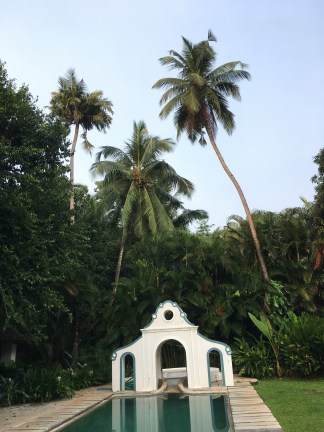
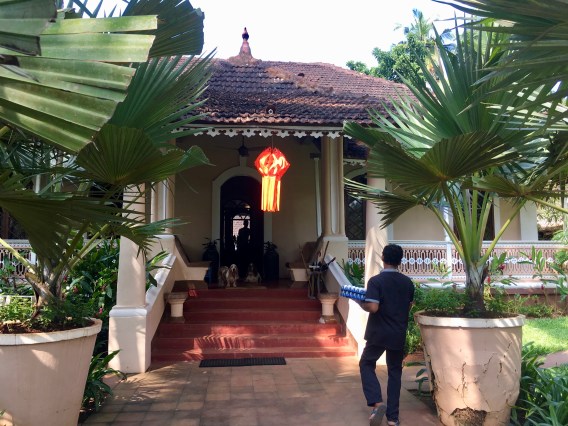
During one of my visits with a good friend, Kristin and I find ourselves in the tranquil village of Majorda. We settle into Vivenda dos Palhacos, a restored 100 year-old Portuguese manor. The boutique hotel with its lovely communal areas, charming pool and the interesting ‘Lorry-Back Bar’, makes it very easy to while away a few days.

The joy is also its location. Tucked under the shade of tall coconut palms on a lane winding through the quiet village, it’s a place where early morning deliveries are announced with the squawk of a bike horn. Where chickens and piglets share the narrow byways. Where serenity is interrupted only by roosters and bells from the nearby parish church.

IMG_0934

At VdP, we’re greeted by laconic basset hounds lazing on the welcoming verandah, and by owner Simon Hayward. Simon and his sister, are from a third generation of British family who have long called India home. Simon stops to chat as Kristin and I enjoy a late afternoon drink on the verandah. I’m soon asking about the photos of the Haywards that decorate the bar area and the many bottles of Hayward’s beer on display.

“My grandfather arrived first and lived in Calcutta, where my sister and I were born. It was a great life growing up in England and India. My father owned horse races. There were hunting trips into the forest of Bengal. We were fortunate to have been brought up in that era.”

I learn that Simon’s father, the late Sir Anthony Hayward, was knighted for his commercial acumen, with enterprises including a brewery and distillery. They also held the rights to import and distribute opium across the country – a practice started by the East India Company and passed down to the British Raj. The practice wasn’t outlawed until the 1950’s.

Simon relates finding his property and how he knew there was a certain charm to it, the buildings and location. “There was even a ‘piggy loo’ outback,” he laughs. “Yes, an outhouse where pigs cleaned things up.”

IMG_0877He hadn’t expected to return to India after a career in advertising in Hong Kong and New Zealand, yet Simon is a natural in these surroundings. Fittingly, he and his sister have been given the honourary status of persons of Indian origin. Goa is most definitely home.

“Sure Goa is a little different to the rest of India I once knew, but we’re part of the local community now. And there are some characters!”

I mention to Simon that the character of VdP seems a perfect mix of colonial and traditional Goan character.

“It’s turned out well. We don’t advertise the property, but rely on word of mouth. This seems to draw in some real characters who stay with us.”

Our time here is shared with expat families on holiday from Dubai and Hong Kong, and dinners in the lovely dining room are lively. The next afternoon, a BBC journalist arrives in time for cocktail hour having just finished researching a documentary about the impact that IT plays in Indian romance. When I relate that I’m a writer, the journalist’s response reads my mind perfectly.
“I could easily spend a week here writing, couldn’t you?”

Such an understatement and I lament that I hadn’t made Goa more of a getaway from Bangalore. I’m thankful for the three visits of the beautiful charm and colour… the Goan susegad!

IMG_1120

If you go:

Stay at the heritage hotel, The Panjim Inn, in the heart of Fontanhas. Their restaurant, The Verandah, is also a good spot for coffee, and wine! panjiminn.com

Black Sheep Bistro in Panjim is a great spot.

Ciaran’s in Palolem, is on a busy beach with kayaking, local boat rides and fishing boats and was a great stay.

Local buses can take you cheaply to Old Goa or hire a car for about 1500 rupees return.

From Vivenda dos Palhaços, it’s a peaceful 15 minute walk to Goa’s longest beach  vivendagoa.com

For more, check out Luke and Trixie’s tips on Goa, https://www.howlblog.ca/travel-guide/goa


Two suitcases, maybe three… and the gift of lettuce

Standard

Yes, for the next two or three months, those will soon be my possessions at-hand… two suitcases, maybe three. Oh, and my trusty white fedora. I find it interesting that in my writer’s biography I mention that, At the age of 26, I packed my hopes and dreams in a 55 L backpack. It was thrilling, liberating, I was free!

Now, the prospect of living out of suitcases is confining and downright inconvenient. We have a little more than one week in our Indian apartment before we close this door and walk through the next. Naturally I’m emotional and a little overwhelmed. That supposed euphoria of packing those suitcases and flying off to ‘freedom’ is inching closer, but the romance of it all still mostly eludes me. Today feels like a Monday Morning Email kind of morning, so writing becomes my solace.

If I were to write an MME to you, it would convey these thoughts…

Screen Shot 2018-02-09 at 4.32.18 PM

Wednesday, April 18th, Bangalore, India,,

Dear Reader,

As I write on this Wednesday morning, song birds serenade, my potted palms colour and cheer as usual, yet boxes already inhabit my once-serene surroundings. Getting ready for the next chapter is a lengthy process, but then its upon you like a fast moving freight train. Transition started months ago when we learned that my husband’s posting would come to an end here. Even though we were part of this decision, we then started discussing, pondering and planning. But in previous moves, we had known where we would next be living.

This time around, I face the difficulty of packing without a destination firmly set, though it will be somewhere in Europe or Canada. And with this, I chuckle a little. For us that is nicely ‘narrowed down’ in this wide, wide world. Asia has been a meaningful experience, yet it’s time to be closer to home. And though I agree with this, I’ve still managed to have two very emotional days over the past few weeks. But even those are part of the process of detachment, acceptance and transition.

The first difficult day happened to be on Easter Sunday. Ironically, after having ‘kids’ living with us for almost a year, Bruce and I happened to be alone. Luke, Trixie and Matt were off backpacking in Sri Lanka and I’ll admit to enjoying some time on our own. I preface this by saying how much we’ve enjoyed this multi-generational living, this ‘suddenly my nest is no longer empty’ phase. I would not have changed it for the world.

It’s been wonderful having them here – days of working, conversing, dining and traveling together. Matt has been with us almost a year, Luke and Trixie since Christmas and I’m conscious that this particular phase will likely never be repeated – I will miss them tremendously on a day to day basis. And on that Easter Sunday, mostly I worried, I found myself frozen with trepidation, then finally I felt sadness as soon we’ll all go our own way; the reality of it all was suddenly breathtaking.

That leaves me and Bruce. After a holiday in Greece and the UK, we’ve decided to be in The Hague for a month or so – to a place that is home for us and also close to head office for Bruce. Things will transpire from there. In the meantime we’ve gone back and forth… where do we send our furniture?

img_1086“Forget the ‘ball and chain’ of the furniture,” Bruce consoled me that day. “It can stay in storage in Vancouver and we’ll see where and when we’ll need it. We’ll go home for the summer. We’ll write. We’ll kayak. We’ll see Andrew and Ayla, family and friends. Look at it as an opportunity, not a fear. And Ter,” he said with a comforting hug,” everyone will be fine. The kids have their own journey to figure out.” And he’s right. Matt is heading back to university, Luke and Trixie are working virtually. They’ll do a little more travelling, then settle in Europe. They are certainly living their dream and history repeats itself – they’re doing what we did at the same age

So I got on with my ‘lasts’ and my farewells. In Marilyn Gardner’s poignant book, World’s Apart, she mentions that rarely do people ask, ‘What have you left behind… those things that we lose when we transition.’ So true and indeed we must say our farewells, both internally and verbally, conscious of what we’re parting with. The places and people we often won’t see again – ever –and it’s difficult.

A week ago brought me to the next overwhelming day. There I stood in my bedroom, surrounded by clothes, shoes, bags, jewellery and scarves… so many darned scarves. Do I unconsciously collect them? There are a few from Azerbaijan, from Italy, Malaysia, even Kazakhstan. And don’t ask me how many from India! Indeed, how to choose which ones travel with me and which ones circumnavigate the world in a sea container. In reality, the scarves are really a metaphor for it all; for a household that gets picked up and shunted along.

I became even more emotional not knowing where I’ll have the opportunity to reunite with my personal things. Will it be a place I get to ‘dress up’ like I do in India for luncheons and events? It’s far different than what I would wear on a daily basis in our home base in Kimberley, or maybe cycling in The Netherlands. It feels like I’m packing away part of my identity.

On that particular day, my chivalrous soulmate again comes to my rescue. “Honey, I img_1088understand, I’ll carry an extra bag for you so you’ll have what you need. I’m sorry this is difficult for you.” But there’s some light-heartedness that also resonates. “You know my things barely fill one suitcase, more space for you!”

Yes he’s the sensible one, the minimalist when it comes to clothes. And to be honest just the acknowledgement that this was difficult for me, gave me strength. I began sorting and setting aside things to give away – to Priya, to the security guards, to the school we support. Finally packing could begin.

Now a week later the suitcases with carefully chosen clothes and accessories, begin to fill – an intro to minimalism has been good for me. Going forward, I’m determined to be more mindful. And yes, I’m well aware these supposed hardships and challenges pale into comparison to what many face. It’s never far from my thoughts.

As I was about to finish this Wednesday morning musing, my doorbell rang. I opened my door to Raj, my vegetable wallah.

“Madam, good day,” he said with his gentle, but exuberant manner that I have come to adore. “Lettuce for you,” Raj offered delightedly, handing me a tiny bunch of red lettuce. It is not something he normally stocks in his heaped cart of vegetables and he’s pleased to present it to me. It’s a bit of a luxury – indeed it felt like a gift.

“Thank you Raj, so, so nice. Yes thank you,” I accepted gratefully.

“Madam, my brother’s marriage is soon in Mysore. Family come?” Reluctantly I shared with Raj that we’ll be leaving soon. He’s taken aback and I found myself apologising.

“Yes Raj, I’m sorry too. I will miss India very much.”

Even those moments help with parting from a neighbourhood that has embraced us whole-heartedly. But it’s been like that this past week – gifts from the local pub that we love going to, heartfelt goodbyes at the ladies groups I’m involved with, and farewell drinks with our landlord and his family. “You must come back for the wedding in August,” they implored many times throughout the evening.

And yesterday, a handcrafted gift from the school we support was presented to me with a sincere note of thanks. Jagruthi enables disenfranchised children the chance of education and security, and is a poignant reminder of the severe hardships many in India face. I will write more, but our involvement has shown me humility and gratitude – for my loving family, the experience of another country, the calling-card of my new book and my speaking and workshop endeavours.

As I wrote a number of years ago in A Fine Set of Luggage when we live a global life, there is much more in those suitcases then meets the eye, thankfully it’s never been more true then now.
So when those two, maybe three suitcases are waiting and we lock the door for the last time, we’ll do what we’ve done in other countries. We’ll say farewell to the country and people who have hosted us so graciously. I know it will be with tears, and I know I can’t imagine not having lived in my beloved India.

For now, I continue the packing… I’ve narrowed the scarves down to a mere twenty!

Until next time, dear reader…


Luke and Trixie blog their adventures at howlblog.ca


India etched on my global heart… thirty days of ‘lasts’

Standard

IMG_3400

Today I have just thirty days… thirty more days of living in India.

A friend was recently asked if she loved this country. “I can only love it a little,” she replied thoughtfully. “I’ve already given my heart to Malaysia.”

And this is how it is when we adopt a country as our home. More often than not, it comes to claim a piece of our being – symbolically etched on our global hearts. Mine is already inscribed with Japan, Scotland, The Netherlands, Qatar, Oman, The US, Norway and Kazakhstan. Now to this, India will add its treasured motif.

I am sentimental and fragile at the moment. How will I say goodbye to so much that I love?  

I’ve done this many times before and I know to say a quiet farewell to all that has been my life here. And I will… with reluctance, but also with much gratitude.

It will be a sad farewell: to the birdsong in the lush canopy outside my windows, to the bats that flutter and flit overhead at sunset as we ‘happy hour’ on the terrace. To the rain tree whose expansive branches reach out like the arms of a fond friend, and to the two lemony yellow villas across the street that backdrop saffrony-orange flowers. Also to a giant-of-a-tree that will soon be plump with juicy mangos, and to the slender palm trees with whale-sized fronds hiding caches of coconuts and pairs of emerald green parakeets. And to my apartment – my beautiful space with its hues of greens, blues and ivories. Where I’ve penned two books, laughed and lived with my family, and stepped out to the terrace to marvel at refreshing, life-giving monsoon rains.

Yes I will bid long, lingering goodbyes: to my narrow street with tall shady trees reaching up to the brilliant blue sky, to the security guards who wave and greet warmly, to the vegetable cart that is trundled down daily with Raj at its helm. And I can’t forget the chai wallah who putters up on his motorbike early afternoon or the the saree-adorned sweepers and the rhythmic s w i s h – s w i s h of their short coconut brooms. I will  also say ‘so long’ to the cry of too many cats and far too many barking dogs – even to the clang-clang of Bishop Cotton’s school gate opening and closing, opening and closing again.

And of course before I leave, I will also give a nod to those things that I have despaired of – the all together too much traffic and having to launch myself into the stream with the now practiced nonchalance of a local. There is the symphony of horns and urban clamour, the potholes and broken sidewalks deep enough to lose oneself, the birds-nests of tangled, dangling wires and the choking air that clogs and catches your breath.

Oh, but there has also been much calm – early morning walks in sheltered parks, outdoor swims in sparkling pools and long lunches in frangipani and bougainvillea dotted courtyards.


At this time, I become conscious of the many
 ‘lasts’. Will this be the last time I walk past faded elegant villas that remind of  what once was, or through a market where vendors sell long coils of garlands as vivid as rainbows? Where the aroma of spices piled high entice and beguile? And I’m sure I’ll gaze at sarees so beautiful, and vibrant, they’ll make my heart leap as they have always done. Or perhaps I’ll engage in the friendly banter of barter with a gentle South Indian soul. 

How I will miss it all. And also my Indian friends; with gifts of sarees, with conversation so rich and stimulating, with sincerity and affection of which I have rarely known.

Inevitably, there will be ‘a last time’ gazing up to grand temples and spendid ruins, boarding a Southern Indian train, or cruising to the market in a rickshaw – wind rustling my hair, smells and sights so close I can touch and embrace them.  

Yes, that litany of ‘lasts’ will mark the cutting of threads that have bound me to this dear place. But in fact, they have already been woven into the tapestry of this global life – India’s richness, etched on my thankful heart.

IMG_1095 2

Two book launches… an Indian chai cafe and a tall, Dutch gabled home

Standard

IMG_4562

I write from The Hague on a chilly March morning, just before I travel back to India. The Netherlands is one of the places in the world I most consider home. It is not surprising as I’m half Dutch – our first son was born here and I have visited often with my mother – keeping strong connections with our Dutch family.

And now, another of life’s milestones has unfolded amongst these cobbled streets and gabled homes that I so adore – my first book has been launched!

IMG_4557

The setting was my co-author’s lovely, gezellig home. That Dutch word for cozy, typified the evening of March 7th. With a crackling fire, candles lit and tulips artfully arranged, and gifted, Jo Parfitt and I welcomed our guests. Many were dear friends who we see but once a year at the Families in Global Transition Conference; many having just arrived from the US, from Switzerland, Hong Kong or perhaps Dubai. Others were local friends or some involved in Jo’s mentoring and publishing life. All of them were congratulatory and pleased for us that Monday Morning Emails was ‘hot off the press’… stacks of boxes tucked away in a corner to prove it!

With Jo and I seated before the warmth of the fireplace, I peered out to the crowd of thirty or so people and soaked in the moment. A book launch is the gilded prize, reward for many hours of silent endeavour – the culmination of a dream. For me, it is my first published book and needless to say, I was a little ‘over the moon’.

“Your first book is always the most poignant,” Jo had admitted the day before as she handed the book to me for the first time.” Its silky cover was more lovely than I had hoped. When I thumbed to the back, to my author’s page, I was euphoric.

The evening of the book launch progressed with readings and discussions. Also with my penning many heartfelt messages as I signed copies of the book. And curiously, after all of this, I found myself back at my hotel, sitting cozily and reading a little of our book. Through it all, I was enveloped in sheer contentment and joy. Yet Monday Morning Emails is not always an easy, calm read. It is thought-provoking and truthful, a vulnerable exchange between global mothers. Between the two of us, Jo and I have raised five sons around the world in twelve different countries. We have supported our husbands careers and found our passion in writing, mentoring and publishing. But with that has come myriad issues as the backdrop of our life has changed every three, four, six years, perhaps after only three months!

In May of last year, Jo and I decided to write to each other every Monday. We well knew the power of writing and initially thought our book would be about the empty nest stage and raising global children, especially as each of us had a son who was having a difficult time with depression and anxiety. As we wrote of this, our dialogue also turned towards the loss of identify of children, building homes for ourselves against an ever-changing backdrop, ageing parents, health and wellness, traumatic childhood experiences – the topics tumbled forth. We found that over the six months we migrated organically from subject to subject exploring not only trying times, but also of great joy. We have experienced so much that makes a global life worth living – unique cultural experiences and privileged insights that we forever treasure.

Our accounts are truthful and personal, and we thank our family for understanding our ‘mission’ – to enlighten, to offer solace, to let people know that they are not the only family going through issues. “Mom, I don’t mind if you write my story,” my youngest son said with support. “If it can help someone not go through what I did, or help parents, then I’m happy to do that.”

IMG_4323

That evening of the book launch not only did I think of my family, who happened as is often the case to be scattered to the four winds – in Canada, in India, in Nepal. But I thought of a group of wonderful people that had already helped launch Monday Morning Emails. A few days before I had travelled to The Hague, I had given a two-day writer’s workshop in Mysore, India. Two hours by train southwest of Bangalore, Mysore is a charming small city that I have visited often and it has always felt like home.

As always, I was welcomed with open arms, arms which extended to an invitation to speak at the launch of a ‘Chai Patthe’ book club event. I had mentioned to my husband that indeed it was an honour to be doing this, but thank goodness I hadn’t been asked to be the ‘chief guest’ as I noticed the title on the announcement. Yet as the book club launch unfolded, that is indeed what seemed to happen.

The setting was an older bungalow that had been transformed into a charming Chai cafe. Older repurposed doors dotted the long narrow room, by coincidence coloured in the same hues as our book theme. I felt immediately at home.

The room was full, prompting some guests to listen and peer through the old barred windows of the once cozy bungalow. Seated up front as one of the ‘dignitaries,’ I gave a short speech. I mentioned how book clubs had always played an important role in my overseas life and how I had journeyed from avid reader to now, a published author. Without an actual copy of Monday Morning Emails, I had wrapped a copy of the book cover around a random book – yes pretending it was really the published version! The crowd chuckled when I admitted the truth, that in fact the launch was going to be held the following week in The Hague.

“When is the launch in India?” one of the guests asked eagerly.

“There isn’t one planned,” I admitted, not anticipating what was to come.

“Well,” someone chimed in, “this can be your launch in India. Now, here in Mysore.”

“Yes, in India before anywhere else!” another attendee added proudly.

“Can we? How wonderful,” I think I exclaimed and then proceeded to read the back of the book blurb, just to make it ‘official.” A round of applause erupted. I was asked questions and a lively discussion followed. Yes, just like you might with a true author… it was starting to feel more and more real. It was a magical evening with people who have become friends and wonderfully, many with whom I’ve shared the joy of writing. And so that evening in The Hague was of course our official launch, but how fortunate am I to have had two such poignant events.

IMG_4512Monday Morning Emails is part memoir, part diary, part self-help. The latter part of the book gives way to advice from eight different experts – including counselling, psychology, retirement, career advice and wellness.

The support that we’ve received since the publication of Monday Morning Emails has been heartwarming. It appears to resonate with readers, offering an unvarnished glimpse of a life that often seems so glamorous, yet is played out in the same ordinary tones as life ‘at home’. For this reason, it is also a book for those who don’t live a peripatetic life but live in one place, yet also face many of the same issues.

It is also starting conversations between parents and children, even those who are older and lived an expat life before any dialogue about this unique life was the norm. Many have also shared that it would be a good read for book clubs to discuss, and with that in mind, we are formulating book club questions and a Monday Morning Emails website.

It turns out that writing of the present and reflections of the past, was not only therapeutic, it was a joy to claim our stories. For indeed, our collected stories are narrations of life’s journey, whether they be global or otherwise. And after all, mothers are mothers wherever we may call home.

IMG_4532

My first touch of Monday Morning Emails


A Saree for the Palace…

Standard

IMG_3670

“To be honest,” Mr. Prakash says in a lowered tone, “a saree gives a sexy look. Yes, yes, it is a fact,” he nods gently. His small shop is stuffed with the saree’s colourful accompaniment, the cropped blouse or choli. They are stacked in veritable mountains – splashes of colours and stitched for every size. Worn with a saree (or sari) to expose the midriff, Mr. Prakash specialises in these enticing bodices.

Considering the vast array of colours, choosing a choli is proving to be interesting. And as is the custom, a choli can also be stitched from the end piece of the fabric of one’s saree. I ponder it all rather carefully. After all, this choli will be for a grand event… I’ve been invited to a wedding at the Palace!

Having my own choli, and saree, had long been on my wish list; the wedding invitation finally coaxed me into action. And by chance, a few days prior to Mr. Prakash’s affirmation of the garment’s sensuality, a saree draping event had helped convince me – it was time to finally own this iconic garment of India.

The draping event was in the home of a member of the women’s group I belong to in Bangalore. I adore these ladies, a mixture of Indians and foreigners – refined and interesting, welcoming and fun to be with. The morning of the saree event was no exception. While the women shared their techniques of saree draping, there was laughter, humour and, wonderfully, a bit of ‘girl’s only’ talk.

First things first. “Make sure you’re wearing your heels before you begin,” someone pointed out while imparting the method of draping in her home state.

I learned that there are at least eighty different ways to wrap oneself in a saree. “Back and forth, back and forth. Now five pleats here,” expert fingers moved slowly for those of us not so adept at this age-old practice. With the saree in place, a lovely voice called out.

“You’re looking smart, very smart. Yes, it’s draped beautifully.” All were in agreement.

Stories were shared and that ‘sexy’ word was mentioned more than once. There seems to be no question; the saree is a sensual garment to wear and we’re told that regional differences can impact this.

“In the old days in Kerala, the young housemaids weren’t allowed to wear full saree. Oh those girls were so lovely, perfect shoulders, no bras, saree gathered at their chest. I can’t tell you how beautiful they were and such an enticement for the men,” someone recalled from earlier days.

“Yes and to think that originally there were no blouses, no cholis. Just the fabric draped over the breasts,” a friend reminded the group. This is an intriguing fact that I had gleaned in my reading. The usage of the short blouse and a petticoat came during the Mughal and British Raj period. The Victorian age demanded a little more modesty – especially in the Empire’s far flung nations where the local ladies were often a ‘distraction.’

The 5 meters of fabric has always been associated with elegance, grace and a bit of mystery. The word saree derives from the Sanskrit meaning ‘a strip of cloth,’ and not only is it beautiful with its endless fabrics and prints, it is practical; warming in the winter and cooling for the summer months.

I have been bewitched by sarees since I arrived in India and that morning’s talk is not only instructive for me as I soon planned to buy one, I simply loved the stories recounted and the insight into this aspect of Indian culture.

“As is the Bengali way, our keys are pinned to the end of the pallu then flung over the shoulder,” a lady originally from that area demonstrated.

“In Coorg, ours are pinned with a brooch,” a Southerner added. There was then a bit of to and fro in the conversation as to the merit of pricking your precious fabric with a pin and perhaps spoiling it.

We heard about the sarees from Assam in North India, much of their silk a unique golden colour – their silk worms prefer only golden leaves, so the story goes. Another saree was modelled, then one from Orissa, and from Lucknow with its typical chikan fabric. How will I ever decide what type of saree to choose, I mused to myself. Will it be silk, silk crepe, chiffon, georgette, silk twill, organza, even cotton?

“I bought my first saree while on a college trip,” one lady recounted nostalgically, taking me away from my impending decision. “I had empty pockets and had to borrow 200 rupees. The agent got 6 of that. Oh it was a special one!”

That reminded one of the foreigners in our group of her own treasured saree. “I’ve been wearing one for some 60 years, since I married my Indian husband,” Mary related, showing off her wedding saree of the finest green and golden Benares silk.

“Ah Mary it’s still looking lovely, very lovely,” she’s assured. When Mary then revealed that she had just celebrated her 55th wedding anniversary, a chorus of congratulations rang through the room.

I then saw an opportunity to pose that nagging question. “How many sarees do you ladies have in your wardrobe?”

“Oh at least 100.” – “Not less than 200.” – “Ah, it would be difficult to count.”

It had been a wonderful morning and I felt more prepared for the endeavour of a saree purchase.

IMG_3116

So here I am a few days later chatting with Mr. Prakash and pondering which choli to buy. Along with a simple set of Indian jewellery, my saree had been chosen – and of this rich and visual event, I’m pleased to share it in a video below.

With Mr. Prakash’s help, I’ve finally decided upon on a brushed-golden choli with tiny capped sleeves. The transaction complete, Mr. Prakash guides me through a lane to his tailor for on-the-spot-adjustment.

IMG_3669

Vinod is a young tailor whose father was in the newspaper business, “But I started stitching at 12 years old,” he tells me. His shop is no larger than a triple-wide broom closet, yet Vinod is the proud owner and he clearly takes pride in his profession.

There’s just enough room for an apprentice tailor who sits at an old Singer sewing machine behind him.  As Vinod adds another hook-and-eye to my little blouse, I announce excitedly that in fact, I’ll be going to my first Indian wedding. When I ask Vinod if he’s married, he laments that these days, it isn’t always suitable to marry a tailor.

“Now everyone wants to marry an IT person,” he says ruefully. Bangalore is of course the IT capital of India, yet Vinod doesn’t dwell on it.

Flashing a smile, he asks, “Have saree already Ma’am?”

“Yes indeed. It’s a soft navy blue, with golden highlights,”

“Ah Ma’am will be looking tip-top,” Vinod reassures me.

“Thank you Vinod, let’s hope for the best,” I say, promising that I’ll be back soon for some tailoring.

“Very good Ma’am. Welcome, welcome anytime.”

And so just like that, I had a ‘wedding ready’ choli and jewellery waiting to don, yet the choice of a saree had been much more involved. It was just how I had envisioned it – a wonderful experience full of colour and fabrics, a confusion of choices enriched by kind advice from strangers and from experts. It is normally the kind of experience that I would revel in relating to you but just for once, I decided to share the experience in a short video. I hope you’ll enjoy accompanying me on my saree adventure…

Filmed at Mysore Saree Udyoy in Bangalore

Mr. Prakash is close by at Attraction in Commercial Plaza B-3

Video by Trixie Pacis – So It Goes Production

IMG_3804 2


IMG_3762