
Night train to Hampi – day one
The Hampi Express pulls into Bangalore just before 10 p.m. Hauling a staggering number
of carriages, it almost snakes its way back out of the station as hundreds of people rush at it. Those with general tickets jostle to find a seat; the 365 km journey to Hampi is a long way if you must stand.
We have the luxury of being booked in a four person sleeper. Two sturdy ceiling fans, frayed burgundy curtains and packages of linens await us…Southern Indian Railways bordering their edges. Two long seats below will transform into beds, while above, two bunks are perfectly serviceable for those who don’t toss and turn.
Lulled to sleep by the gentle locomotion, I am awakened through the night by the absence of movement at various stations. At one, I pull back the curtain as the unwelcome light from a platform threads into our compartment. On a station bench a tall gangly figure is wrapped in a shawl, arms on knees, his eyes pierce mine. I modestly retreat behind my drape, but as we roll along through the night I imagine all the people. All of the lives in the small villages that line the track…some seventy percent of India lives rurally.
I peer outside just before sunrise, steel factories loom against the awakening sky. This land is rich in iron ore and I see shadows of families scavenging scattered pieces, tumbled from passing trains and scooped into wicker baskets.
Hampi unwrapped – day two
The cry of a chai wallah from outside our compartment awakes us– an informal announcement that we’ve arrived at Hospete station. We disembark at 7:20 am, two of us rested, one of us groggy. Our senses are immediately heightened as we alight. Carriages disgorge flocks of passengers. Porters proffer their services twirling cloths into mini turbans on crowns of heads, a ready perch for a bag or two. Wallahs announce and drivers implore, tuk-tuk, tuk-tuk?
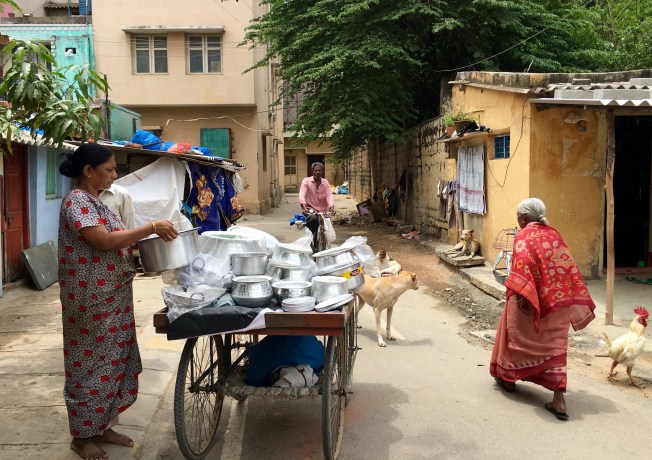
We have a driver waiting and he is soon maneuvering through traffic along with stray dogs, cows and bulls, wild pigs and piglets…all navigating the lively streets.

After a quick refresh and breakfast at our hotel, we’re back on the road and the lush countryside welcomes us. We pass bullock cart after bullock cart laden with feed, crops and the fruits of the land. I understand why this site was chosen as the heart of an empire. The Tungabhadra river runs through the valley bringing sustenance to sugar cane and banana plantations, rice paddies and coconut groves. It is fertile and beautiful.
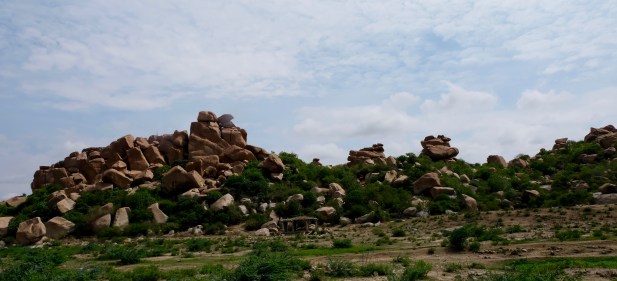
A few kilometres down the road we come upon Hampi, a richness of deep-red soil framed by massive monolithic boulders. Shades of bronzes and rust, pale pinks and greys offered a natural defence (and building material) for the once mighty Vijayanagara Empire. After waiting for a shepherd and his goats to pass, we enter through the narrow Talavaraghatta Gate. One passes into an enchanting land…

Now a UNESCO World Heritage Site, Hampi has attracted settlers, travellers, traders and pilgrims since the mid 1300’s. With ruins that rival those of Rome and Pompeii, accounts from early foreign travellers capture scenes from the past…
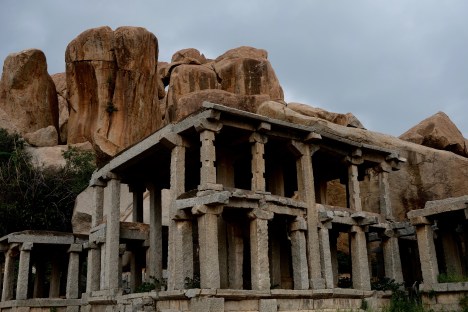 “Travelling about three-hundred miles from Goa, we arrived at the great city of Vijayanagara…sixty miles in circumference…ninety thousand men bear arms. Their king is more powerful than all the other kings in India. He takes to himself twelve thousand wives, of whom four thousand follow him on foot wherever he may go. A like number are handsomely equipped and ride on horseback.” Nicole Conti, an Italian traveller, 1420
The lore of Hampi is not only infused with tales of an extravagant and powerful empire, but with the presence of gods, goddesses and heroes – a connection to the Ramayana, the ancient Sanskrit epic which follows Prince Rama’s quest to rescue his beloved wife Sita from the clutches of Ravana with the help of an army of monkeys. We learn this through Basava, our guide throughout the day from Explore Hampi.
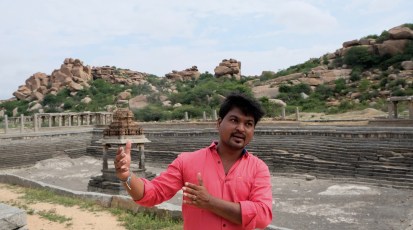
“Everyone calls me Hampi Basava,” he tells us. The son of a farmer, Basava grew up hearing tales of the great empire from his grandmother, inspiring him to share the richness of his hometown. As did encounters with archeologists who excavated the site, “I learned much from them, but still learning.”
The Vijayanagara empire reached the zenith of its power under Krishnadevaraya from 1509 to 1529. Over time the city of Vijayanagara Pattana, became simply ‘Hampi’ and hosted the Pan Supari Bazaar with its daily market and almost one-thousand meters of stalls.
We walk the broad boulevards now quiet and forlorn, but I can still feel and hear the pulse of the people. The clatter of hooves mixing with the slow squeak of a rusty oxen cart. The calling of traders from colonnaded street-long bazaars. Colours gleaming against the scorching sun – gold and jewels glinting. Exotic spices, vermillion, turmeric and sandalwood piling in peaked domes. Sensuous silks and imported Chinese blue and white, hiding in the shade of the columned stalls. A chiseled relief of a fish announcing a nearby water-well. A sign suggesting the courtesan’s bazaar…always held on a Tuesday.

In 1520 Domingo Paes, a Portuguese horse-trader, wrote…”In this city, you will find belonging to every nation and people, because of the great trade which it was and the many precious stones there…the streets and markets are full of laden oxen.”
We approach the Vitthala Temple and I am instantly mesmerized. The massive enclosure has lofty gopuras (pyramidal temples) to three sides, grandiose protection to Vishnu’s mode of conveyance, the opulent stone chariot. “The wheels were once capable of turning,” Basava assures us. The king, concerned with the long treks the pilgrims endured to the sacred temples, entreated the weary pilgrims…Take the energy of the wheels.

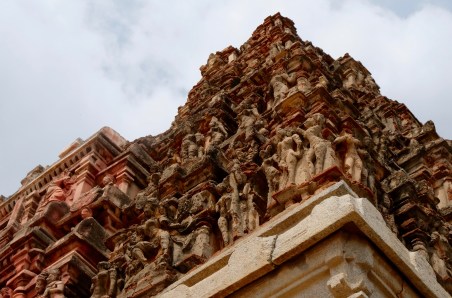
The nearby mandapas, intricately columned gathering places, are exquisite. Relief carvings depict dancers, drummers, voluptuous courtesans and warriors, royal elephants and sartorial hints of foreign visitors…a fez from Morocco, a cloak from Europe, a turban from the Middle East.
Basava taps on musical stone pillars sending harmonious notes through the open air pavilions. The granite architecture has beguiling lotus motifs with traces of colours that once decorated and hints of Chinese, Indo-Islamic and European influence. We see shrines, sculptured gateways and monuments to a legion of gods, Shiva, Vishnu and Ganesha, a god favoured for good luck.
Nearby at the Royal Enclosure, the queens private bath, the royal stage, the king’s underground shrine and even a stepped water-tank speak of grandeur. The king had admired it else elsewhere and imported it piece by piece, step by step. Numbered and reassembled in its odd- numbered formatting. These are the numbers Indians favour – 1 for a preferred God, 3 for the past, present and future, 5 for the elements, 7 for the days, 9 for the planets.

By late afternoon the much anticipated monsoon-rain threatens on the horizon. Clouds roll over orchards and palms, and the granite-bouldered sky. It’s been a stifling hot day, the wind picks up and the clouds shower upon us. We don’t mind. It is cooling and refreshing. “Raindrops like lotus buds,” Basava says lyrically. “The farmers will be blessed. Come, we can’t miss the elephant stables.”
The number varies as to how many elephants the kings kept, accounts speak of anywhere from four to nine-hundred. Twelve or so royal elephants resided in the lavish stables. Domingo Paes elaborated…“The elephants are covered with velvet and gold with fringes, and rich cloths of many colours, with bells so that the earth resounds. On their heads are painted faces of giants and beasts. On the back of each one of them are three or four men, armed with shields and javelins.”
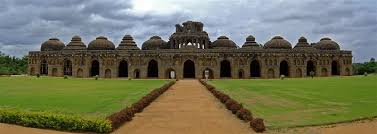 We dash across the rain-soaked grass to the stables with its lofty doomed roofs, surely too beautiful to only house elephants. But these beasts were an integral part of daily and royal life, fitting of an empire that ends…abruptly.
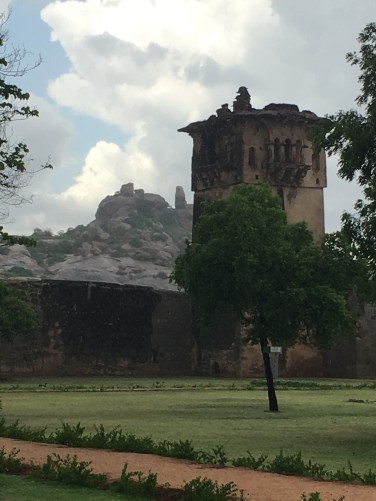 I almost don’t want to hear the fate of this once great city. In 1565 the empire’s armies
suffered a catastrophic defeat by an alliance of Muslim sultanates. The great city was captured, plundered, holy Hindu sites destroyed and more than 100,000 Hindus massacred. As with many great empires, its life cut abruptly short…its heart and soul ripped away.
On a mountain side at the end of the day, we stop for a cooling drink of coconut water. The river gently flows below us and I hear a haunting voice, repeating like an ancient mantra. Lost in her own thoughts, a tiny aged woman crouches under the shade of a boulder. The plaintive strains of her lyrics punctuate the day. Quietly I sit, and listen.
A coracle across the river – day three
With the option of a small ferry or a coracle, we chose the latter. The round cane-bound vessels have plied this river since before the days of the empire and though precarious to board, we float peacefully down the Tungabhadra River. Only the warnings of crocodiles concern us…the monkeys play in the temples, the sloth bears and leopards stay on land. Patches of leafy greens contrast the boulders that seem set to topple into the shallow waters. Temples are chiseled from the granite, integrated seamlessly into the chunky contours of the land.
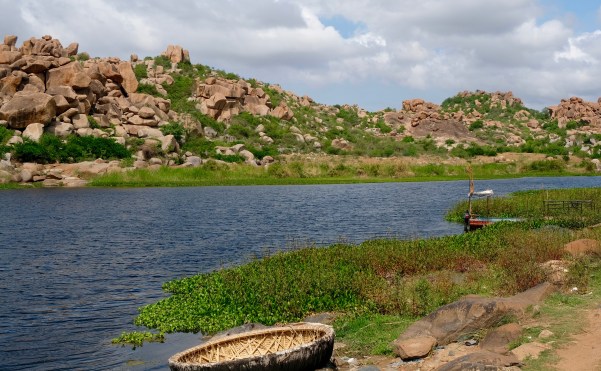
We walk a kilometre or so along a winding road, through a hamlet and past emerald fields. We pass local teens playing cricket, heaps of sugar cane piled on stout wagons and the shell of an old coracle now tidily protecting firewood.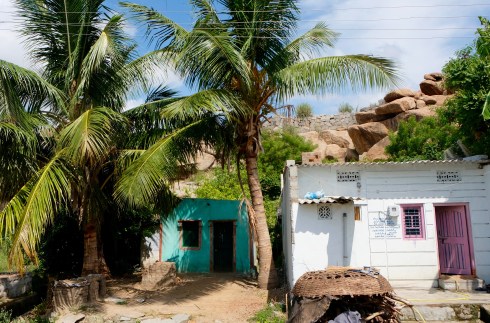
We reach Anegondi the 3rd century capital of the Vijayanagara empire. Yet even before then, legend speaks of the monkey kingdom here as noted in Ramayana. Local story-tellers refer to Anegondi as mother earth, one of the cradles of dynasties.
After walking through its ancient gate, we are almost immediately upon the town square, a ceremonial ‘temple car’ parked off to one corner. Unlike the stone chariot in Hampi, the elaborately carved wooden ‘car’ can be pulled through the streets on festival days. Rickshaws, town-folk, holy-cows and cyclists manouver a smooth, black-stoned sculpture…perhaps it is the town round-about.


Close by, the Gagan Mahal begs to be restored and I picture how stunning the palace must have once been with its lattice work detailed arches and breezy terraces. While I’m peeking inside, Bruce is surrounded by village children. They flip through our guide book and hoist themselves up on the stone wall. I line them up for a photograph and on a whim decide to buy them a drink. Our ‘child’ is back at the hotel recovering from sun-stroke so we’re happy to improvise. It’s Father’s Day after all.


We march the troops across the street and besiege the small shop. The shopkeeper is surprised, perhaps he knows that news travels fast in this sleepy town. Before we know it, yet more youngsters gather and holler out their drink of choice. “Now enough,” the shopkeeper firmly cuts us off as other customers await their turn, not entirely amused by our generosity.
We wander further, the same children pass on their bikes and shout a ‘hello, namaste, thank-you.’ We stroll onwards through the streets.
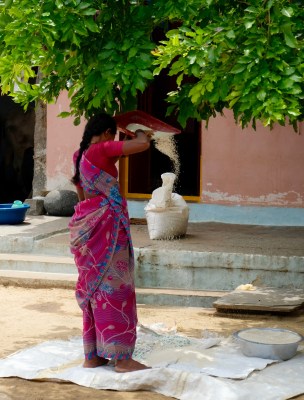
Rice shifts and slides from bamboo baskets.

Bangles are offered from a turbaned peddler.

Slathers of mandarin-orange paint brighten a simple village home.
I am happy here, surrounded by shades of pinks, baby-blues and soft greens. It reminds me of those romantic, carefree days of travelling in India from our past…no agenda, no expectations, just the hope of serendipity.


We travel the ferry back across the river, taking the bus instead of a tuk-tuk to the hotel and unbeknownst to us, the next day we’ll hire a car instead of returning home by train. Southern Indian Railways inexplicably cancels our return tickets. We can stand, we can wait five days until sleepers can be booked, or we can see the countryside by car. There isn’t much choice, perhaps it is what I hoped for after all. And my lingering image?
As we leave Hampi behind, a group of nine or so people journey along-side the road. One waves a bright red trianglular flag, each person wears a matching scarf – no bags, no luggage. They are pilgrims.
“Going to the Hampi temple,” our drivers enlightens us, “finding sleep in temples along the way.”
“How far have they walked?” I ask.
“Maybe days are there, or weeks from village.”
For many this will always be a spiritual and magical place.


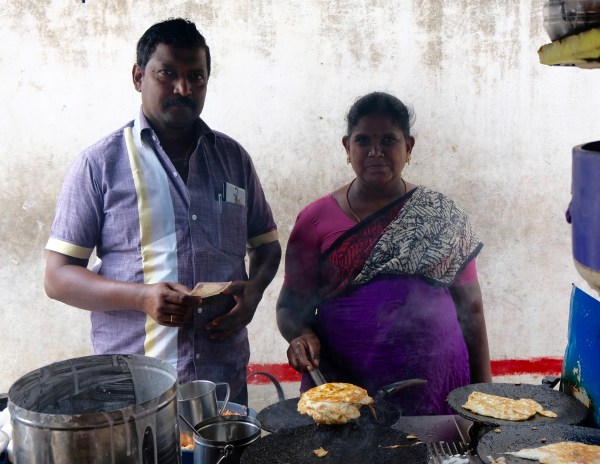


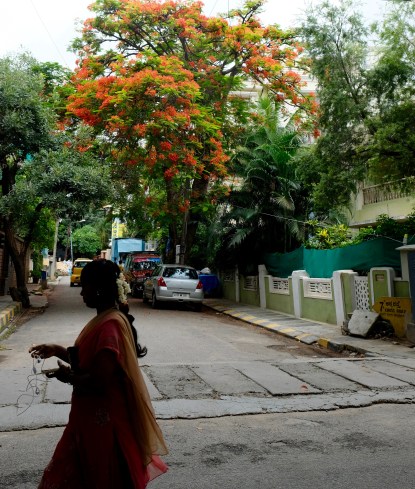


 These are a few negatives that I might have mentioned in the article, had I been more candid. After time in pedestrian and cycle-friendly Holland and the beautiful mountains and cityscapes of Canada, there is the inevitable adjustment to India. This coming and going in an expat life takes one across the full spectrum of experiences and emotions, there are many of them.


 The following Sunday morning we walk through nearby Cubbon Park. It’s not exactly manicured, but lush and peaceful nevertheless. There are glimpses of the city’s past as a British cantonment, military legacy of the final Mysore war. A reminder of when residents strolled through this once glorious ‘garden city’.




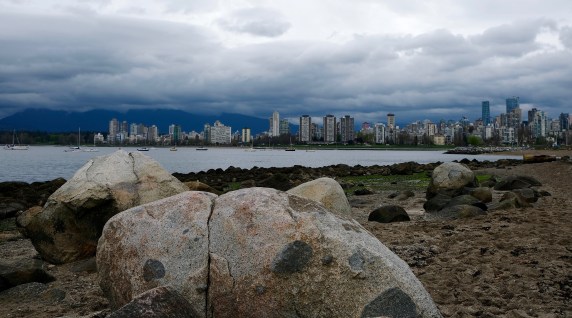
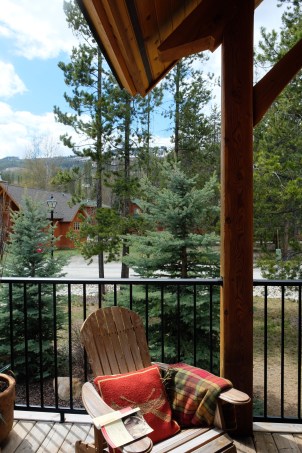 Back at our home base, we got down to practicalities. The lawn cried out for raking to usher spring growth, layers of dust counted the months since our last visit and the deck beckoned us to sit and luxuriate. During respites in a favourite chair, I looked longingly at my deserted flower pots, begging for summer blooms. But in vain; we won’t return until August.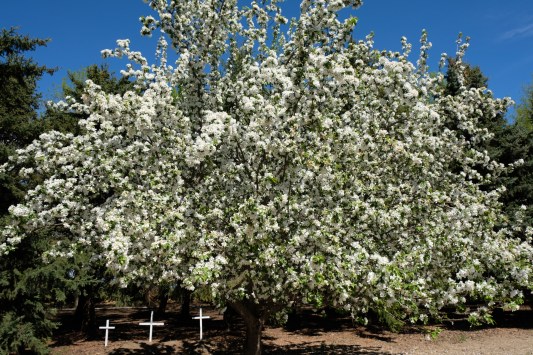
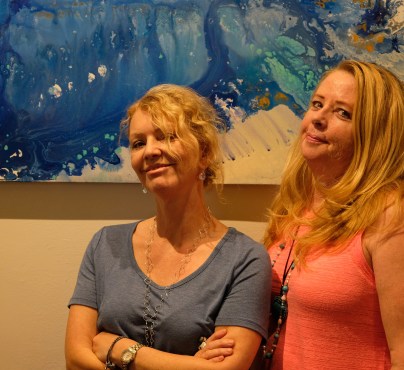 When Carol walked half an hour later into our small condo in Calgary, suitcases lined the hallway. She offered her condolences and with a hug reminded me, “You get to leave again.” Tales of my global life are music to her ears.
 “It’s almost the end of May. How strange most homes still have a snow shovel on the front porch,” I remarked after yet another shovel belied the gorgeous weather.


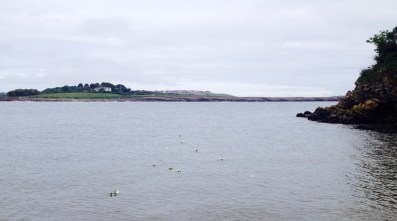 Fifteen roses, a loved one’s ashes, and a few Scottish thistles drifted peacefully out to sea. In remembrance of a life and good deeds done. And that seems all we can ask for; to live, to love, to have loved ones remember and speak well of us when our time comes. To be there for those who need comforting.




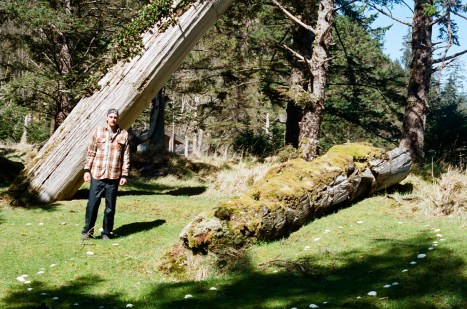



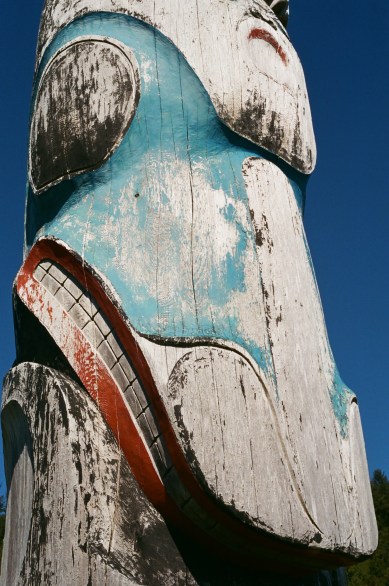

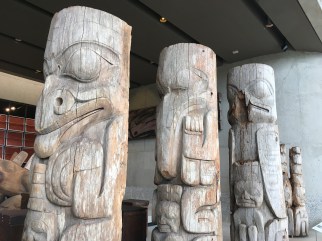
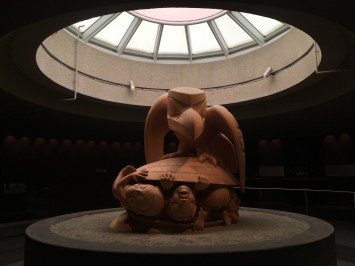

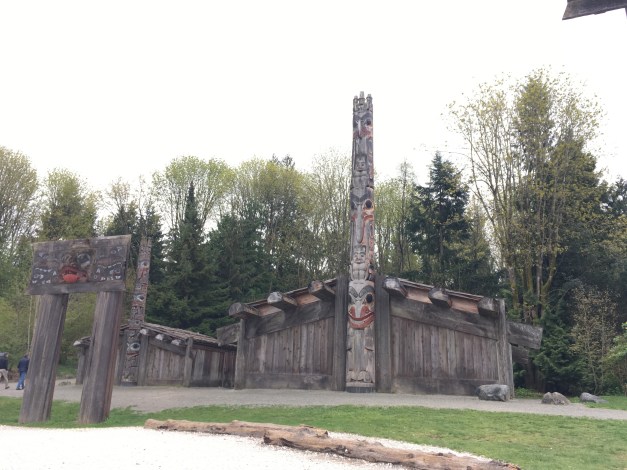
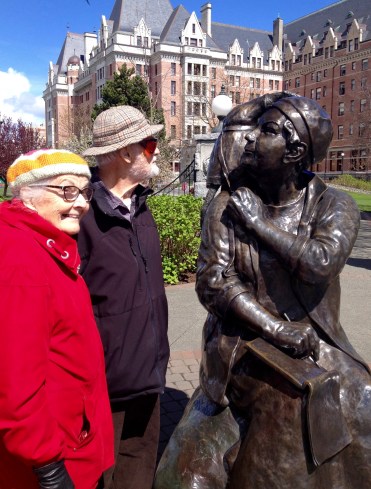
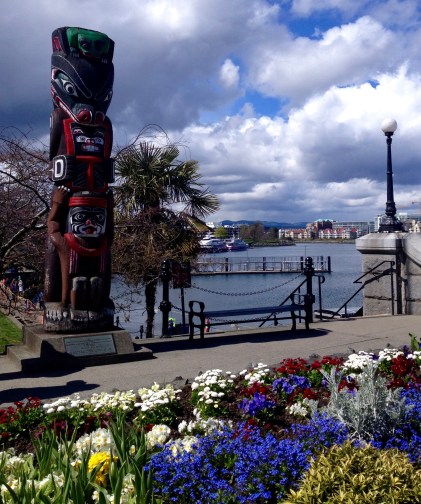
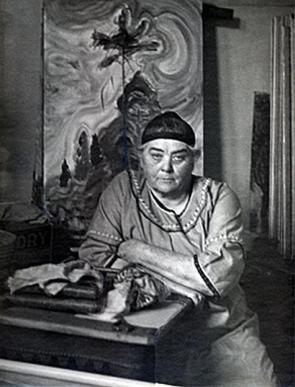
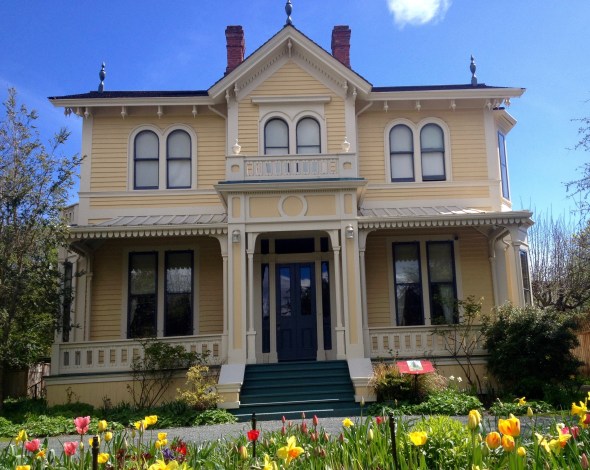
 I tell Jack and Eloise that as a writer, not only do I love Emily’s words, but I admire her intrepid explorations to capture her favourite subjects. Once vital cultural entities in First Nation villages, Emily seemed prescient in knowing that totems would ‘disappear’ as the Colonial settlers pushed the Coastal First Nations away from their lands, stripping them of their deep-rooted culture.






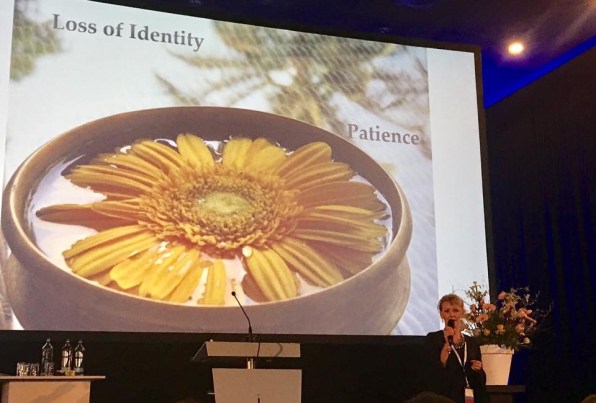
 For me, opportunities such as the FIGT Conference are a cause for pause and for celebration. The four day gathering is a meeting of people discussing, disseminating, listening, learning and sharing – then taking these ideas back to our global community.

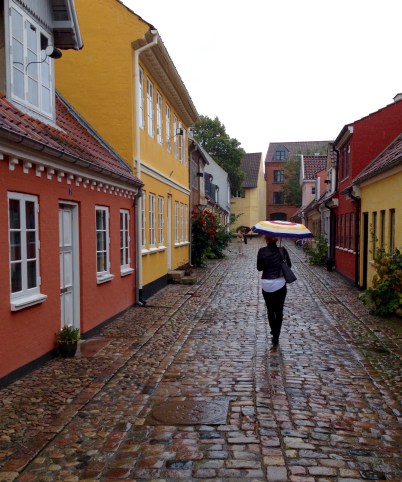 As the endless rain and the autumn winds welcomed us to Norway, our lively
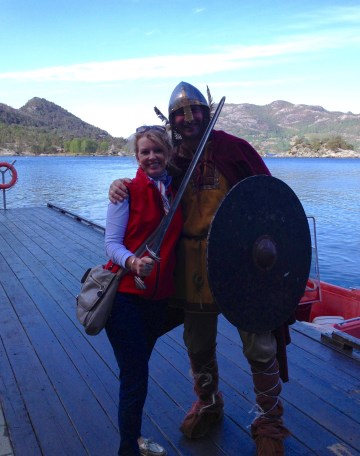 As important as it had been to me, I declined to teach as I had in other countries. I believed there would be a new opportunity and if I reverted to what I knew, I would not be in a position for this new country to infuse and inspire with its beauty and uniqueness.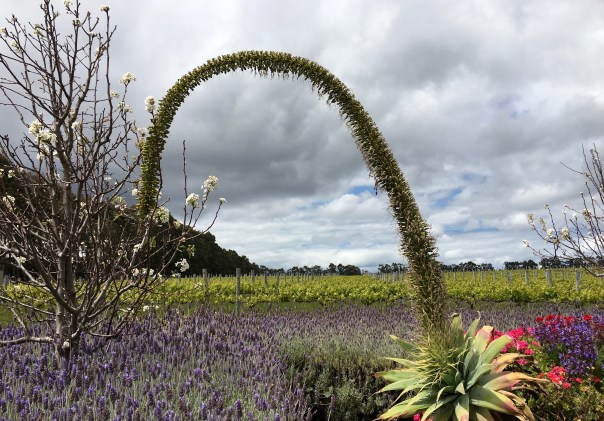
 We departed my beloved Norway and soon called the soviet-style streets of Kazakhstan home. And we became empty-nesters.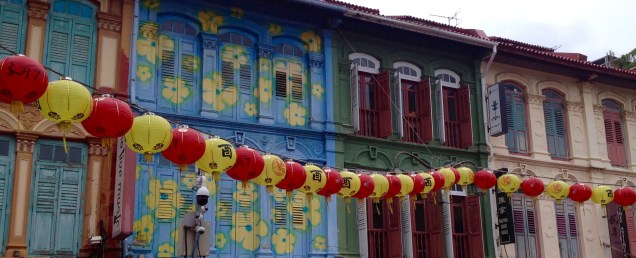
 Yet on most days I choose to be joyful; to embrace the colour, the culture, the mysteries of India.
 So there is never truly ‘wasted time’ if we grow from it.
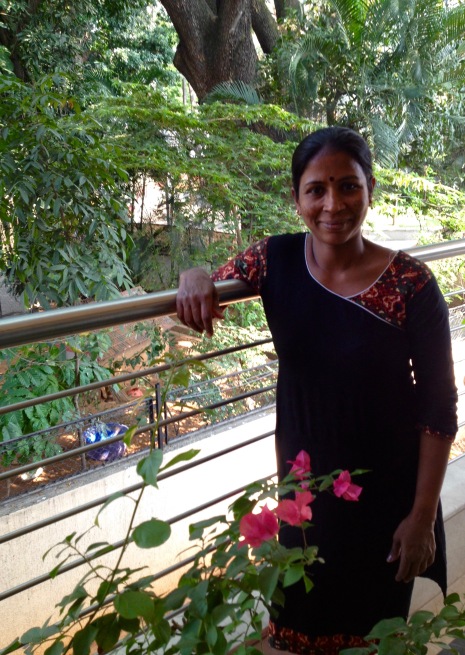 Priya’s story has revealed itself gradually; snippets of conversation as we’ve come to know each other in our one year in India. I have known since she joined us as housekeeper, that Priya is widowed and raising children alone. This in itself, could be considered remarkable in India.
 How did you feel, do you remember this? Oh yes, I was happy. Food was there. The bus ride was far, to Kerala, a convent. Sister Paulina took me. You know Madam, Priya gazes out to the lush rain tree and palm trees beyond for inspiration, coconut leaves were rolled long for lights (torch). Moved back and forth, very pretty at night. And spoons from jackfruit, we eat rice, lots of rice and coconut chutney always there. Priya smiles with the memory of this and I tell her I love this kind of chutney. Oh yes Madam!
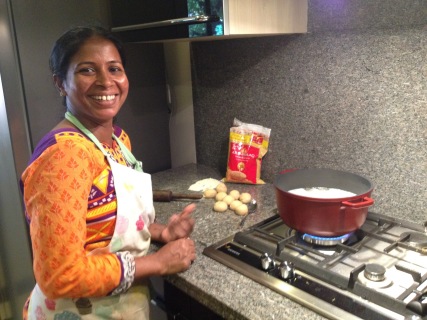 You didn’t go back home of course, you had no choice but to marry? No this is my life. I dream Madam and Priya laughs at her own naivety at the time, I can watch T.V, cook for my husband, a good life. Her voice trails off at what might have been…


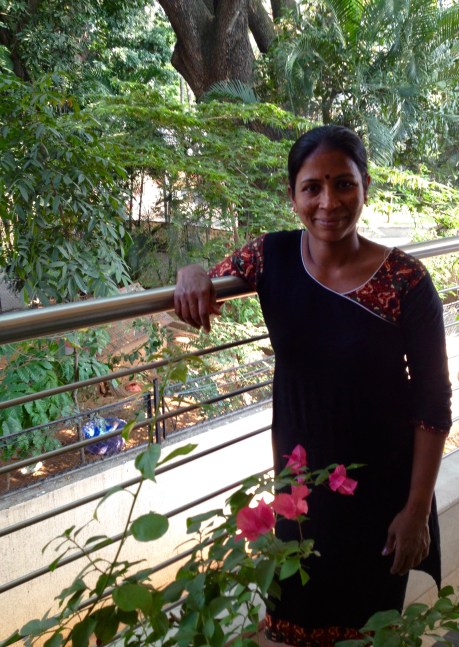 Priya’s story has inspired me to write. To write of her courage of overcoming a difficult past and of capturing the lives of all the hard-working people in our neighbourhood. Allow me first to paint a picture…
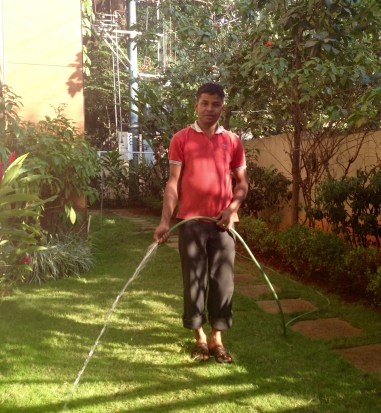 Boran is thirty-two and like many men who work in Bangalore as gardeners or security guards, he is from the north of India. They are a three-day train journey from home, usually taken only once a year. Working from afar, their families remain in the villages, reliant on monthly remittances.
 Kajul has replaced our first guard Rajesh Kumar who, a little tipsy one night, took a topple from his bike. A month in his village to heal broken bones was prescribed, but no sign of him yet – the ‘grapevine’ hasn’t provided any answers.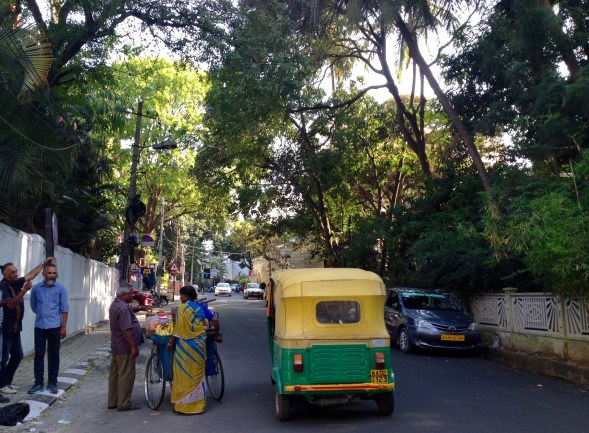
 ‘My’ mango tree which I see from my window will be harvested in July. A barefooted climber will scuttle up its massive branches and shake the mangos loose, dropping them onto a sheet, hoisted up at each corner. One after another the mangos will tumble down.
 around Mangalora’s fruit cart. After hugs from both of the ladies, and an admonishment that I am never here, Anu asked if I’m home now. “I leave later this week again Ma’am, I’m a speaker at a conference and will go home to see family.”
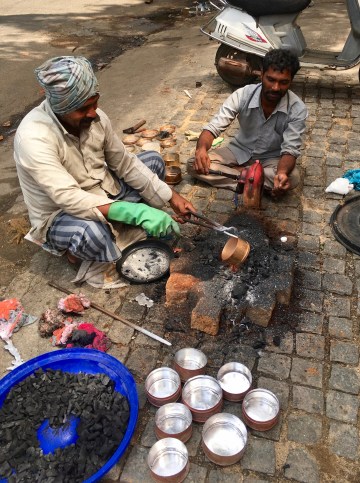 On this morning I turn the corner onto Lavelle Road, mindful of bikes, rickshaws and laden vegetable carts. A pony-pulled cart surprisingly trots past. Another unexpected sight greets me in front of Sodabottleopenerwallah, a restaurant we’re fond of. A brass polisher has set up in front to polish the tiffin boxes. The waft of red-hot charcoal infuses the air as the wallah heats, scrubs and buffs the small pots used for curries and rices. The sidewalk serves as the wallah’s work bench, ideal for this vital itinerant service.
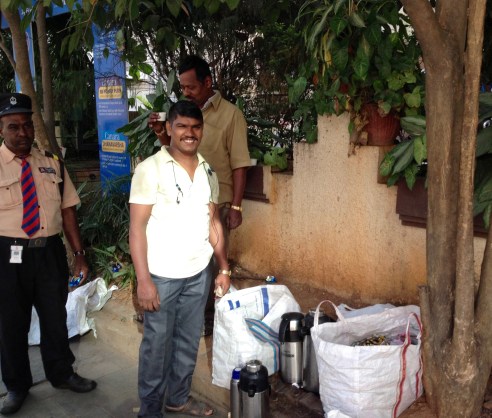 stares greet me as I pay the 500 rupees (10 dollars) for my consultation. The doctor’s professionalism belies his simple surroundings and when he hears that I write, our conversation meanders to authors and history, to the once sleepy and peaceful Bangalore. “This was once the ideal city, so green with a temperate climate,” the doctor says ruefully, reflecting on his more than two decades in the city.
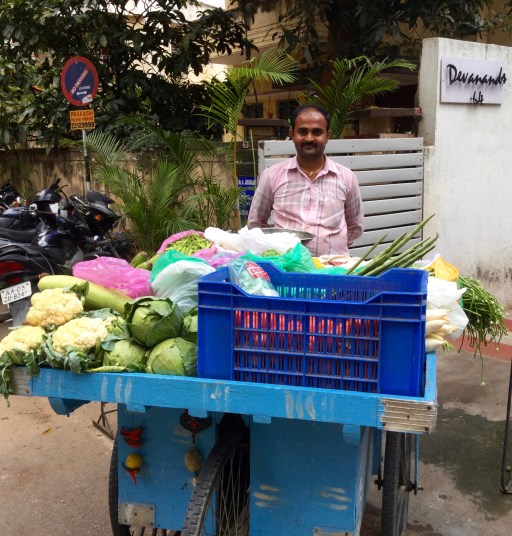 “Nineteen years Madam, but the cart is new, 2004. Cost 32,000 rupees.”


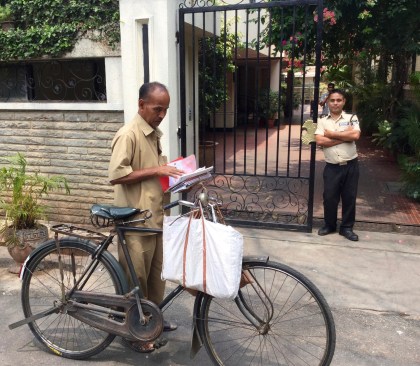 Just then Priya walks up to start her three hour shift. “Madam, just home? Where were you?” she wants to know as she takes one of the shopping bags.


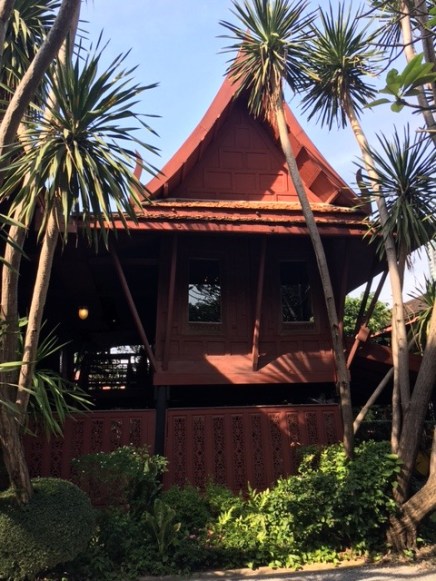 It was more soulful and quiet then. Without tour guides and with only occasional travellers, one had time to savour; the objects d’art, the finely carved doors, the priceless collections of Chinese blue and white, the delicate bencharong, five coloured porcelain.


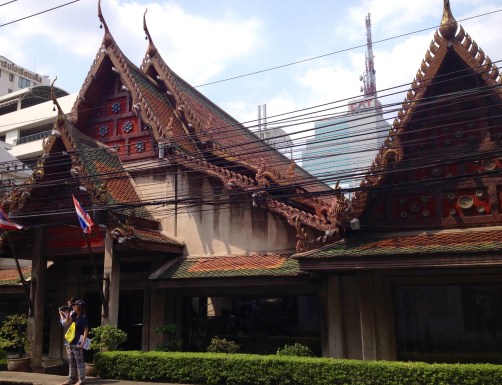
 First and perhaps the most widely accepted is that Thompson innocently set out for a jungle walk from the Moonlight Bungalow where he was staying with friends in the


 I had been to the mansion earlier in the year, gathering information for the book project. Along with writers from the region, I had the good fortune to be invited to a candle-lit dinner in Indigo, the mansion’s elegant restaurant. Serendipity saw my place-card positioned across from Laurence Loh, the man who brought the mansion back to life; rescuing it from its dilapidated state and likely from demolition.


 I find myself on ‘hallowed’ ground…that is, if one is both a lover of shoes and familiar with Jimmy Choo. His story began in Penang, a local boy who shared his roots with the very man I’m speaking with, Mr. Wong Heng Mun.


 Back in the workshop, I notice the nonya shoe that is in the works. Its delicate glass beads have been painstakingly stitched into a pattern onto fabric, and is now being crafted into a sandal or perhaps a slipper.


 notesonaboardingpass