


There are a few unsent ‘postcards’ from Penang this past year. Having co-authored a book about its pioneers, both past and present, there is much to write. I could relate the fascinating history of Francis Light, who claimed the island for the East India Company in 1786, or the myriad settlers from near and far, especially the resourceful Chinese and the stalwart Southern Indians. There are Penang’s iconic shophouses, godowns and clan temples. Its diverse culture and heritage trades, the legendary food and the engaging street art. That and more will be revealed when the book is published. But for now, a few snippets from the Penang I’ve come to know and love…
The Blue Mansion…
A photo of her hangs in the mansion’s dining room, her dress and hairstyle unusually simple for a person of her status. Tan Tay Po was 20 when she married the 70 year-old Cheong Fatt Tze. She would become his favourite wife – there were eight of them – and the Blue Mansion was Tan Tay’s splendid home.
Known as the ‘Rockefeller of the East’, Cheong Fatt Tze had homes (and wives) scattered throughout S.E. Asia, but the indigo-blue mansion in Penang was his preferred. Where he’d find his beloved wife number 7.
 I had been to the mansion earlier in the year, gathering information for the book project. Along with writers from the region, I had the good fortune to be invited to a candle-lit dinner in Indigo, the mansion’s elegant restaurant. Serendipity saw my place-card positioned across from Laurence Loh, the man who brought the mansion back to life; rescuing it from its dilapidated state and likely from demolition.
Laurence Loh is one of Malaysia’s esteemed architects and I followed many who have spoken to him over the years, BBC, CNN, Architectural publications and others. Laurence is understated yet passionate about his role as a conservation architect.
“Why take on such a daunting project?” I asked. “What motivated you to dedicate years to the restoration of a mansion? ” In fact a home now considered to be one of the finest restored mansions in the world.
Laurence admitted that he had not given the property much thought as he passed it daily as a youth on his way to school. Years later having returned home to Penang after time abroad, Laurence felt a strong pull towards the temple-like building. Along with partners, he and his wife Lin Lee would buy the property on Leith Street and transform the Chinese court-yard home to the enchanting splendour of its past – it would take 11 years of meticulous restoration.


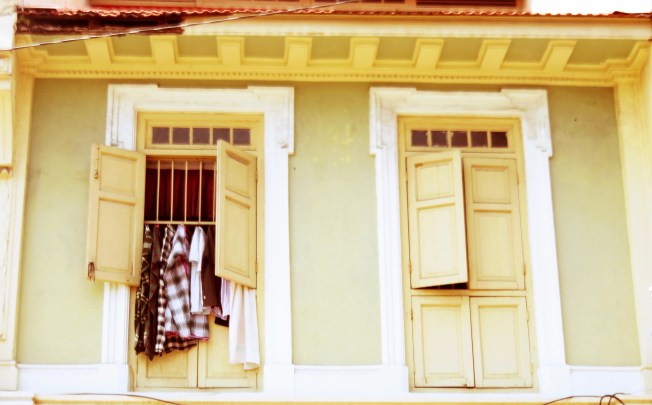
That evening as we had dined, Laurence explained that developers had hovered in anticipation for the prized site when it came on the market. Conservation in 1989 was almost non-existent with no guidelines and little vision. The mansion lay in a state of decay and disregard with more than thirty tenant families inhabiting it. Motorbikes zoomed through the house and washing lines hung from gilded panels. Animal bones, droppings, feathers and rubbish littered the rooms.
Laurence told me modestly, “It just needed to be cleaned up and restored. There was an epiphany that this would take hold of our lives.” And he hinted that it was meant to be…that perhaps Cheong Fatt Tze had already chosen him as the rescuer.
I was curious if it was the love story of wife number 7, ‘the one he loved above all others,’ as Laurence had put it. Or perhaps it was the unique sense of scale, proportion and space with which the mansion had been designed. I sensed that it is a little of both. Laurence admitted that a keen sense of preserving the legacies of Penang’s forefathers, especially those of the Chinese settlers, had motivated him. “I’m very proud of my Chinese roots,” he explained, “it’s essential they’re preserved.”


The residence was originally completed in 1904 by Cheong Fatt Tze. Having arrived from China to Batavia in 1856 as a penniless 16 year-old, Cheong would come to epitomize South East Asia’s determined Chinese entrepreneurs – of which there were many. Cheong transcended from a carrier of river water to a one-man multinational conglomerate. Initially there was help from his merchant father-in-law, that of wife number 1, yet Cheong would go on to successfully deal in the commodities of the day: pepper, tin, rubber, tea and coffee, rice and opium. He would invest in banks, glassworks, textiles, cattle and a vineyard. He would start his own shipping line when refused first-class service on another. He was an extraordinary entrepreneur.
On a recent visit to Penang, I decide to spend an evening at the Mansion in one of its 18 restored guest rooms. I’d be untruthful if I didn’t confess that its history and spirt is felt within its storied walls. It’s not an uneasiness, but more of a tacit acknowledgement that you are just passing through…the home will always be Cheong Fatt Tze’s.
The next day, I’m invited to join a tour. The private rooms are roped off to the public and there’s a secret delight in having been in the inner sanctum of the mansion. Along with tourists from different countries, I learn that nothing was left to chance when the grand home was built. With its 5 inner courtyards, the centre wing was where business was conducted and were family was housed, perhaps one or all of the 3 wives and various concubines. This was often the norm for a man of Cheong’s social standing.
“Wives 3, 6 and 7 lived here. But if you were out of favour you could easily find yourself in the side wings or across the street in the servants quarters”, our guide reveals motioning to separate buildings across the street. Yet we’re told of Cheong’s great philanthropist tendencies, of his ease with both Asian traditions and of the Western World. We hear of his discerning sense of fashion from Mandarin outfits of fine silk, to top hats and tails.
Indeed the photos and other manifestations capture the essence of time, place and wealth. We see intricate Scottish ironworks (a must-have to affirm one’s wealth in the British empire), gilded decoration, priceless porcelain and Art Nouveau stained glass windows. But its the chien nien that intrigues me most.


Chien nien translates to cut-and-paste shard works, a laborious process whereby specially produced rice bowls are cut with pliers to provide shards of coloured porcelain. Lime putty is then used to form the shards into intricate patterns of men, women, animals and scenes depicting Chinese mythology and various Gods. Some 10,000 bowls, imported from China, were needed to restore the mansion’s chien nien – believed the most prolific on any private building outside of China.
As we gather in the central courtyard, we’re asked a question that I had heard previously from Laurence. “Do you feel the chi, the spirt?”
It is reference to the elaborate feng shui that Cheong Fatt Tze implemented in his home .
“This is the heart, here in the middle, where the greatest chi energy radiates,” our guide says motioning to a spot between two stone columns. “This precise point would have been selected by a feng shui master, the house grew from there.”
It seems very little was left to chance. Granite steps were added as ideally one must always step up when entering a Chinese home…it denotes promotion. The granite implies strength and stability. Golden coins were buried in auspicious corners to ensure continued wealth. The side wings of the home contain six rooms on each floor. The number six as it rhymes with ‘lok lok tai soon‘…smoothness for every dealing.
The Chinese believe that rain water brings wealth (farming, crops) and that nature’s wealth should be drawn inwards. Hence the mansion’s elaborate pipes and gutters to collect rainwater, emptying into the courtyards, backing up in loops, cooling both the floors and ceiling spaces. “The water can come in quickly but should flow out slowly, just like the Chinese ethos towards money.” This is conveyed to us with a chuckle, yet it is clearly to be taken seriously.
When we encounter a photo of the beloved wife number 7, we learn that Tan Tay was the daughter of a Penang goldsmith and the only wife mentioned in the tycoon’s will. When Cheong died in 1916, flags were lowered to half-mast throughout Asia by both British and Dutch authorities. His coffin was toured to Penang, Singapore and Hong Kong for farewells, before burial in his native China.

And of the mansion? Cheong’s will stated that it was not to be sold until the death of he and Tan Tay’s son, only 2 at the time of his father’s death. When he died in 1989, the last daughter-in-law would fall short of money and resort to leasing the mansion’s once grand rooms, contributing to the dilapidated state Laurence Loh would find the mansion.
As the tour finishes, I recall something Laurence had shared that with me. “Cheong Fatt Tze had wanted nine generations to live in this home. He wanted it to be enjoyed by many.”
Thanks to the vision of a passionate architect, that is happily the case…
*The Blue Mansion is properly known as the Cheong Fatt Tze Mansion
A connection with Jimmy Choo…
 I find myself on ‘hallowed’ ground…that is, if one is both a lover of shoes and familiar with Jimmy Choo. His story began in Penang, a local boy who shared his roots with the very man I’m speaking with, Mr. Wong Heng Mun.
I’m at Hong Kong Shoes on Kimberley Street and have decided to have a pair of shoes made by Mr. Wong and his team of cobblers.
There are three skilled artisans busy today in the long, narrow shophouse. One shoemaker is stitching and another cutting strips of leather with scissors as large as a size- 13 shoe. Mr. Wong minds the front of the shop. He not only knows a thing or two about shoes, he apprenticed alongside Penang’s runaway success story…Jimmy Choo. Like Mr. Wong, Mr. Choo also came from a family of shoemakers.
“Jimmy was about 15 or so, a little older than me when we apprenticed. It was my father that taught us.” Mr. Wong’s father, Wong Sam Chai, was Penang’s esteemed master cobbler for some 60 years.
This is not the original location of the shop but still, it’s become a bit of a mecca for shoe lovers visiting Penang. The shop is certainly not as salubrious as a Jimmy Choo. This is more of an ‘organized chaos’ with shoe mouldings, scraps of leather and shoe samples crammed onto shelves and arrayed on the floor. Proudly displayed magazine and newspaper clippings of the Choo connection decorate the walls. The workshop is stuffed with tools of the trade: threads on bobbins, glue for soles of leather, hammers and heels, and a ‘museum piece’ Singer – timeless and trusty.
Mr. Wong is kind enough to lead me up the worn treads of narrow stairs to the second floor. Shoe moulds as far as the eye can see. Wooden and plastic – shades of greens, hues of blues and wood polished smooth by expert hands, sizes and shapes for all.


Mr. Wong tells me that more than 200 pairs of shoes are handcrafted every month for clients. “Some locals but many foreigners.”
 Back in the workshop, I notice the nonya shoe that is in the works. Its delicate glass beads have been painstakingly stitched into a pattern onto fabric, and is now being crafted into a sandal or perhaps a slipper.
Traditionally this was a pastime expertised by Malay ladies. Beaded slippers complimented their colourful sarongs and lavish kebayas, their tight fitting embroidered blouses.
I’m told that the craft of stitching the coloured glass beads was even a skill coveted for marriage. It seems that presenting a pair of hand-stitched men’s slippers was effective for impressing a future husband. Wonderful examples of nonya slippers and all else pertaining to their refined and opulent culture can be enjoyed at the Pinang Peranakan Mansion.
Today, pieces of the beaded designs are still created and sold to Hong Kong Shoes, both for personal orders or otherwise. “Many foreigners also like these,” Mr. Wong assures me as we admire the intricate samples. In somewhat of a paradox he shows off a massive shoe mould, though I don’t catch the name of who it was a match for – surely it was an extremely tall basketball player.


I’m just a normal size 6.5 and I tell Mr. Wong that I’d like my sandals copied please, “though just a little more tight fitting.” I dig my worn footwear from my bag. They’ve traipsed over the cobblestones of Rome, through the narrow lanes of Cintra and the back streets of Miri…and many others in between. I surprise myself by choosing roughly the same colours of leather…actually I think I’m just a little overwhelmed with the vast array of samples.
Mr. Wong opens a notebook, asks me to take off my shoes and instructs me to stand on the blank paper. He traces my feet, jots down some notes and confirms my order on a small notebook…order 8565. I pay, then he bundles up the note paper, my beloved sandals and plunks them in a plastic bag. Gosh, I hope I see those again, I can’t help but fret.
“How long Sir, until they’re ready?
“About two, three months,” he tells me with a confident smile.
“Lovely, my friend will pick them up for me,” I say, giving a knowing glance to a good friend who spends much of her time here. I already envision my next visit, my shiny pair of sandals awaiting me.
“No worry,” Mr Wong assures me,” we make many, many shoes.”
I can’t resist asking, “Who is the most famous client you’ve had?”
“Oh, Hollywood famous,”he says matter-of-factly. He’s most definitely not revealing any secrets.


And may I share a few of my ‘preferred’ in Penang…
Hotel…Campbell House on Lebuh Campbell
Restaurants…Seven Terraces, Il Bacaro, China House
Museums…Pinang Peranakan Mansion, the house of Sun Yat Sen (father of modern China), Penang State Museum, Cheong Fatt Tze Mansion
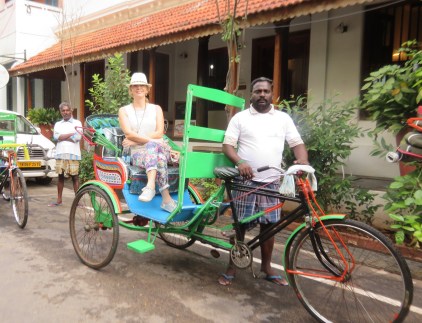
Things to do…Enjoy street food, especially Char Kuey Teow. Trishaw to discover the many Street Art installations. Take in the view at the peak of Penang Hill and visit The Habitat, Penang Hill. Wander along Beach Street, Armenian Street, Love Street and all in between. Venture out to the Spice Gardens. Have tea at the Eastern and Oriental Hotel. Take in live music at China House. Visit the many temples and mosques. Stroll the clan jetties. Don’t miss Occupy Beach Street early Sunday mornings. Arrange your visit to coincide with the brilliant George Town Festival…


 The brothers grew up in Saskatchewan where a weighty stack of wood got you through the biting cold winters.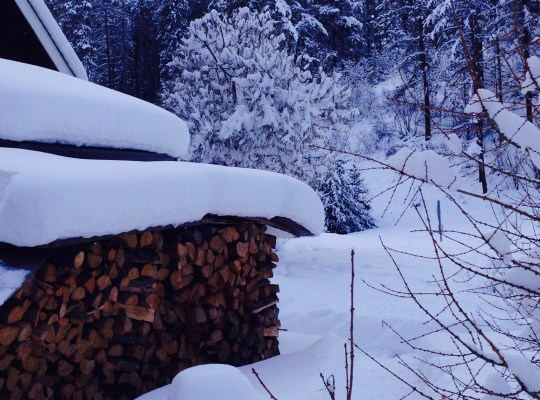
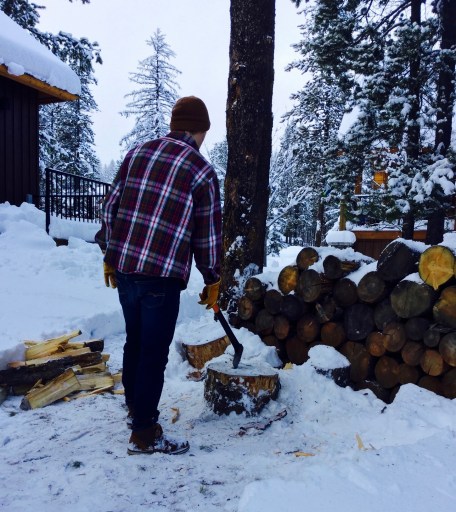 Upright and solid pile: the same could be said of the man.




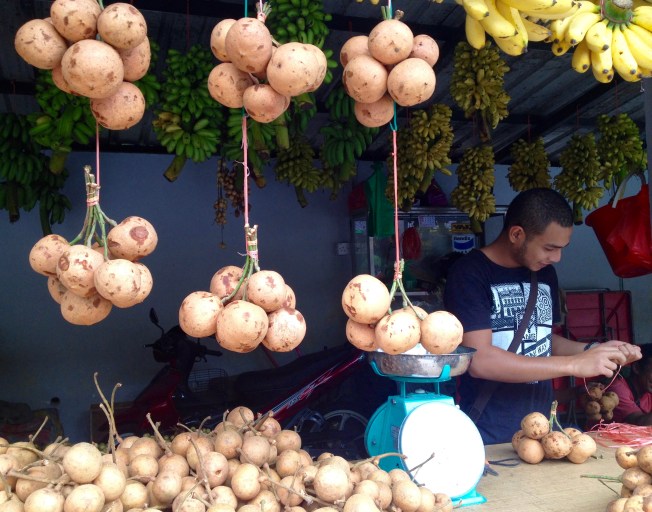
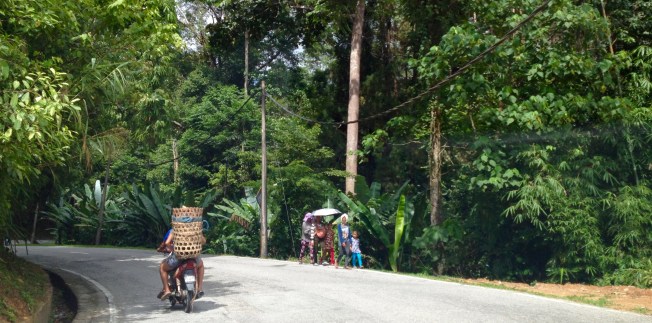
 Risking tiger attacks as they scour the jungle undergrowth, durian pickers rush to bring the costly commodity to market. The putrid aroma of durian belies its creamy, sweet taste. Or so I’m told…I can’t bring myself to try the noxious fruit. In hotels and public transportation throughout S.E Asia, signs strictly forbid durian on their premises.


 We arrive late afternoon at one of the former colonial hotels, The Lakehouse. Upon retirement Colonel Stanley Foster opened it in 1966; relatively late as guesthouses and bungalows sprung up here from the 1930’s onwards. The Lakehouse is how I envisioned.


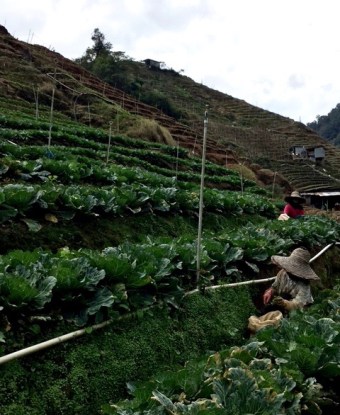


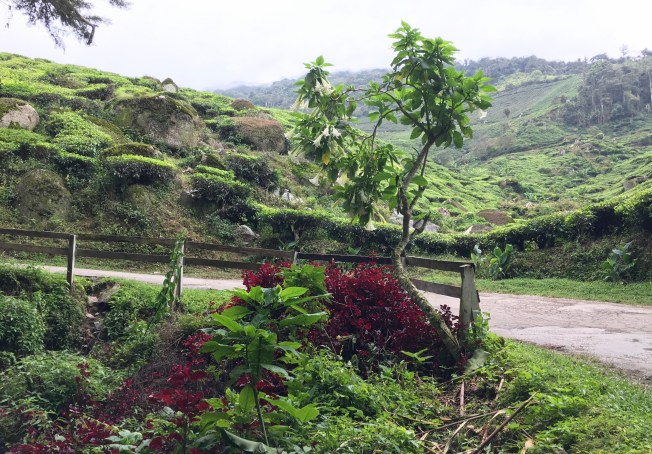
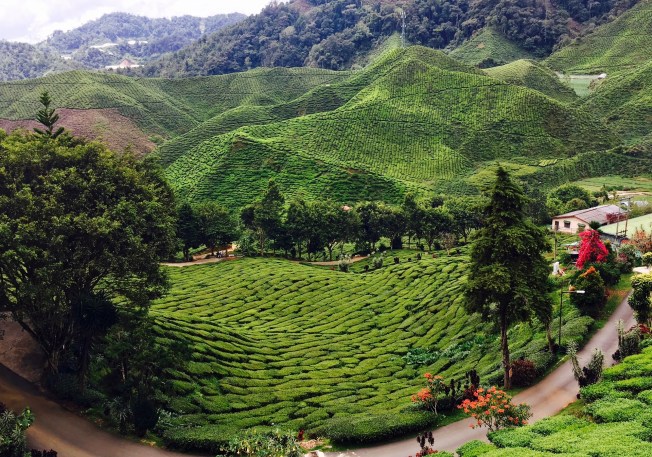
 We pass barrack-like cabins where the pluckers live and we take the liberty of skirting the road, treading on water channels that double as steps and define the vast fields of the Camellia Sinensis.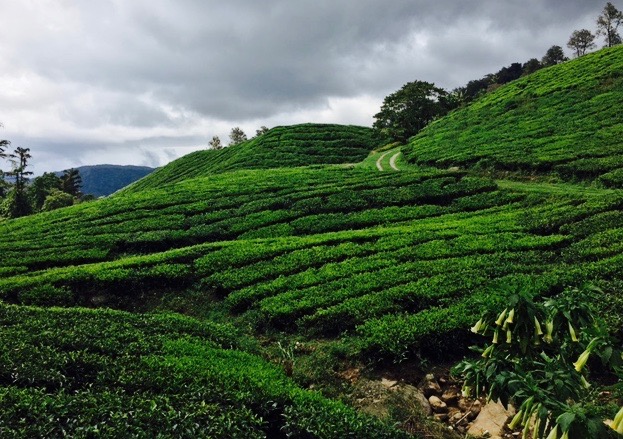


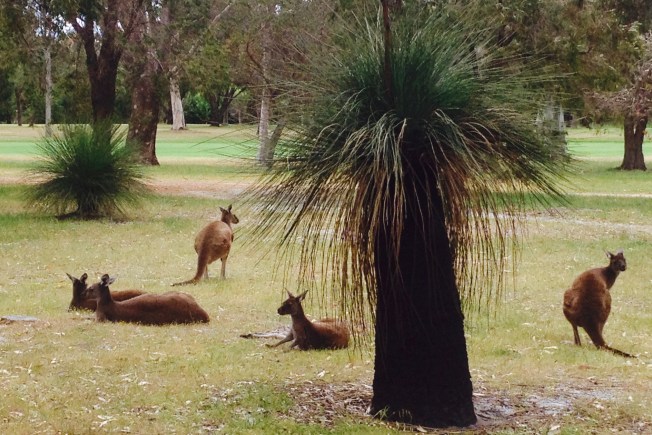
 The first hint of the iconic hoppers – they can travel at an impressive 40 km. an hour – are the road signs. In place of signs cautioning of caribou in Canada, of sheep in Scotland, or perhaps camels in Kazakhstan, the highways in Australia warn drivers of the kangaroo. The gangly marsupials outnumber the population by almost 3 to 1. Said to be particularly prolific in the ‘outback’ with some standing over 6 feet tall, it’s best to drive though that territory with a substantial 4WD, big bull-bars and spotlights…just in case you meet a ‘big red.’
 The fear of sharks alone, more present than ever these days, would give most people pause. The many warning signs positioned prominently along the beach tell it like it is…rips, waves, cliffs and sharks. The surfer emerges from the water and I catch up with him in the parking lot and ask if he gets scared out there.



 We wend our way towards town, detouring out of curiosity to see the extensive Leeuwin Estate. The grounds are long closed and the sun is lowering in the sky. Suddenly my husband slams on the brakes, “There’s one,” he says motioning to the field,”there, between that row.” I leap out of the car and creep to the fence. No it’s gone, just hopped away…maybe I saw a tail?


 Time with family and friends recently in Canada was wonderful – home in the true sense. However my other life in India called.
 Mysore’s streets and broad tree-line boulevards, are lively but less urgent than Bangalore’s. Stately buildings exude charm and a sense of place and history. All reminiscent of our India of old – a fondly re-discovered treasure.
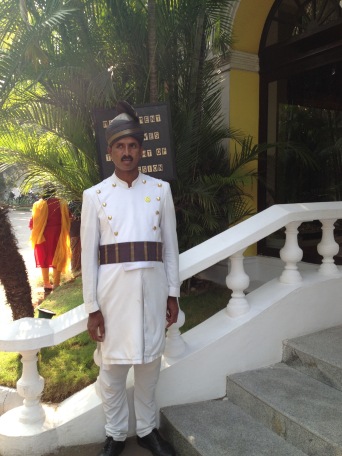 Our guest from the 1920’s makes her way down the spiral staircase to the porticoed entrance. She dons a sun hat and the doorman, splendidly attired in the Mysore fashion of the day, bids her ‘Good afternoon’. He summons a carriage and the visitor is conveyed to the Maharaja’s Palace. As the palace draws into view, she is instantly captivated.


 The next morning a ‘carriage’ of a different kind awaits us. The environs of Mysore beg to be explored and we jump into a classic ’66 Mahindra Jeep. It’s rugged and basic, it’s a beauty.


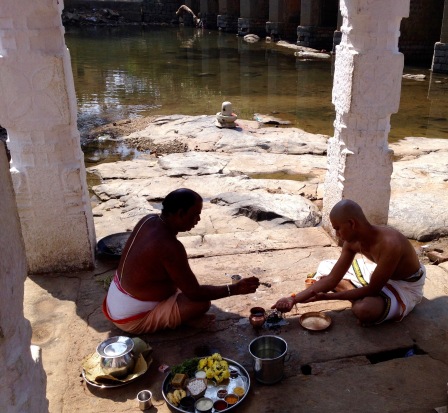 On the side of the stepped ghat, under an ancient stone pavilion, a ceremony unfolds. A young man, bereaved of his father, is in the midst of a solemn ritual. Guided by a brahmin priest, he recites prayers as water is rhythmically dabbed on his wrist. His head is shaved as tradition demands. We listen to the priest’s intonation, a soothing, flowing mantra. We offer condolences to the women witnessing the ceremony, sensing that we have intruded on their grief. Yet they acknowledge us with a gentle nod as we quietly take our leave. On the upper ghat, another Brahmin priest invites us into his vividly painted temple to witness the ritual about to commence. Inside, the centuries-old place of worship is cool and somber. We sit cross-legged on the stone floor opposite the priest flanked by two men, one an assistant, the other the supplicant.
 The priest leads them in prayer for the well-being of the family. The father takes his cues from the Brahmin as his adult son and wife look on. Sanskrit mantras mix with wafts of camphor in the still air. Rice and turmeric are sprinkled, offerings in a timeless ritual.


 South India lives up to its reputation of friendliness, of mystic sights and ancient traditions. This is why, I remind myself. Why this peripatetic life with its farewells and re-attachments, its solitudes and contemplative transition, is more than worth it. These are the moments to treasure.


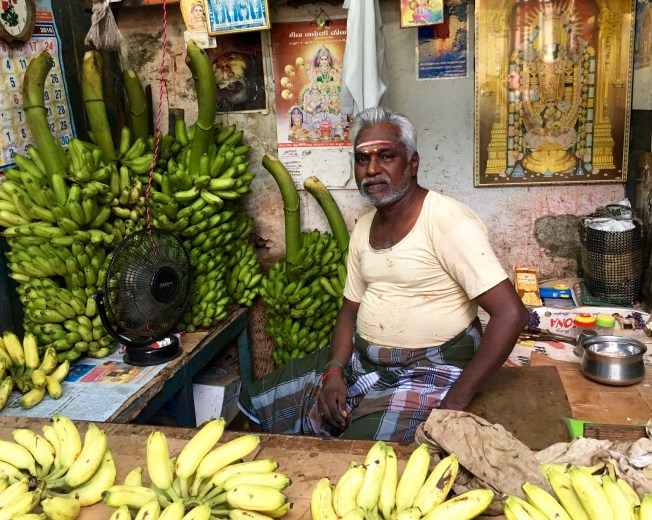
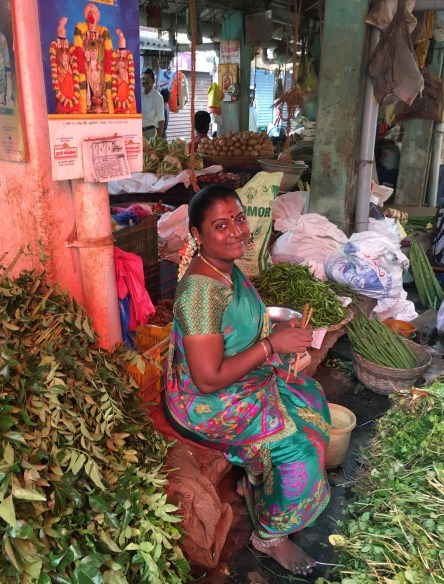 and orange for carrots and mangos.


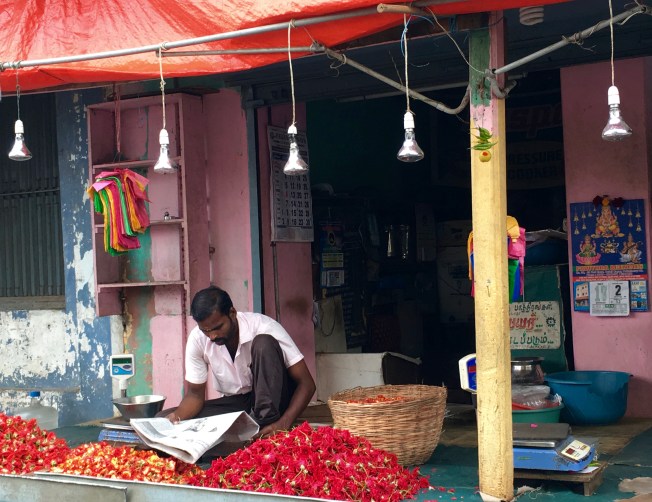
 They are offered for worship, draped around doorways at a housewarming, a new motorbike or auto rickshaw may be blessed with a garland, a bride and groom exchange them three times during a wedding. They are also woven into a lady’s plaited hair, especially here in Southern India.


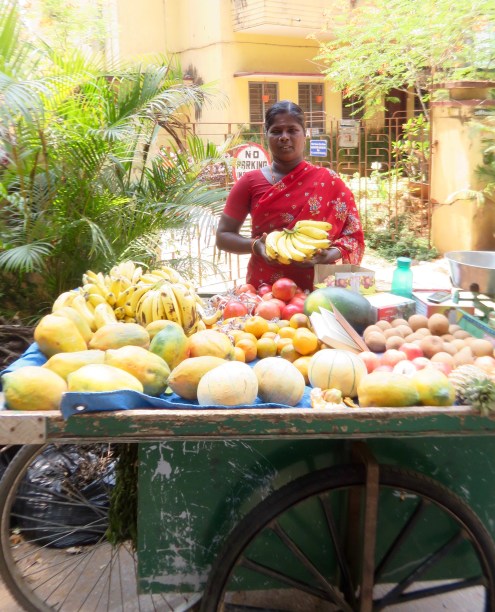
 Barely ten minutes out of Pondicherry a time capsule awaits. As the clatter of the wheels settle to a rhythmic, soothing pattern, the city gives way to a beautiful patchwork; palms, rice, vegetables and flowers. From these fields come the produce, the bounty found in Pondicherry’s Grand Bazaar.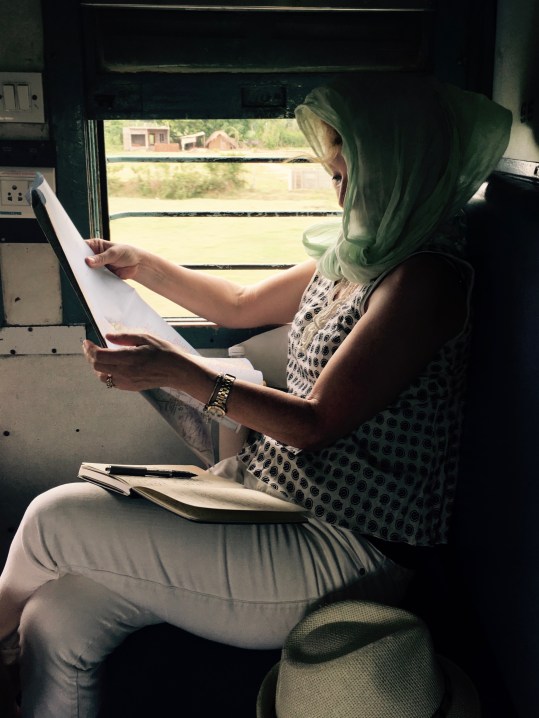



















 Her name was Klara. She was a true Amsterdammer who rowed the Amstel and cruised the cobbled streets, stylish and carefree on the back of her paramour’s motorcycle.
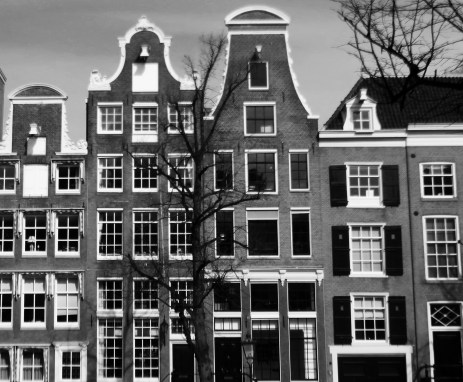 Golden Age architecture, of stout upright bikes and tulips in infinite bunches… of tall homes with gables of necks, steps and bells.
 I keenly felt Klara’s absence one chilly day while exploring. I warmed in a simple cafe; one that serves mushy pea soup and burns long stemmed candles on scratched, worn tables. One where velvet curtains encircle the entrance to keep out the draft – where locals linger over a Heineken.
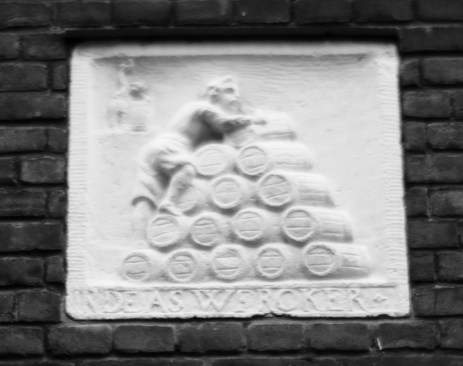 These chiseled cartouches implore us to slow down and conjure that time. I also come across shops that aren’t fancy and offer ‘stuff’ spullen, places where one can browse endlessly. I see a vision of Klara’s home that once proudly displayed all the trinkets gifted to her and wonder where it had gone.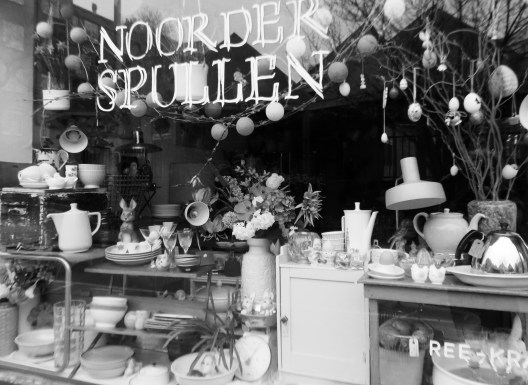
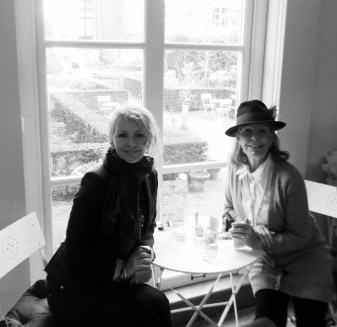 “If you like this, you must see the Catwalk
 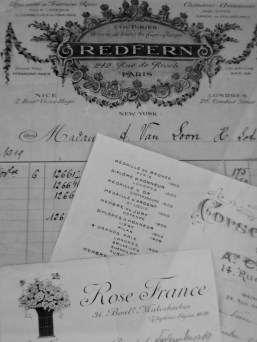 Exhibit at the Rijksmuseum.” Off we go on the sun-drenched yet brisk day, to soak up yet more exquisite fabrics and designs. Gathered from centuries past and as early as the Golden Age when Dutch culture was at its zenith, the creations rotate slowly on a long oblong stage as if on a sumptuous sushi belt. Enthusiasts of all ages sit at this avant garde fashion show, coveting the delicate, aged designs.
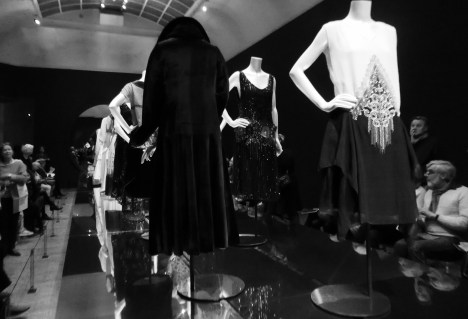 “Oh how my Tante Klara would have loved this,” I proclaim to my new friend. I relate how years ago Klara had given me a black lacy dress, sleeveless and hand-stitched. She had once worn it with panache; I was thrilled to have it as mine and wore it with infinite pleasure. Klara’s seamstress eye would have devoured this collection that was swirling slowly for appreciative fashion- lovers.
 Through the following days I meet many empowered and interesting women. The Families in Global Transition Conference brings many together; they thrive in careers and raise children globally, they are entrepreneurs, authors, publishers, educators, life coaches and more. We network, learn from each other, dine, laugh, lament and celebrate as one. We comment on how fortunate we are to come together, how marvellous it is to share stories of womanhood against the backdrop of a global life. We hug our farewells, restored and uplifted.
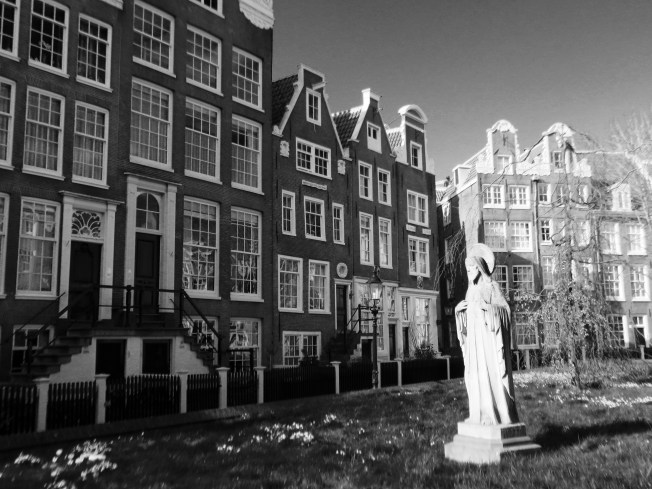 The company of these kindred spirits comforts me in this first return to Amsterdam; the first time that Klara is no longer here. The last few visits dementia had stolen her spirit, her creative and inquisitive mind, and just a few months ago her life.
 Klara first introduced me to this serene oasis, and as I was then, my friends are charmed with its beauty and calm. The houses and churches that line the square are mostly from the 17th and 18th centuries; beautiful in their aged grace as is the elderly lady we encounter.
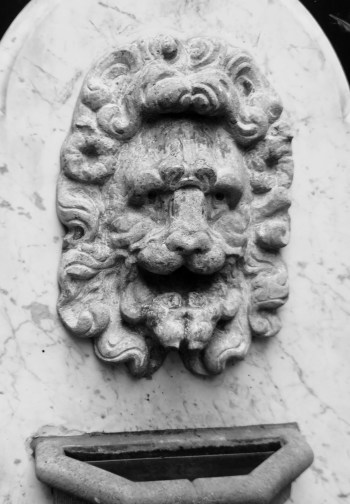 A few days later I spend the day with a dear family friend, we were both fortunate to have been like the children that Klara never had. Hetty tells me of her final days and the peaceful end.
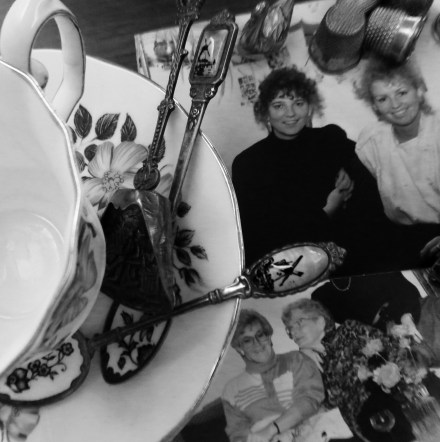 The first thing I had done when I arrived in Amsterdam was buy tulips. “I’ll need a vase for my bloomen, please Meneer,” I had said to my host Pierre when I checked in at the charming Seven Bridges Hotel. As if by design, my room had thick velvet curtains, an armoire and an antique oval table for those tulips. I felt as if I was back at Klara’s.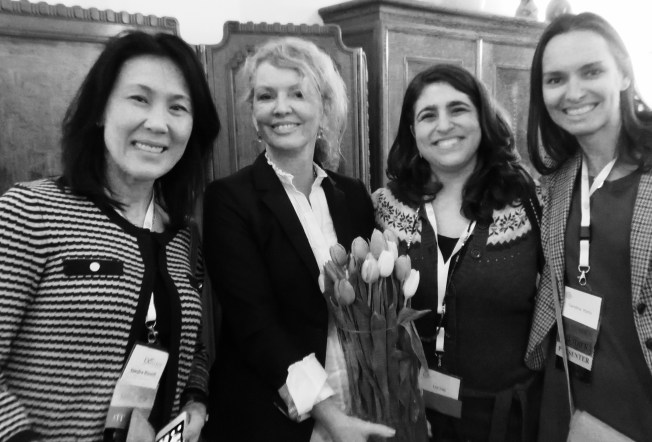
 notesonaboardingpass